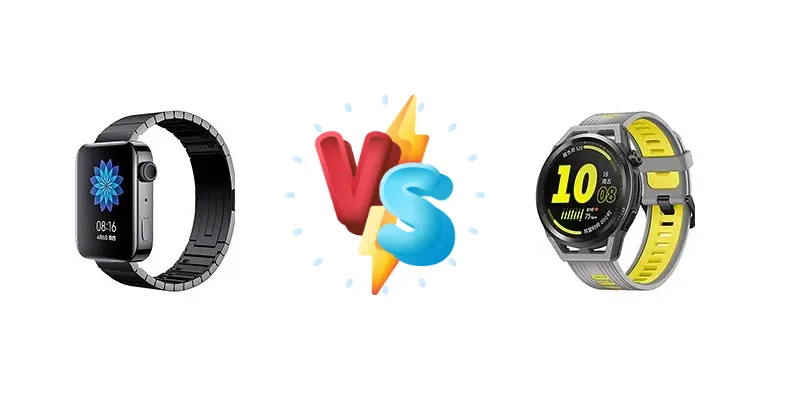
The smartwatch market offers a spectrum of choices, from feature-rich Wear OS devices to those prioritizing battery life and fitness tracking. This comparison pits the Xiaomi Mi Watch (China), powered by the Qualcomm Snapdragon Wear 3100, against the Huawei Watch GT Runner, a device focused on endurance and wireless convenience. We'll dissect the implications of these design choices for the average user.
🏆 Quick Verdict
For users deeply integrated into the Google ecosystem and demanding app compatibility, the Xiaomi Mi Watch (China) offers a more versatile experience thanks to its Snapdragon Wear 3100 chipset. However, the Huawei Watch GT Runner excels in battery life and provides a streamlined experience for fitness enthusiasts, making it the better choice for dedicated runners.
| Network |
|---|
| 2G bands | GSM 850 / 900 / 1800 / 1900 | N/A |
| 3G bands | HSDPA 850 / 900 / 2100 | N/A |
| 4G bands | 1, 3, 5, 7, 8, 18, 19, 20, 26, 39, 40, 41 | N/A |
| EDGE | - | No |
| GPRS | - | No |
| Speed | HSPA, LTE | No |
| Technology | GSM / HSPA / LTE | No cellular connectivity |
| Launch |
|---|
| Announced | 2019, November. Released 2019, November | 2021, November 18 |
| Status | Discontinued | Available. Released 2021, November 26 |
| Body |
|---|
| Build | - | Glass front, plastic frame, plastic back |
| Dimensions | 44.7 x 36.9 x 12.3 mm (1.76 x 1.45 x 0.48 in) | 46.4 x 46.4 x 11 mm (1.83 x 1.83 x 0.43 in) |
| SIM | eSIM | No |
| Weight | 44 g / 56 g (1.55 oz) | 38.5 g (1.38 oz) |
| | - | 50m water resistant
5 ATM
IP68
Compatible with standard 22mm straps |
| Display |
|---|
| Protection | Corning Gorilla Glass 3 or Sapphire crystal glass | - |
| Resolution | 368 x 448 pixels (~326 ppi density) | 466 x 466 pixels (~326 ppi density) |
| Size | 1.78 inches | 1.43 inches |
| Type | Super AMOLED | AMOLED |
| Platform |
|---|
| CPU | Quad-core 1.2 GHz Cortex-A7 | - |
| Chipset | Qualcomm Snapdragon Wear 3100 (28 nm) | - |
| GPU | Adreno 304 | - |
| OS | Proprietary OS | HarmonyOS 2.0 |
| Memory |
|---|
| Card slot | No | No |
| Internal | 8GB 1GB RAM | 4GB |
| | eMMC 4.5 | - |
| Sound |
|---|
| 3.5mm jack | No | No |
| 35mm jack | No | No |
| Loudspeaker | Yes | Yes |
| Comms |
|---|
| Bluetooth | 4.2, A2DP, LE | 5.2, LE, EDR |
| NFC | Yes | Yes |
| Positioning | GPS, GLONASS, BDS | GPS, GLONASS, BDS |
| Radio | No | No |
| USB | No | No |
| WLAN | Wi-Fi 802.11 b/g/n | No |
| Features |
|---|
| Sensors | Accelerometer, gyro, heart rate, barometer | Accelerometer, gyro, heart rate, barometer, compass, SpO2 |
| Battery |
|---|
| Charging | Wireless | Wireless |
| Type | Li-Ion 570/590 mAh, non-removable | Li-Po 455 mAh |
| Misc |
|---|
| Colors | Black, Silver | Black, Gray |
| Price | About 150 EUR | About 300 EUR |
Xiaomi Mi Watch (China)
- Wear OS provides access to a vast app ecosystem.
- Snapdragon Wear 3100 offers smoother performance.
- Wireless charging adds convenience.
- Snapdragon Wear 3100 may result in shorter battery life.
- Limited battery information available.
Huawei Watch GT Runner
- Likely superior battery life due to proprietary chipset.
- Wireless charging for convenient power-ups.
- Designed with runners in mind, potentially offering specialized features.
- Proprietary OS limits app availability.
- Performance may be slower compared to the Snapdragon Wear 3100.
Display Comparison
Both devices feature wireless charging, but details regarding display technology (AMOLED, LCD, resolution, brightness) are absent for both. Given the Mi Watch's Wear OS foundation, it likely boasts a higher pixel density for sharper text and images. Without specific nit ratings, it's difficult to assess outdoor visibility, but the Snapdragon Wear 3100's processing power *could* support more advanced display features like adaptive brightness. The GT Runner, likely prioritizing power efficiency, may have a more conservative display profile.
Camera Comparison
Neither device is marketed for its camera capabilities, and no camera specifications are provided in the context data. This suggests both are primarily focused on smartwatch functionality rather than photography. Any camera implementation would likely be basic and of limited utility.
Performance
The Xiaomi Mi Watch (China) leverages the Qualcomm Snapdragon Wear 3100 (28nm), a quad-core 1.2 GHz Cortex-A7 processor. This chipset, while not the latest, provides a significant performance boost over older Wear OS devices, enabling smoother app transitions and responsiveness. The Huawei Watch GT Runner, lacking publicly available chipset details, likely employs a proprietary, power-efficient processor. This trade-off means the GT Runner will likely excel in battery life but may exhibit slower app loading times and less fluid animations compared to the Mi Watch. The 28nm process of the Snapdragon Wear 3100, while older, is a known quantity, allowing for predictable performance characteristics.
Battery Life
Both the Xiaomi Mi Watch (China) and the Huawei Watch GT Runner support wireless charging, a convenience feature. However, the lack of mAh capacity information for both devices makes a direct battery life comparison impossible. Huawei historically prioritizes battery life in its wearables, suggesting the GT Runner likely has a larger battery capacity and more aggressive power management. The Snapdragon Wear 3100, while powerful, is known to be relatively power-hungry, meaning the Mi Watch may require more frequent charging despite wireless capabilities.
Buying Guide
Buy the Xiaomi Mi Watch (China) if you need a smartwatch with broader app support, access to the Google Play Store, and the flexibility of Wear OS. This is ideal for users who want a smartwatch that functions as an extension of their smartphone. Buy the Huawei Watch GT Runner if you prioritize long battery life, a dedicated running experience, and seamless wireless charging, and are less concerned with a vast app ecosystem.
Frequently Asked Questions
❓ Will the Xiaomi Mi Watch (China) receive Wear OS updates, and for how long?
Given the Snapdragon Wear 3100 is an older chipset, long-term software support is a concern. While the Mi Watch will initially benefit from Wear OS updates, the duration of support is uncertain and depends on Xiaomi's commitment to the platform. Users should expect a limited lifespan of major OS updates.
❓ How does the Huawei Watch GT Runner's proprietary OS impact app compatibility?
The Huawei Watch GT Runner utilizes a proprietary operating system, meaning it does not have access to the Google Play Store. Users are limited to the apps pre-installed by Huawei or those specifically developed for its ecosystem. This significantly restricts functionality compared to Wear OS devices like the Xiaomi Mi Watch.
❓ Is the wireless charging on either device particularly fast?
While both devices offer wireless charging, the charging speeds are unknown. Given the GT Runner's focus on battery life, it may prioritize slower, more efficient wireless charging to preserve battery health. The Mi Watch, with its more powerful processor, *could* support faster wireless charging, but this is speculative without specific wattage information.