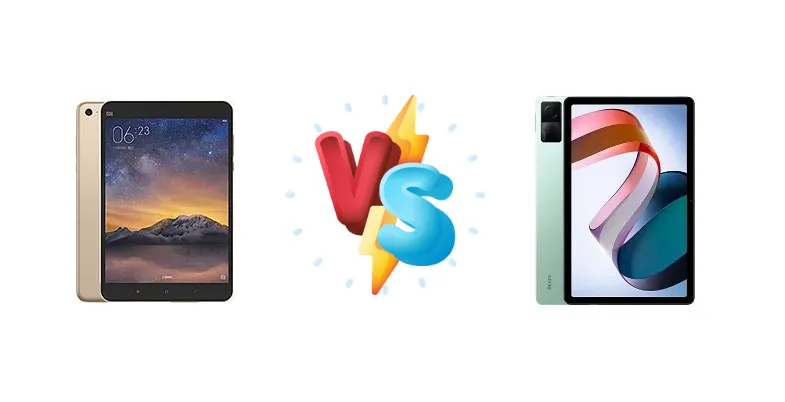
The Xiaomi Mi Pad 2 and Redmi Pad represent different eras of Xiaomi's tablet offerings. The Mi Pad 2, an older model, aimed for premium performance, while the Redmi Pad focuses on affordability and everyday use. Let's dive into a comprehensive comparison to see which tablet reigns supreme.
🏆 Quick Verdict
The Redmi Pad is the clear winner. While the Mi Pad 2 had a brief moment of relevance, the Redmi Pad's modern chipset, brighter display, faster charging, and overall value make it a significantly better choice for most users in 2024.
| Network |
|---|
| 2G bands | N/A | N/A |
| 3G bands | - | N/A |
| 4G bands | - | N/A |
| EDGE | No | N/A |
| GPRS | No | N/A |
| Technology | No cellular connectivity | No cellular connectivity |
| Launch |
|---|
| Announced | 2015, November. Released 2015, November | 2022, October 04 |
| Status | Discontinued | Available. Released 2022, October 05 |
| Body |
|---|
| Build | - | Glass front, aluminum frame |
| Dimensions | 200.4 x 132.6 x 7 mm (7.89 x 5.22 x 0.28 in) | 250.5 x 158.1 x 7.1 mm (9.86 x 6.22 x 0.28 in) |
| SIM | No | No |
| Weight | 322 g (11.36 oz) | 465 g (1.03 lb) |
| Display |
|---|
| Resolution | 1536 x 2048 pixels, 4:3 ratio (~326 ppi density) | 1200 x 2000 pixels, 5:3 ratio (~220 ppi density) |
| Size | 7.9 inches, 190.9 cm2 (~71.8% screen-to-body ratio) | 10.61 inches, 320.4 cm2 (~80.9% screen-to-body ratio) |
| Type | IPS LCD | IPS LCD, 1B colors, 90Hz, 400 nits (typ) |
| Platform |
|---|
| CPU | Quad-core 2.24 GHz | Octa-core (2x2.2 GHz Cortex-A76 & 6x2.0 GHz Cortex-A55) |
| Chipset | Intel Atom X5-Z8500 | Mediatek Helio G99 (6 nm) |
| GPU | Intel HD Graphics | Mali-G57 MC2 |
| OS | Android OS/ Optional Windows 10 (64 GB model), MIUI 7 | Android 12, upgradable to Android 13, MIUI 14 |
| Memory |
|---|
| Call records | Yes | - |
| Card slot | No | microSDXC |
| Internal | 16GB 2GB RAM, 64GB 2GB RAM | 64GB 3GB RAM, 128GB 4GB RAM, 128GB 6GB RAM |
| Phonebook | Yes | - |
| | - | UFS 2.2 |
| Main Camera |
|---|
| Single | 8 MP, f/2.0 | 8 MP, f/2.0, (wide), AF |
| Video | 1080p@30fps | 1080p@30fps |
| Selfie camera |
|---|
| Single | 5 MP | 8 MP, f/2.3, 105° (ultrawide) |
| Video | | 1080p@30fps |
| Sound |
|---|
| 3.5mm jack | Yes | No |
| 35mm jack | Yes | No |
| Loudspeaker | Yes, with stereo speakers | Yes, with stereo speakers (4 speakers) |
| | - | 24-bit/192kHz audio |
| Comms |
|---|
| Bluetooth | 4.1, A2DP, LE | 5.2, A2DP, LE |
| NFC | No | No |
| Positioning | No | No |
| Radio | No | No |
| USB | USB Type-C | USB Type-C, OTG |
| WLAN | Wi-Fi 802.11 a/b/g/n/ac, dual-band, Wi-Fi Direct, hotspot | Wi-Fi 802.11 a/b/g/n/ac, dual-band, Wi-Fi Direct |
| Features |
|---|
| Games | Downloadable | - |
| Java | Yes | - |
| Messaging | SMS, MMS, Email, Push Email, IM | - |
| Sensors | Accelerometer, gyro, compass | Accelerometer |
| Battery |
|---|
| Charging | 10W wired | 18W wired |
| Music play | Up to 100 h | - |
| Stand-by | Up to 649 h | - |
| Talk time | Up to 12 h 30 min (multimedia) | - |
| Type | Li-Po 6190 mAh, non-removable | Li-Po 8000 mAh |
| Misc |
|---|
| Colors | Dark grey, Champagne gold | Graphite Gray, Moonlight Silver, Mint Green |
| Models | - | 22081283G |
| Price | About 180 EUR | About 250 EUR |
| SAR EU | - | 0.36 W/kg (body) |
| Tests |
|---|
| Display | - |
Contrast ratio: 1529:1 (nominal) |
| Loudspeaker | - |
-23.9 LUFS (Very good)
|
| Performance | - |
AnTuTu: 319077 (v9)
GeekBench: 1852 (v5.1)
GFXBench: 13fps (ES 3.1 onscreen) |
Xiaomi Mi Pad 2
- Compact design
- Windows compatibility (limited)
- Relatively lightweight
- Outdated chipset
- Poor performance
- Low brightness display
- Slow charging
- Limited software support
Xiaomi Redmi Pad
- Modern chipset (Helio G99)
- Bright display
- Fast charging (18W)
- Good value for money
- Improved performance
- Plastic build quality
- Camera not exceptional
- May lack premium features
Display Comparison
The Redmi Pad boasts a significantly brighter display (402 nits) compared to the Mi Pad 2, offering better visibility in various lighting conditions. Both have a nominal contrast ratio of 1529:1, but the Redmi Pad's higher brightness gives it a noticeable edge in image quality. The Redmi Pad's display is also likely larger, contributing to a more immersive experience.
Camera Comparison
Camera quality is generally not a primary concern for tablets. However, the Redmi Pad likely has a more modern camera setup, potentially offering better image processing and low-light performance. The Mi Pad 2's cameras are likely quite dated.
Performance
The Redmi Pad's Mediatek Helio G99 chipset is a substantial upgrade over the Mi Pad 2's Intel Atom X5-Z8500. The G99's octa-core architecture and 6nm manufacturing process provide significantly better performance for multitasking, gaming, and demanding applications. The Mi Pad 2 struggles with modern apps and heavier workloads.
Battery Life
The Redmi Pad's 18W charging is faster than the Mi Pad 2's 10W charging, allowing for quicker top-ups. Battery capacity is likely similar, but the Redmi Pad's more efficient chipset may result in slightly better overall battery life.
Buying Guide
Who should buy the Xiaomi Mi Pad 2? Likely only those seeking a very specific, older Windows-compatible tablet at a deeply discounted price. Who should buy the Xiaomi Redmi Pad? Anyone looking for a budget-friendly Android tablet for media consumption, light gaming, and everyday tasks.
Frequently Asked Questions
❓ Is the Mi Pad 2 still worth buying?
Generally no. The Mi Pad 2 is quite outdated and struggles with modern software. Unless you have a very specific need for its Windows compatibility and find it at a drastically reduced price, the Redmi Pad is a far better investment.
❓ What resolution do both tablets have?
The Mi Pad 2 has a 2048 x 1536 resolution. The Redmi Pad has a 1920 x 1200 resolution. While the Mi Pad 2 has a slightly higher resolution, the Redmi Pad's larger display size often makes the difference negligible.