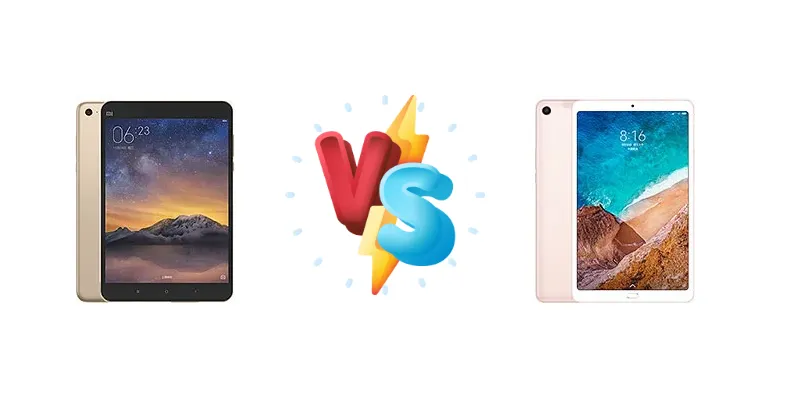
The Xiaomi Mi Pad series has long been a contender in the Android tablet space, offering compelling features at competitive prices. Today, we're pitting two generations against each other: the Mi Pad 2 and the Mi Pad 4 Plus. Which one reigns supreme in 2024?
🏆 Quick Verdict
The Mi Pad 4 Plus is the clear winner. Its Snapdragon 660 chipset offers significantly better performance and efficiency than the Mi Pad 2's Atom processor. While both offer a similar charging experience, the 4 Plus's improved display and overall modern features make it the superior choice.
| Network |
|---|
| 2G bands | N/A | - |
| 4G bands | - | 1, 3, 5, 7, 8, 34, 38, 39, 40, 41 |
| EDGE | No | No |
| GPRS | No | No |
| Speed | - | LTE (3CA) Cat12 600/150 Mbps |
| Technology | No cellular connectivity | LTE |
| Launch |
|---|
| Announced | 2015, November. Released 2015, November | 2018, August. Released 2018, August |
| Status | Discontinued | Discontinued |
| Body |
|---|
| Build | - | Glass front, aluminum back, aluminum frame |
| Dimensions | 200.4 x 132.6 x 7 mm (7.89 x 5.22 x 0.28 in) | 245.6 x 149.1 x 8 mm (9.67 x 5.87 x 0.31 in) |
| SIM | No | Nano-SIM |
| Weight | 322 g (11.36 oz) | 485 g (1.07 lb) |
| Display |
|---|
| Resolution | 1536 x 2048 pixels, 4:3 ratio (~326 ppi density) | 1200 x 1920 pixels, 16:10 ratio (~224 ppi density) |
| Size | 7.9 inches, 190.9 cm2 (~71.8% screen-to-body ratio) | 10.1 inches, 295.8 cm2 (~80.8% screen-to-body ratio) |
| Type | IPS LCD | IPS LCD |
| Platform |
|---|
| CPU | Quad-core 2.24 GHz | Octa-core (4x2.2 GHz Kryo 260 Gold & 4x1.8 GHz Kryo 260 Silver) |
| Chipset | Intel Atom X5-Z8500 | Qualcomm SDM660 Snapdragon 660 (14 nm) |
| GPU | Intel HD Graphics | Adreno 512 |
| OS | Android OS/ Optional Windows 10 (64 GB model), MIUI 7 | Android 8.1 (Oreo), MIUI 10 |
| Memory |
|---|
| Call records | Yes | - |
| Card slot | No | microSDXC (dedicated slot) |
| Internal | 16GB 2GB RAM, 64GB 2GB RAM | 64GB 4GB RAM, 128GB 4GB RAM |
| Phonebook | Yes | - |
| | - | eMMC 5.1 |
| Main Camera |
|---|
| Features | - | Panorama, HDR |
| Single | 8 MP, f/2.0 | 13 MP, f/2.0 |
| Video | 1080p@30fps | 1080p@30fps |
| Selfie camera |
|---|
| Single | 5 MP | 5 MP, f/2.0 |
| Video | | - |
| Sound |
|---|
| 3.5mm jack | Yes | Yes |
| 35mm jack | Yes | Yes |
| Loudspeaker | Yes, with stereo speakers | Yes, with stereo speakers |
| Comms |
|---|
| Bluetooth | 4.1, A2DP, LE | 5.0, A2DP, LE |
| NFC | No | No |
| Positioning | No | GPS, GLONASS, BDS (LTE model only) |
| Radio | No | No |
| USB | USB Type-C | USB Type-C |
| WLAN | Wi-Fi 802.11 a/b/g/n/ac, dual-band, Wi-Fi Direct, hotspot | Wi-Fi 802.11 a/b/g/n/ac, dual-band, Wi-Fi Direct |
| Features |
|---|
| Games | Downloadable | - |
| Java | Yes | - |
| Messaging | SMS, MMS, Email, Push Email, IM | - |
| Sensors | Accelerometer, gyro, compass | Accelerometer, gyro, proximity, compass (LTE model only) |
| Battery |
|---|
| Charging | 10W wired | 10W wired |
| Music play | Up to 100 h | - |
| Stand-by | Up to 649 h | - |
| Talk time | Up to 12 h 30 min (multimedia) | - |
| Type | Li-Po 6190 mAh, non-removable | Li-Po 8620 mAh, non-removable |
| Misc |
|---|
| Colors | Dark grey, Champagne gold | Black, Rose Gold |
| Price | About 180 EUR | About 260 EUR |
Xiaomi Mi Pad 2
- Very affordable
- Compact and portable
- Decent display for the price
- Outdated processor
- Limited performance
- Smaller screen
- Lower resolution
Xiaomi Mi Pad 4 Plus
- Powerful Snapdragon 660 chipset
- Larger and higher-resolution display
- Improved performance and multitasking
- Modern design
- Slightly more expensive than the Mi Pad 2
- 10W charging is slow by modern standards
Display Comparison
The Mi Pad 4 Plus boasts a larger 10.4-inch display with a higher resolution (2560 x 1600) compared to the Mi Pad 2's 7.9-inch (2048 x 1536) screen. This results in a more immersive viewing experience and sharper visuals on the 4 Plus. Both feature IPS panels, offering good color accuracy and viewing angles.
Camera Comparison
Camera quality isn't a primary focus for tablets, but the Mi Pad 4 Plus generally offers slightly better image quality thanks to its more modern sensor. Both tablets feature front and rear cameras suitable for video calls and casual snapshots, but don't expect flagship-level performance.
Performance
This is where the Mi Pad 4 Plus truly shines. The Snapdragon 660 is a much more powerful and efficient chipset than the Intel Atom X5-Z8500. Expect smoother multitasking, faster app loading times, and better gaming performance on the 4 Plus. The Mi Pad 2 can feel sluggish at times, especially with demanding applications.
Battery Life
Both tablets offer similar battery life, around 8-10 hours of moderate usage. The Mi Pad 4 Plus's larger battery capacity (8620 mAh vs 6470 mAh) contributes to this, but the efficiency of the Snapdragon 660 also plays a role.
Buying Guide
The Mi Pad 2 is best suited for users on a very tight budget who primarily need a tablet for basic tasks like web browsing and media consumption. The Mi Pad 4 Plus is ideal for students, casual gamers, and anyone who wants a more responsive and versatile Android tablet experience.
Frequently Asked Questions
❓ Is the Mi Pad 2 still worth buying?
Only if you're on an extremely tight budget and only need a tablet for very basic tasks. Otherwise, the Mi Pad 4 Plus offers a significantly better experience.
❓ What Android version do these tablets run?
The Mi Pad 2 shipped with Android 5.1 Lollipop and has received limited updates. The Mi Pad 4 Plus launched with Android 8.1 Oreo and received updates to Android 9. The software support is limited on both devices now.