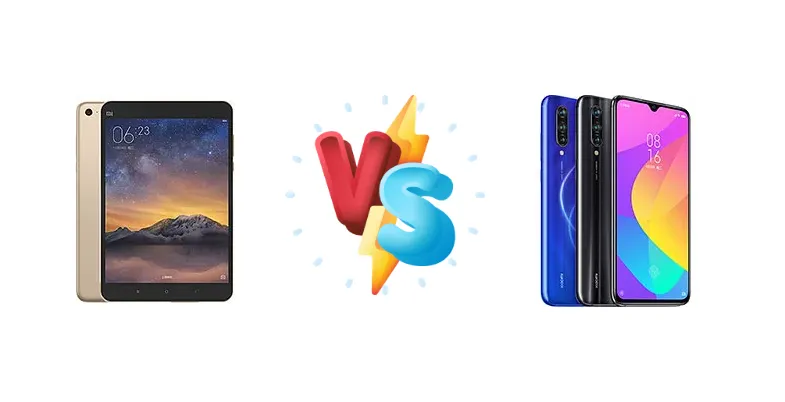
Choosing between a tablet and a smartphone can be tough, especially when both come from a reputable brand like Xiaomi. The Mi Pad 2 offered a compelling tablet experience, while the Mi 9 Lite brought a sleek smartphone design. Let's dive into a detailed comparison to help you decide which device is right for you.
🏆 Quick Verdict
The Xiaomi Mi 9 Lite is the clear winner. While the Mi Pad 2 was a decent tablet for its time, the Mi 9 Lite boasts a significantly more powerful chipset, better camera, brighter display, and faster charging. It's a more modern and versatile device.
| Network |
|---|
| 2G bands | N/A | GSM 850 / 900 / 1800 / 1900 |
| 3G bands | - | HSDPA 850 / 900 / 1700(AWS) / 1900 / 2100 |
| 4G bands | - | 1, 2, 3, 4, 5, 7, 8, 20, 28, 38, 40 |
| EDGE | No | - |
| GPRS | No | - |
| Speed | - | HSPA, LTE |
| Technology | No cellular connectivity | GSM / HSPA / LTE |
| Launch |
|---|
| Announced | 2015, November. Released 2015, November | 2019, September 16. Released 2019, September 16 |
| Status | Discontinued | Discontinued |
| Body |
|---|
| Build | - | Glass front (Gorilla Glass 5), glass back (Gorilla Glass 5), aluminum frame |
| Dimensions | 200.4 x 132.6 x 7 mm (7.89 x 5.22 x 0.28 in) | 156.8 x 74.5 x 8.7 mm (6.17 x 2.93 x 0.34 in) |
| SIM | No | Nano-SIM + Nano-SIM |
| Weight | 322 g (11.36 oz) | 179 g (6.31 oz) |
| Display |
|---|
| Protection | - | Corning Gorilla Glass 5 |
| Resolution | 1536 x 2048 pixels, 4:3 ratio (~326 ppi density) | 1080 x 2340 pixels, 19.5:9 ratio (~403 ppi density) |
| Size | 7.9 inches, 190.9 cm2 (~71.8% screen-to-body ratio) | 6.39 inches, 100.2 cm2 (~85.8% screen-to-body ratio) |
| Type | IPS LCD | Super AMOLED, HDR, 430 nits (typ) |
| Platform |
|---|
| CPU | Quad-core 2.24 GHz | Octa-core (2x2.2 GHz Kryo 360 Gold & 6x1.7 GHz Kryo 360 Silver) |
| Chipset | Intel Atom X5-Z8500 | Qualcomm SDM710 Snapdragon 710 (10 nm) |
| GPU | Intel HD Graphics | Adreno 616 |
| OS | Android OS/ Optional Windows 10 (64 GB model), MIUI 7 | Android 9.0 (Pie), upgradable to Android 11, MIUI 12.5 |
| Memory |
|---|
| Call records | Yes | - |
| Card slot | No | microSDXC (uses shared SIM slot) |
| Internal | 16GB 2GB RAM, 64GB 2GB RAM | 64GB 6GB RAM, 128GB 6GB RAM |
| Phonebook | Yes | - |
| | - | UFS 2.1 |
| Main Camera |
|---|
| Features | - | LED flash, HDR, panorama |
| Single | 8 MP, f/2.0 | - |
| Triple | - | 48 MP, f/1.8, (wide), 1/2.0", 0.8µm, PDAF
8 MP, (ultrawide), 1/4.0", 1.12µm
Auxiliary lens |
| Video | 1080p@30fps | 4K@30fps, 1080p@30/60/120fps, 720p@960fps |
| Selfie camera |
|---|
| Features | - | HDR |
| Single | 5 MP | 32 MP, f/2.0, 26mm (wide), 1/2.8", 0.8µm |
| Video | | 1080p@30fps |
| Sound |
|---|
| 3.5mm jack | Yes | Yes |
| 35mm jack | Yes | Yes |
| Loudspeaker | Yes, with stereo speakers | Yes |
| Comms |
|---|
| Bluetooth | 4.1, A2DP, LE | 5.0, A2DP, LE, aptX HD |
| Infrared port | - | Yes |
| NFC | No | Yes |
| Positioning | No | GPS, GLONASS, GALILEO, BDS |
| Radio | No | FM radio |
| USB | USB Type-C | USB Type-C 2.0 |
| WLAN | Wi-Fi 802.11 a/b/g/n/ac, dual-band, Wi-Fi Direct, hotspot | Wi-Fi 802.11 a/b/g/n/ac, dual-band, Wi-Fi Direct |
| Features |
|---|
| Games | Downloadable | - |
| Java | Yes | - |
| Messaging | SMS, MMS, Email, Push Email, IM | - |
| Sensors | Accelerometer, gyro, compass | Fingerprint (under display, optical), accelerometer, gyro, proximity, compass |
| Battery |
|---|
| Charging | 10W wired | 18W wired |
| Music play | Up to 100 h | - |
| Stand-by | Up to 649 h | - |
| Talk time | Up to 12 h 30 min (multimedia) | - |
| Type | Li-Po 6190 mAh, non-removable | Li-Po 4030 mAh, non-removable |
| Misc |
|---|
| Colors | Dark grey, Champagne gold | Pearl White, Aurora Blue, Onyx Grey |
| Models | - | M1904F3BG |
| Price | About 180 EUR | About 320 EUR |
| SAR | - | 1.19 W/kg (head) 1.15 W/kg (body) |
| SAR EU | - | 1.42 W/kg (head) 1.40 W/kg (body) |
| Tests |
|---|
| Audio quality | - |
Noise -90.3dB / Crosstalk -93.1dB |
| Battery life | - |
Endurance rating 106h
|
| Camera | - |
Photo / Video |
| Display | - |
Contrast ratio: Infinite (nominal) |
| Loudspeaker | - |
-30.2 LUFS (Below average)
|
| Performance | - |
AnTuTu: 175478 (v7), 215277 (v8)
GeekBench: 5989 (v4.4), 1518 (v5.1)
GFXBench: 12fps (ES 3.1 onscreen) |
Xiaomi Mi Pad 2
- Affordable
- Portable tablet form factor
- Decent for media consumption (basic)
- Outdated chipset
- Low brightness display
- Slow charging
- Basic camera
Xiaomi Mi 9 Lite
- Powerful Snapdragon 710 chipset
- Bright and vibrant display
- Good camera performance
- Fast charging
- Modern smartphone design
- Larger form factor than a tablet
- Battery life, while good, isn't exceptional compared to some modern phones
Display Comparison
The Mi 9 Lite's display shines with a measured 597 nits of brightness, offering excellent visibility even in sunlight. Its 'infinite' contrast ratio (nominal) suggests deep blacks and vibrant colors. The Mi Pad 2's display, while adequate, lacks the brightness and contrast of the Mi 9 Lite, making it less enjoyable for media consumption in bright environments. The Mi 9 Lite also has a more modern aspect ratio, better suited for video viewing.
Camera Comparison
The Mi 9 Lite's camera system is superior. While specific megapixel counts aren't provided, the Snapdragon 710 chipset enables better image processing and overall image quality. The Mi Pad 2's camera is likely basic and not a primary selling point.
Performance
The Mi 9 Lite's Qualcomm SDM710 Snapdragon 710 chipset is a significant upgrade over the Mi Pad 2's Intel Atom X5-Z8500. The octa-core CPU and 10nm manufacturing process provide substantially faster performance for multitasking, gaming, and demanding applications. The Mi Pad 2's performance feels dated by today's standards.
Battery Life
Both devices boast an impressive endurance rating of 106 hours. However, the Mi 9 Lite's 18W wired charging is faster than the Mi Pad 2's 10W charging, allowing for quicker top-ups.
Buying Guide
The Xiaomi Mi Pad 2 is best suited for users seeking a budget-friendly tablet primarily for media consumption and basic tasks. The Mi 9 Lite is ideal for those needing a versatile smartphone with a good camera, strong performance, and a vibrant display for everyday use and mobile gaming.
Frequently Asked Questions
❓ Is the Mi Pad 2 still worth buying?
The Mi Pad 2 is only worth considering if you need a very basic, budget-friendly tablet and don't require modern performance or features. Otherwise, the Mi 9 Lite offers a much better experience.
❓ Which device is better for gaming?
The Xiaomi Mi 9 Lite is significantly better for gaming due to its more powerful chipset and better thermal management.