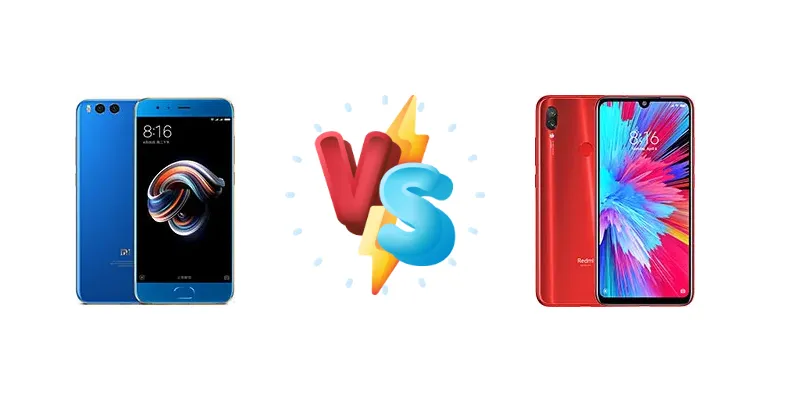
Xiaomi offers a range of excellent mid-range phones, and the Mi Note 3 and Redmi Note 7S are two popular contenders. Both pack a Snapdragon 660 chipset, but subtle differences in features and design can make a big impact. Let's dive into a head-to-head comparison to help you choose the right one for your needs.
🏆 Quick Verdict
The Redmi Note 7S edges out the Mi Note 3 due to its slightly faster charging (QC4 vs QC3) and often more competitive pricing. While the Mi Note 3 boasts a slightly more premium design and potentially better display contrast, the 7S offers a compelling blend of features and value.
| Network |
|---|
| 2G bands | GSM 850 / 900 / 1800 / 1900 - SIM 1 & SIM 2 | GSM 850 / 900 / 1800 / 1900 |
| 3G bands | HSDPA 850 / 900 / 1700(AWS) / 1900 / 2100 | HSDPA 850 / 900 / 1900 / 2100 |
| 4G bands | 1, 3, 5, 7, 8, 34, 38, 39, 40, 41 | 1, 3, 5, 8, 40, 41 |
| Speed | HSPA 42.2/5.76 Mbps, LTE (2CA) Cat6 300/50 Mbps | HSPA 42.2/5.76 Mbps, LTE (2CA) Cat12 600/150 Mbps |
| Technology | GSM / CDMA / HSPA / EVDO / LTE | GSM / HSPA / LTE |
| | CDMA2000 1xEV-DO | - |
| Launch |
|---|
| Announced | 2017, September. Released 2017, September | 2019, May. Released 2019, May |
| Status | Discontinued | Discontinued |
| Body |
|---|
| Build | Glass front (Gorilla Glass 4), glass back, aluminum frame | Glass front (Gorilla Glass 5), glass back (Gorilla Glass 5), plastic frame |
| Dimensions | 152.6 x 74 x 7.6 mm (6.01 x 2.91 x 0.30 in) | 159.2 x 75.2 x 8.1 mm (6.27 x 2.96 x 0.32 in) |
| SIM | Nano-SIM + Nano-SIM | Nano-SIM + Nano-SIM |
| Weight | 163 g (5.75 oz) | 186 g (6.56 oz) |
| | - | Splash resistant |
| Display |
|---|
| Protection | Corning Gorilla Glass 4 | Corning Gorilla Glass 5 |
| Resolution | 1080 x 1920 pixels, 16:9 ratio (~401 ppi density) | 1080 x 2340 pixels, 19.5:9 ratio (~409 ppi density) |
| Size | 5.5 inches, 83.4 cm2 (~73.8% screen-to-body ratio) | 6.3 inches, 97.4 cm2 (~81.4% screen-to-body ratio) |
| Type | IPS LCD | IPS LCD |
| Platform |
|---|
| CPU | Octa-core (4x2.2 GHz Kryo 260 Gold & 4x1.8 GHz Kryo 260 Silver) | Octa-core (4x2.2 GHz Kryo 260 Gold & 4x1.8 GHz Kryo 260 Silver) |
| Chipset | Qualcomm SDM660 Snapdragon 660 (14 nm) | Qualcomm SDM660 Snapdragon 660 (14 nm) |
| GPU | Adreno 512 | Adreno 512 |
| OS | Android 7.1 (Nougat), upgradable to Android 9, MIUI 12 | Android 9.0 (Pie), planned upgrade to Android 10, MIUI 12 |
| Memory |
|---|
| Card slot | No | microSDXC (uses shared SIM slot) |
| Internal | 64GB 6GB RAM, 128GB 6GB RAM | 32GB 3GB RAM, 64GB 4GB RAM |
| | eMMC 5.1 | eMMC 5.1 |
| Main Camera |
|---|
| Dual | 12 MP, f/1.8, 27mm (wide), PDAF, 4-axis OIS
12 MP, f/2.6, 52mm (telephoto), AF, 2x optical zoom | 48 MP, f/1.8, (wide), 1/2.0", 0.8µm, PDAF
Auxiliary lens |
| Features | Dual-LED dual-tone flash, HDR, panorama | Dual-LED flash, HDR, panorama |
| Single | 13 MP, f/2.0, 28mm (wide), AF | - |
| Video | 4K@30fps, 720p@120fps | 1080p@30/60/120fps, (gyro-EIS) |
| Selfie camera |
|---|
| Features | - | HDR |
| Single | 16 MP, f/2.5, (wide), 1/3.06" 1.0µm | 13 MP, f/2.0, (wide), 1/3.1", 1.12µm |
| Video | 1080p@30fps | 1080p@30fps |
| Sound |
|---|
| 3.5mm jack | No | Yes |
| 35mm jack | No | Yes |
| Loudspeaker | Yes, with stereo speakers | Yes |
| | 24-bit/192kHz audio
| - |
| Comms |
|---|
| Bluetooth | 5.0, A2DP, LE | 5.0, A2DP, LE |
| Infrared port | Yes | Yes |
| NFC | Yes | No |
| Positioning | GPS, GLONASS, BDS | GPS, GLONASS, BDS |
| Radio | No | FM radio, recording |
| USB | USB Type-C | USB Type-C 2.0 |
| WLAN | Wi-Fi 802.11 a/b/g/n/ac, dual-band, Wi-Fi Direct | Wi-Fi 802.11 a/b/g/n/ac, dual-band, Wi-Fi Direct |
| Features |
|---|
| Sensors | Fingerprint (front-mounted), accelerometer, gyro, proximity, compass, barometer | Fingerprint (rear-mounted), accelerometer, gyro, proximity, compass |
| Battery |
|---|
| Charging | 18W wired, QC3 | 18W wired, QC4 |
| Music play | Up to 54 h | - |
| Talk time | Up to 17 h (3G) | - |
| Type | Li-Ion 3500 mAh, non-removable | Li-Po 4000 mAh, non-removable |
| Misc |
|---|
| Colors | Black, Blue | Onyx Black, Sapphire Blue, Ruby Red, Astro White |
| Models | MCE8 | M1901F71 |
| Price | About 280 EUR | About 140 EUR |
| SAR | 0.50 W/kg (head) 1.54 W/kg (body) | - |
| SAR EU | 0.29 W/kg (head) 0.39 W/kg (body) | - |
| Tests |
|---|
| Audio quality |
Noise -95.2dB / Crosstalk -93.4dB | - |
| Battery life | Endurance rating 83h | - |
| Display |
Contrast ratio: Infinite (nominal), 3.679 (sunlight) | - |
| Loudspeaker |
Voice 64dB / Noise 66dB / Ring 73dB | - |
| Performance |
Basemark OS II 2.0: 813Basemark X: 4802 | - |
Xiaomi Mi Note 3
- Premium design and build quality
- Excellent AMOLED display (rich colors, deep blacks)
- Long battery life (83h endurance rating)
- Slightly better display contrast
- Camera not as impressive as the Redmi Note 7S
- QC3 charging (slightly slower than QC4)
- May be harder to find new
Xiaomi Redmi Note 7S
- 48MP main camera (detailed photos)
- QC4 charging (potentially faster)
- More readily available
- Competitive pricing
- Larger display
- IPS LCD display (less vibrant than AMOLED)
- Less premium design
- Sunlight readability not as good as Mi Note 3 (potentially)
Display Comparison
The Mi Note 3 features a 5.99-inch AMOLED display with a reported infinite contrast ratio (though this is a nominal figure, real-world contrast is excellent). The Redmi Note 7S has a 6.3-inch IPS LCD display. While the Note 7S offers a larger screen, the Mi Note 3's AMOLED panel generally provides richer colors, deeper blacks, and better viewing angles. The Note 7S's sunlight readability is decent, but the Mi Note 3's contrast ratio suggests it might perform slightly better in bright conditions.
Camera Comparison
The Redmi Note 7S typically features a 48MP main camera, offering more detailed photos than the Mi Note 3's 12MP sensor. Both phones have secondary depth sensors for portrait mode. Image processing and low-light performance can vary depending on software updates, but the Redmi Note 7S generally delivers better image quality, especially in well-lit conditions. The Mi Note 3's camera is still capable, but not as impressive.
Performance
Both phones share the same Snapdragon 660 chipset and Kryo 260 CPU cores, meaning day-to-day performance will be very similar. Expect smooth multitasking and responsive app loading. However, slight variations in RAM management and software optimization could lead to minor differences in real-world speed. The Redmi Note 7S might have a slight edge due to potentially more optimized software.
Battery Life
The Mi Note 3 boasts an impressive endurance rating of 83 hours, suggesting excellent battery life. Both phones have 18W wired charging, but the Redmi Note 7S supports QC4, potentially offering slightly faster charging speeds than the Mi Note 3's QC3. Real-world battery performance will depend on usage patterns.
Buying Guide
The Xiaomi Mi Note 3 is ideal for users prioritizing a more premium feel and potentially a slightly better display experience. The Redmi Note 7S is a great choice for budget-conscious buyers who want a reliable phone with a good camera and fast charging.
Frequently Asked Questions
❓ Is the Mi Note 3 still worth buying?
If you prioritize a premium design and AMOLED display, and can find one at a good price, the Mi Note 3 is still a viable option. However, the Redmi Note 7S offers a more modern feature set and better camera for a similar or lower price.
❓ Which phone has faster charging?
The Redmi Note 7S supports QC4, while the Mi Note 3 supports QC3. QC4 is slightly faster, but both offer 18W charging.