
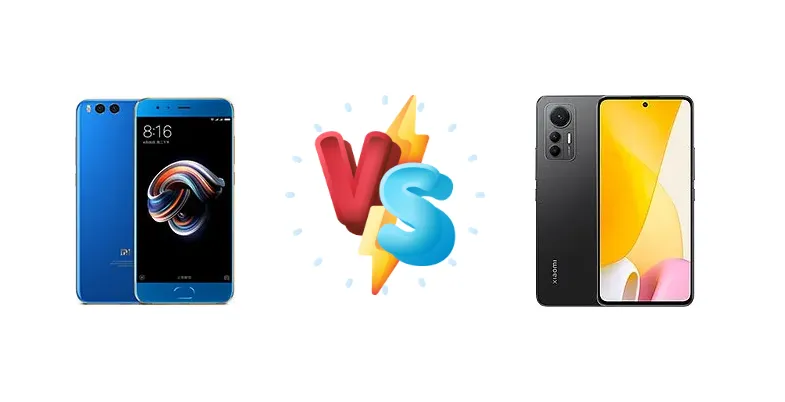
Xiaomi Mi Note 3 vs Xiaomi 12 Lite: A Detailed Comparison
| Phones Images | |||||
|---|---|---|---|---|---|
|
🏆 Quick Verdict
The Xiaomi 12 Lite is the clear winner. While the Mi Note 3 offers decent battery life, the 12 Lite boasts a significantly faster processor, a brighter display, a more modern camera system, and incredibly fast charging. It's a substantial upgrade across the board.
| PHONES | ||
|---|---|---|
| Phone Names | Xiaomi Mi Note 3 | Xiaomi 12 Lite |
| Network | ||
|---|---|---|
| 2G bands | GSM 850 / 900 / 1800 / 1900 - SIM 1 & SIM 2 | GSM 850 / 900 / 1800 / 1900 |
| 3G bands | HSDPA 850 / 900 / 1700(AWS) / 1900 / 2100 | HSDPA 850 / 900 / 1700(AWS) / 1900 / 2100 |
| 4G bands | 1, 3, 5, 7, 8, 34, 38, 39, 40, 41 | 1, 2, 3, 4, 5, 7, 8, 12, 13, 17, 18, 19, 20, 26, 28, 32, 38, 40, 41, 42, 48, 66 |
| 5G bands | - | 1, 3, 5, 7, 8, 20, 28, 38, 40, 41, 66, 77, 78 SA/NSA |
| Speed | HSPA 42.2/5.76 Mbps, LTE (2CA) Cat6 300/50 Mbps | HSPA, LTE, 5G |
| Technology | GSM / CDMA / HSPA / EVDO / LTE | GSM / HSPA / LTE / 5G |
| CDMA2000 1xEV-DO | - | |
| Launch | ||
|---|---|---|
| Announced | 2017, September. Released 2017, September | 2022, July 09 |
| Status | Discontinued | Available. Released 2022, July 11 |
| Body | ||
|---|---|---|
| Build | Glass front (Gorilla Glass 4), glass back, aluminum frame | Glass front (Gorilla Glass 5), glass back, plastic frame |
| Dimensions | 152.6 x 74 x 7.6 mm (6.01 x 2.91 x 0.30 in) | 159.3 x 73.7 x 7.3 mm (6.27 x 2.90 x 0.29 in) |
| SIM | Nano-SIM + Nano-SIM | Nano-SIM + Nano-SIM |
| Weight | 163 g (5.75 oz) | 173 g (6.10 oz) |
| Display | ||
|---|---|---|
| Protection | Corning Gorilla Glass 4 | Corning Gorilla Glass 5 |
| Resolution | 1080 x 1920 pixels, 16:9 ratio (~401 ppi density) | 1080 x 2400 pixels, 20:9 ratio (~402 ppi density) |
| Size | 5.5 inches, 83.4 cm2 (~73.8% screen-to-body ratio) | 6.55 inches, 103.6 cm2 (~88.2% screen-to-body ratio) |
| Type | IPS LCD | AMOLED, 68B colors, 120Hz, Dolby Vision, HDR10+, 950 nits (peak) |
| Platform | ||
|---|---|---|
| CPU | Octa-core (4x2.2 GHz Kryo 260 Gold & 4x1.8 GHz Kryo 260 Silver) | Octa-core (1x2.4 GHz Cortex-A78 & 3x2.2 GHz Cortex-A78 & 4x1.9 GHz Cortex-A55) |
| Chipset | Qualcomm SDM660 Snapdragon 660 (14 nm) | Qualcomm SM7325 Snapdragon 778G 5G (6 nm) |
| GPU | Adreno 512 | Adreno 642L |
| OS | Android 7.1 (Nougat), upgradable to Android 9, MIUI 12 | Android 12, upgradable to Android 14, HyperOS |
| Memory | ||
|---|---|---|
| Card slot | No | No |
| Internal | 64GB 6GB RAM, 128GB 6GB RAM | 128GB 6GB RAM, 128GB 8GB RAM, 256GB 8GB RAM |
| eMMC 5.1 | UFS 2.2 | |
| Main Camera | ||
|---|---|---|
| Dual | 12 MP, f/1.8, 27mm (wide), PDAF, 4-axis OIS 12 MP, f/2.6, 52mm (telephoto), AF, 2x optical zoom | - |
| Features | Dual-LED dual-tone flash, HDR, panorama | Dual-LED dual-tone flash, HDR, panorama |
| Single | 13 MP, f/2.0, 28mm (wide), AF | 32 MP, f/2.5, (wide), 1/2.8", 0.8µm, AF |
| Triple | - | 108 MP, f/1.9, 26mm (wide), 1/1.52", 0.7µm, PDAF 8 MP, f/2.2, 120˚ (ultrawide), 1/4.0", 1.12µm 2 MP (macro) |
| Video | 4K@30fps, 720p@120fps | 4K@30fps, 1080p@30/60/120fps; gyro-EIS |
| Selfie camera | ||
|---|---|---|
| Features | - | HDR, panorama |
| Single | 16 MP, f/2.5, (wide), 1/3.06" 1.0µm | 32 MP, f/2.5, (wide), 1/2.8", 0.8µm, AF |
| Video | 1080p@30fps | 1080p@30/60fps, 720p@120fps |
| Sound | ||
|---|---|---|
| 3.5mm jack | No | No |
| 35mm jack | No | No |
| Loudspeaker | Yes, with stereo speakers | Yes, with dual speakers |
| 24-bit/192kHz audio | 24-bit/192kHz audio | |
| Comms | ||
|---|---|---|
| Bluetooth | 5.0, A2DP, LE | 5.2, A2DP, LE, aptX HD, aptX Adaptive |
| Infrared port | Yes | Yes |
| NFC | Yes | Yes (market/region dependent) |
| Positioning | GPS, GLONASS, BDS | GPS (L1), GLONASS (G1), BDS (B1I+B1c), GALILEO (E1), QZSS (L1) |
| Radio | No | No |
| USB | USB Type-C | USB Type-C 2.0, OTG |
| WLAN | Wi-Fi 802.11 a/b/g/n/ac, dual-band, Wi-Fi Direct | Wi-Fi 802.11 a/b/g/n/ac/6, dual-band, Wi-Fi Direct |
| Features | ||
|---|---|---|
| Sensors | Fingerprint (front-mounted), accelerometer, gyro, proximity, compass, barometer | Fingerprint (under display, optical), accelerometer, gyro, compass |
| - | Virtual proximity sensing | |
| Battery | ||
|---|---|---|
| Charging | 18W wired, QC3 | 67W wired, PD3.0, QC4, 50% in 13 min |
| Music play | Up to 54 h | - |
| Talk time | Up to 17 h (3G) | - |
| Type | Li-Ion 3500 mAh, non-removable | Li-Po 4300 mAh |
| Misc | ||
|---|---|---|
| Colors | Black, Blue | Black, Lite Green, Lite Pink |
| Models | MCE8 | 2203129G |
| Price | About 280 EUR | € 119.80 / $ 269.00 / £ 121.15 |
| SAR | 0.50 W/kg (head) 1.54 W/kg (body) | 1.09 W/kg (head) 0.73 W/kg (body) |
| SAR EU | 0.29 W/kg (head) 0.39 W/kg (body) | 0.60 W/kg (head) 1.00 W/kg (body) |
| Tests | ||
|---|---|---|
| Audio quality | Noise -95.2dB / Crosstalk -93.4dB | - |
| Battery life | Endurance rating 83h | Endurance rating 100h |
| Camera | - | Photo / Video |
| Display | Contrast ratio: Infinite (nominal), 3.679 (sunlight) | Contrast ratio: Infinite (nominal) |
| Loudspeaker | Voice 64dB / Noise 66dB / Ring 73dB | -25.2 LUFS (Very good) |
| Performance | Basemark OS II 2.0: 813Basemark X: 4802 | AnTuTu: 528905 (v9) GeekBench: 2943 (v5.1) GFXBench: 29fps (ES 3.1 onscreen) |
Xiaomi Mi Note 3
- Excellent battery life
- Relatively affordable
- Decent display contrast (theoretically)
- Outdated processor
- Slower charging
- Less vibrant display
- Older camera technology
Xiaomi 12 Lite
- Fast Snapdragon 778G 5G processor
- Bright and vibrant display
- Fast 67W charging
- Modern camera system
- Stylish design
- Potentially higher price
- Battery life slightly less than Mi Note 3 (though still excellent)
Display Comparison
The Xiaomi 12 Lite's display is a significant upgrade. It boasts a measured peak brightness of 824 nits, making it much easier to see in direct sunlight compared to the Mi Note 3's nominal 'infinite' contrast ratio. While the Mi Note 3's contrast is theoretically excellent, the lack of brightness data makes it less usable outdoors. The 12 Lite likely has a more modern panel technology as well.
Camera Comparison
The Xiaomi 12 Lite has a more modern and likely more capable camera system. While specific camera specs are not detailed, the 12 Lite's newer chipset and likely improved image processing algorithms should result in better photo and video quality, especially in low-light conditions. The Mi Note 3's camera is adequate but shows its age.
Performance
The Xiaomi 12 Lite's Snapdragon 778G 5G chipset is considerably faster than the Mi Note 3's Snapdragon 660. The 778G's Cortex-A78 cores provide a noticeable performance boost in everyday tasks and demanding games. The 12 Lite also benefits from a more modern 6nm manufacturing process, leading to improved efficiency.
Battery Life
Both phones offer impressive endurance ratings (83h and 100h respectively). However, the Xiaomi 12 Lite's 67W fast charging is a game-changer, allowing it to reach 50% charge in just 13 minutes – a stark contrast to the Mi Note 3's 18W charging.
Buying Guide
The Xiaomi Mi Note 3 is a good option for budget-conscious users who prioritize battery life and don't need the latest features. The Xiaomi 12 Lite is ideal for those seeking a stylish phone with excellent performance, a vibrant display, and a capable camera, especially if fast charging is a priority.