
Xiaomi Mi Mix Fold vs Samsung Galaxy Z Fold4: The Ultimate Foldable Face-Off
| Phones Images | |||||
|---|---|---|---|---|---|
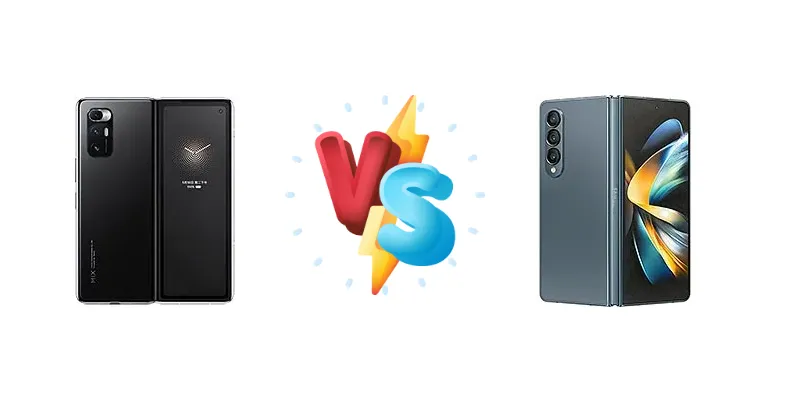
|
🏆 Quick Verdict
The Samsung Galaxy Z Fold4 edges out the Mi Mix Fold thanks to its superior software support, refined design, and more powerful Snapdragon 8+ Gen 1 chip. While the Mi Mix Fold boasts faster charging, the Z Fold4’s overall package is more polished and reliable.
| PHONES | ||
|---|---|---|
| Phone Names | Xiaomi Mi Mix Fold | Samsung Galaxy Z Fold4 |
| Network | ||
|---|---|---|
| 2G bands | GSM 850 / 900 / 1800 / 1900 | GSM 850 / 900 / 1800 / 1900 |
| 3G bands | HSDPA 850 / 900 / 1700(AWS) / 1900 / 2100 | HSDPA 850 / 900 / 1700(AWS) / 1900 / 2100 |
| 4G bands | 1, 2, 3, 4, 5, 7, 8, 12, 17, 18, 19, 20, 26, 28, 34, 38, 39, 40, 41, 42 | 1, 2, 3, 4, 5, 7, 8, 12, 13, 17, 18, 19, 20, 25, 26, 28, 32, 38, 39, 40, 41, 66 - International |
| 5G bands | 1, 3, 28, 41, 77, 78, 79 SA/NSA | 1, 2, 3, 5, 7, 8, 12, 20, 25, 28, 38, 40, 41, 66, 75, 77, 78 SA/NSA/Sub6 - International |
| Speed | HSPA, LTE, 5G | HSPA 42.2/5.76 Mbps, LTE (7CA) Cat20 2000/200 Mbps, 5G |
| Technology | GSM / CDMA / HSPA / EVDO / LTE / 5G | GSM / CDMA / HSPA / EVDO / LTE / 5G |
| CDMA2000 1xEV-DO | CDMA2000 1xEV-DO | |
| Launch | ||
|---|---|---|
| Announced | 2021, March | 2022, August 10 |
| Status | Available. Released 2021, April 16 | Available. Released 2022, August 25 |
| Body | ||
|---|---|---|
| Build | Glass front (folded), plastic front (unfolded), glass back (Gorilla Glass 5) or ceramic back, aluminum frame | Glass front (Gorilla Glass Victus+) (folded), plastic front (unfolded), glass back (Gorilla Glass Victus+), aluminum frame |
| Dimensions | Unfolded: 173.3 x 133.4 x 7.6 mm Folded: 173.3 x 69.8 x 17.2 mm | Unfolded: 155.1 x 130.1 x 6.3 mmFolded: 155.1 x 67.1 x 14.2-15.8 mm |
| SIM | Nano-SIM + Nano-SIM | · Nano-SIM + eSIM· Nano-SIM + Nano-SIM + eSIM (max 2 at a time) |
| Weight | 317 g (Glass)332 g (Ceramic) (11.18 oz) | 263 g (9.28 oz) |
| - | IPX8 water resistant (up to 1.5m for 30 min) Armor aluminum frame with tougher drop and scratch resistance (advertised) Stylus support | |
| Display | ||
|---|---|---|
| Resolution | 1860 x 2480 pixels, 4:3 ratio (~387 ppi density) | 1812 x 2176 pixels (~373 ppi density) |
| Size | 8.01 inches, 198.7 cm2 (~85.9% screen-to-body ratio) | 7.6 inches, 183.2 cm2 (~90.9% screen-to-body ratio) |
| Type | Foldable AMOLED, 1B colors, HDR10+, Dolby Vision, 600 nits (typ), 900 nits (peak) | Foldable Dynamic AMOLED 2X, 120Hz, HDR10+, 1200 nits (peak) |
| Cover display: AMOLED, 90Hz, HDR10+, Dolby Vision, 650 nits (typ), 900 nits (peak) 6.52 inches, 840 x 2520 pixels, 27:9 ratio | Cover display: Dynamic AMOLED 2X, 120Hz, Corning Gorilla Glass Victus+ 6.2 inches, 904 x 2316 pixels, 23.1:9 ratio | |
| Platform | ||
|---|---|---|
| CPU | Octa-core (1x2.84 GHz Cortex-X1 & 3x2.42 GHz Cortex-A78 & 4x1.80 GHz Cortex-A55) | Octa-core (1x3.19 GHz Cortex-X2 & 3x2.75 GHz Cortex-A710 & 4x1.80 GHz Cortex-A510) |
| Chipset | Qualcomm SM8350 Snapdragon 888 5G (5 nm) | Qualcomm SM8475 Snapdragon 8+ Gen 1 (4 nm) |
| GPU | Adreno 660 | Adreno 730 |
| OS | Android 10, MIUI 12 | Android 12L, up to 4 major Android upgrades, One UI 6.1.1 |
| Memory | ||
|---|---|---|
| Card slot | No | No |
| Internal | 256GB 12GB RAM, 512GB 12GB RAM, 512GB 16GB RAM | 256GB 12GB RAM, 512GB 12GB RAM, 1TB 12GB RAM |
| UFS 3.1 | UFS 3.1 | |
| Main Camera | ||
|---|---|---|
| Features | Color spectrum sensor, Dual-LED flash, HDR, panorama | LED flash, HDR, panorama |
| Single | 20 MP, 27mm (wide), 1/3.4", 0.8µm | - |
| Triple | 108 MP, f/1.8, (wide), 1/1.52", 0.7µm, PDAF 8 MP, 80mm (telephoto/macro), liquid lens, PDAF, 3x optical zoom 13 MP, f/2.4, 123˚ (ultrawide), 1.12µm | 50 MP, f/1.8, 23mm (wide), 1/1.56", 1.0µm, dual pixel PDAF, OIS 10 MP, f/2.4, 66mm (telephoto), 1/3.94", 1.0µm, PDAF, OIS, 3x optical zoom 12 MP, f/2.2, 12mm, 123˚ (ultrawide), 1/3.06", 1.12µm |
| Video | 8K@24/30fps, 4K@30/60fps, 1080p@30/60fps, gyro-EIS | 8K@24fps, 4K@60fps, 1080p@60/240fps (gyro-EIS), HDR10+ |
| Selfie camera | ||
|---|---|---|
| Features | HDR, panorama | HDR |
| Single | 20 MP, (wide) | 4 MP, f/1.8, 26mm (wide), 1/3.0", 2.0µm, under display Cover camera: 10 MP, f/2.2, 24mm (wide), 1/3.0", 1.22µm |
| Video | 1080p@30/60fps, 720p@120fps | 4K@30/60fps, 1080p@30/60fps, gyro-EIS |
| Sound | ||
|---|---|---|
| 3.5mm jack | No | No |
| 35mm jack | No | No |
| Loudspeaker | Yes, with stereo speakers (4 speakers) | Yes, with stereo speakers |
| 24-bit/192kHz audio Tuned by Harman Kardon | 32-bit/384kHz audio Tuned by AKG | |
| Comms | ||
|---|---|---|
| Bluetooth | 5.2, A2DP, LE, aptX HD, aptX Adaptive | 5.2, A2DP, LE, aptX HD |
| Infrared port | Yes | - |
| NFC | Yes | Yes |
| Positioning | GPS (L1+L5), GLONASS (L1), BDS (B1I+B1c+B2a), GALILEO (E1+E5a), QZSS (L1+L5), NavIC (L5) | GPS, GLONASS, GALILEO, BDS |
| Radio | No | No |
| USB | USB Type-C | USB Type-C 3.2, OTG |
| WLAN | Wi-Fi 802.11 a/b/g/n/ac/6e, dual-band, Wi-Fi Direct | Wi-Fi 802.11 a/b/g/n/ac/6e, dual-band, Wi-Fi Direct |
| Features | ||
|---|---|---|
| Sensors | Fingerprint (side-mounted), accelerometer, gyro, proximity, compass, barometer | Fingerprint (side-mounted), accelerometer, gyro, proximity, compass, barometer |
| - | Bixby natural language commands and dictation Samsung DeX (desktop experience support) Samsung Pay (Visa, MasterCard certified) Ultra Wideband (UWB) support | |
| Battery | ||
|---|---|---|
| Charging | 67W wired, PD3.0, QC4, 100% in 37 min | 25W wired, 50% in 30 min 15W wireless 4.5W reverse wireless |
| Type | Li-Po 5020 mAh | Li-Po 4400 mAh |
| Misc | ||
|---|---|---|
| Colors | Black, Ceramic | Graygreen, Phantom Black, Beige, Burgundy |
| Models | M2011J18C | SM-F936B, SM-F936B/DS, SM-F936U, SM-F936U1, SM-F936N, SM-F936W, SM-F9360 |
| Price | About 1300 EUR | $ 457.00 / € 511.80 / £ 485.00 / ₹ 73,899 |
| SAR | - | 0.96 W/kg (head) 0.92 W/kg (body) |
| SAR EU | - | 1.30 W/kg (head) 1.51 W/kg (body) |
| Tests | ||
|---|---|---|
| Battery life | - | Endurance rating 101h |
| Camera | - | Photo / Video |
| Display | - | Contrast ratio: Infinite (nominal) |
| Loudspeaker | - | -28.3 LUFS (Average) |
| Performance | - | AnTuTu: 964530 (v9) GeekBench: 3981 (v5.1) GFXBench: 43fps (ES 3.1 onscreen) |
Xiaomi Mi Mix Fold
- Larger unfolded display
- Faster charging (67W)
- Competitive price (typically)
- Unique design
- Less refined software
- Older chipset (Snapdragon 888)
- Durability concerns (compared to Z Fold4)
- Camera performance not as strong
Samsung Galaxy Z Fold4
- More powerful chipset (Snapdragon 8+ Gen 1)
- Brighter and more vibrant display
- Superior camera system
- Refined software and ecosystem
- Improved durability
- Slower charging (25W)
- Higher price
- Smaller unfolded display (compared to Mi Mix Fold)
Display Comparison
The Mi Mix Fold features a larger 8.01-inch unfolded display, offering more screen real estate for multitasking and media consumption. However, the Z Fold4’s 7.6-inch display boasts a brighter 1000 nits peak brightness and a near-infinite contrast ratio, resulting in a more vibrant and immersive viewing experience. Samsung's display also has a more refined hinge mechanism.
Camera Comparison
While both phones offer capable camera systems, the Galaxy Z Fold4 generally produces better image quality, particularly in challenging lighting conditions. Samsung's image processing is more consistent and refined. The Z Fold4 also benefits from improved video recording capabilities.
Performance
The Galaxy Z Fold4’s Snapdragon 8+ Gen 1 provides a noticeable performance boost over the Mi Mix Fold’s Snapdragon 888. Expect smoother multitasking, faster app loading times, and better gaming performance on the Z Fold4. Both phones handle everyday tasks with ease.
Battery Life
Both phones offer all-day battery life, with the Z Fold4 having a slight edge due to software optimization. The Mi Mix Fold’s 67W charging is significantly faster than the Z Fold4’s 25W wired charging, allowing for quicker top-ups.
Buying Guide
The Xiaomi Mi Mix Fold is ideal for users prioritizing a wider unfolded display and faster charging, and who are comfortable with a less mature foldable ecosystem. The Samsung Galaxy Z Fold4 is best for those seeking a more refined, durable, and feature-rich foldable experience with excellent software support and a strong camera system.