
Xiaomi Mi Mix Fold vs. Huawei Mate X3: Which Foldable Phone Wins?
| Phones Images | |||||
|---|---|---|---|---|---|
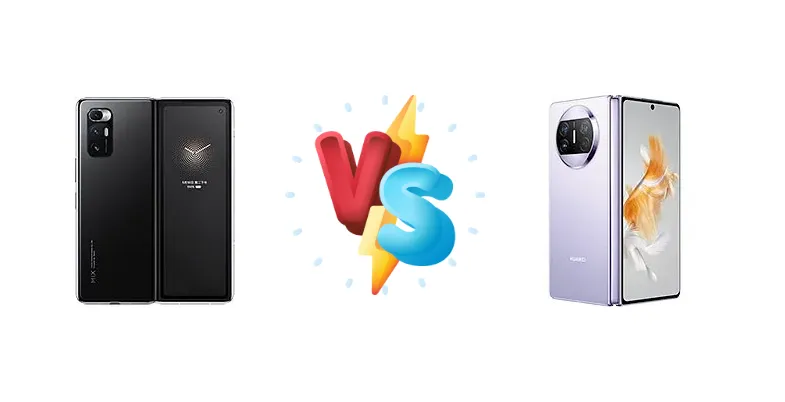
|
🏆 Quick Verdict
For most users, the Huawei Mate X3 emerges as the superior choice. Its Snapdragon 8+ Gen 1 4G chipset delivers noticeably improved performance and thermal management compared to the Mi Mix Fold’s Snapdragon 888, coupled with comparable battery life and a brighter display. However, the Mi Mix Fold may appeal to those seeking a potentially lower price point.
| PHONES | ||
|---|---|---|
| Phone Names | Xiaomi Mi Mix Fold | Huawei Mate X3 |
| Network | ||
|---|---|---|
| 2G bands | GSM 850 / 900 / 1800 / 1900 | GSM 850 / 900 / 1800 / 1900 |
| 3G bands | HSDPA 850 / 900 / 1700(AWS) / 1900 / 2100 | HSDPA 800 / 850 / 900 / 1700(AWS) / 1900 / 2100 |
| 4G bands | 1, 2, 3, 4, 5, 7, 8, 12, 17, 18, 19, 20, 26, 28, 34, 38, 39, 40, 41, 42 | 1, 2, 3, 4, 5, 7, 8, 12, 17, 18, 19, 20, 26, 28, 34, 38, 39, 40, 41 |
| 5G bands | 1, 3, 28, 41, 77, 78, 79 SA/NSA | - |
| Speed | HSPA, LTE, 5G | HSPA, LTE |
| Technology | GSM / CDMA / HSPA / EVDO / LTE / 5G | GSM / CDMA / HSPA / EVDO / LTE |
| CDMA2000 1xEV-DO | CDMA2000 1xEV-DO | |
| Launch | ||
|---|---|---|
| Announced | 2021, March | 2023, March 23 |
| Status | Available. Released 2021, April 16 | Available. Released 2023, April 08 |
| Body | ||
|---|---|---|
| Build | Glass front (folded), plastic front (unfolded), glass back (Gorilla Glass 5) or ceramic back, aluminum frame | Glass front, glass back or eco leather back, aluminum frame |
| Dimensions | Unfolded: 173.3 x 133.4 x 7.6 mm Folded: 173.3 x 69.8 x 17.2 mm | Unfolded: 156.9 x 141.5 x 5.3 mmFolded: 156.9 x 72.4 x 11.1 mm |
| SIM | Nano-SIM + Nano-SIM | Nano-SIM + Nano-SIM |
| Weight | 317 g (Glass)332 g (Ceramic) (11.18 oz) | 239 g or 241 g (8.43 oz) |
| - | IPX8 dust/water resistant (up to 1.5m for 30 min) | |
| Display | ||
|---|---|---|
| Protection | - | Kunlun Glass (cover display only) |
| Resolution | 1860 x 2480 pixels, 4:3 ratio (~387 ppi density) | 2224 x 2496 pixels (~426 ppi density) |
| Size | 8.01 inches, 198.7 cm2 (~85.9% screen-to-body ratio) | 7.85 inches, 197.5 cm2 (~88.9% screen-to-body ratio) |
| Type | Foldable AMOLED, 1B colors, HDR10+, Dolby Vision, 600 nits (typ), 900 nits (peak) | Foldable OLED, 1B colors, 120Hz |
| Cover display: AMOLED, 90Hz, HDR10+, Dolby Vision, 650 nits (typ), 900 nits (peak) 6.52 inches, 840 x 2520 pixels, 27:9 ratio | Cover display: OLED, 120Hz, 6.4 inches, 1080 x 2504 pixels | |
| Platform | ||
|---|---|---|
| CPU | Octa-core (1x2.84 GHz Cortex-X1 & 3x2.42 GHz Cortex-A78 & 4x1.80 GHz Cortex-A55) | Octa-core (1x3.19 GHz Cortex-X2 & 3x2.75 GHz Cortex-A710 & 4x2.0 GHz Cortex-A510) |
| Chipset | Qualcomm SM8350 Snapdragon 888 5G (5 nm) | Qualcomm SM8475 Snapdragon 8+ Gen 1 4G (4 nm) |
| GPU | Adreno 660 | Adreno 730 |
| OS | Android 10, MIUI 12 | HarmonyOS 3.1 (China), EMUI 13.1 (Europe), no Google Play Services |
| Memory | ||
|---|---|---|
| Card slot | No | Nano Memory (uses shared SIM slot) |
| Internal | 256GB 12GB RAM, 512GB 12GB RAM, 512GB 16GB RAM | 256GB 12GB RAM, 512GB 12GB RAM, 1TB 12GB RAM |
| UFS 3.1 | UFS | |
| Main Camera | ||
|---|---|---|
| Features | Color spectrum sensor, Dual-LED flash, HDR, panorama | Laser AF, color spectrum sensor, LED flash, panorama, HDR |
| Single | 20 MP, 27mm (wide), 1/3.4", 0.8µm | - |
| Triple | 108 MP, f/1.8, (wide), 1/1.52", 0.7µm, PDAF 8 MP, 80mm (telephoto/macro), liquid lens, PDAF, 3x optical zoom 13 MP, f/2.4, 123˚ (ultrawide), 1.12µm | 50 MP, f/1.8, 23mm (wide), PDAF, OIS 12 MP, f/3.4, 125mm (periscope telephoto), PDAF, OIS, 5x optical zoom 13 MP, f/2.2, 13mm (ultrawide), AF |
| Video | 8K@24/30fps, 4K@30/60fps, 1080p@30/60fps, gyro-EIS | 4K@30/60fps, 1080p@30/60fps, gyro-EIS |
| Selfie camera | ||
|---|---|---|
| Features | HDR, panorama | HDR, panorama |
| Single | 20 MP, (wide) | 8 MP, f/2.4, (wide) Cover camera: 8 MP, f/2.4, (wide) |
| Video | 1080p@30/60fps, 720p@120fps | 4K@30fps, 1080p@30fps |
| Sound | ||
|---|---|---|
| 3.5mm jack | No | No |
| 35mm jack | No | No |
| Loudspeaker | Yes, with stereo speakers (4 speakers) | Yes, with stereo speakers |
| 24-bit/192kHz audio Tuned by Harman Kardon | - | |
| Comms | ||
|---|---|---|
| Bluetooth | 5.2, A2DP, LE, aptX HD, aptX Adaptive | 5.2, A2DP, LE |
| Infrared port | Yes | Yes |
| NFC | Yes | Yes |
| Positioning | GPS (L1+L5), GLONASS (L1), BDS (B1I+B1c+B2a), GALILEO (E1+E5a), QZSS (L1+L5), NavIC (L5) | GPS (L1+L5), GLONASS (B1I+B1c+B2a), BDS (B1I+B1c+B2a), GALILEO (E1+E5a), QZSS (L1+L5), NavIC |
| Radio | No | No |
| USB | USB Type-C | USB Type-C 3.1, DisplayPort 1.2, OTG |
| WLAN | Wi-Fi 802.11 a/b/g/n/ac/6e, dual-band, Wi-Fi Direct | Wi-Fi 802.11 a/b/g/n/ac/6, dual-band, Wi-Fi Direct |
| Features | ||
|---|---|---|
| Sensors | Fingerprint (side-mounted), accelerometer, gyro, proximity, compass, barometer | Fingerprint (side-mounted), accelerometer, gyro, proximity, compass, barometer, altimeter |
| - | BDS Satellite Message | |
| Battery | ||
|---|---|---|
| Charging | 67W wired, PD3.0, QC4, 100% in 37 min | 66W wired 50W wireless 7.5W reverse wireless |
| Type | Li-Po 5020 mAh | Market-dependent versions:· Li-Po 4800 mAh (Global)· Si/C Li-Ion 5060 mAh (China only) |
| Misc | ||
|---|---|---|
| Colors | Black, Ceramic | Black, White, Violet, Dark Green, Gold |
| Models | M2011J18C | ALT-AL00, ALT-L29 |
| Price | About 1300 EUR | About 1500 EUR |
| Tests | ||
|---|---|---|
| Battery life | - | Endurance rating 81h |
| Camera | - | Photo / Video |
| Display | - | Contrast ratio: Infinite (nominal) |
| Loudspeaker | - | -26.3 LUFS (Good) |
| Performance | - | AnTuTu: 993592 (v9) GeekBench: 4283 (v5.5), 4512 (v6) GFXBench: 41fps (ES 3.1 onscreen) |
Xiaomi Mi Mix Fold
- Potentially lower price point
- 67W fast wired charging
- Established foldable design
- Older Snapdragon 888 chipset
- Less efficient power consumption
- Limited charging options (wired only)
Huawei Mate X3
- Superior Snapdragon 8+ Gen 1 4G performance
- Brighter and higher contrast display
- Wireless and reverse wireless charging
- 4G connectivity limitation
- Potentially higher price
- Foldable design complexity
Display Comparison
The Huawei Mate X3 boasts a significantly brighter display, reaching a measured 926 nits, compared to the Mi Mix Fold’s unspecified peak brightness. While both utilize foldable OLED technology, the Mate X3’s higher brightness translates to better outdoor visibility. The Mate X3’s ‘Infinite’ contrast ratio (nominal) suggests superior black levels, enhancing visual fidelity. Details regarding the Mi Mix Fold’s panel technology (LTPO, refresh rate) are missing, making a direct comparison difficult, but the Mate X3’s display clearly holds an advantage in raw performance.
Camera Comparison
Both devices are listed as having Photo/Video capabilities, but specific details are lacking. Without sensor size, aperture, or image processing details, a meaningful comparison is impossible. However, given Huawei’s historical strength in mobile photography, it’s reasonable to assume the Mate X3 benefits from more sophisticated image processing algorithms. The absence of any mention of specific camera features on the Mi Mix Fold suggests a less emphasized camera experience.
Performance
The core difference lies in the chipsets. The Huawei Mate X3’s Snapdragon 8+ Gen 1 4G (4nm) represents a substantial upgrade over the Xiaomi Mi Mix Fold’s Snapdragon 888 (5nm). The 8+ Gen 1’s 4nm process offers improved power efficiency and thermal performance, meaning sustained performance under load will be higher on the Mate X3. The Mate X3’s CPU features a faster Cortex-X2 core (3.19 GHz vs 2.84 GHz) and newer Cortex-A710 cores (2.75 GHz vs 2.42 GHz), resulting in quicker application launches and smoother multitasking. The 4G limitation on the Mate X3 is a significant drawback for some users, but the chipset’s inherent efficiency mitigates some of the impact.
Battery Life
Both devices achieve an endurance rating of 81 hours, indicating comparable battery life despite the Mi Mix Fold’s unspecified battery capacity. However, the Mate X3 offers a more versatile charging solution with 66W wired, 50W wireless, and 7.5W reverse wireless charging, while the Mi Mix Fold is limited to 67W wired charging. The Mate X3’s wireless charging capabilities provide added convenience, and the faster charging speeds (66W vs 67W) combined with the more efficient chipset contribute to a more streamlined user experience. The Mi Mix Fold reaches 100% charge in 37 minutes, while the Mate X3’s charging time is not specified, but is likely comparable.
Buying Guide
Buy the Xiaomi Mi Mix Fold if you prioritize a potentially lower entry cost into the foldable market and are comfortable with a slightly older chipset. Buy the Huawei Mate X3 if you demand the best possible performance in a foldable form factor, appreciate a brighter and more vibrant display, and value the added convenience of wireless charging. The Mate X3 is geared towards power users and those who want a premium experience.