
Xiaomi Mi Mix Fold vs Honor Magic V2 RSR Porsche Design: A Generational Leap?
| Phones Images | |||||
|---|---|---|---|---|---|
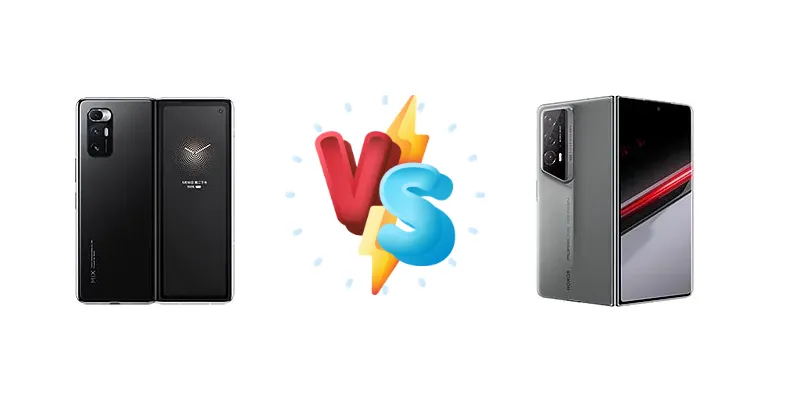
|
🏆 Quick Verdict
For most users, the Honor Magic V2 RSR Porsche Design is the superior choice. The Snapdragon 8 Gen 2 provides a substantial performance boost and improved efficiency over the Mi Mix Fold’s Snapdragon 888, translating to smoother multitasking and gaming. While the Mi Mix Fold offers a compelling value proposition, the Magic V2’s advancements justify the higher price for power users.
| PHONES | ||
|---|---|---|
| Phone Names | Xiaomi Mi Mix Fold | Honor Magic V2 RSR Porsche Design |
| Network | ||
|---|---|---|
| 2G bands | GSM 850 / 900 / 1800 / 1900 | GSM 850 / 900 / 1800 / 1900 |
| 3G bands | HSDPA 850 / 900 / 1700(AWS) / 1900 / 2100 | HSDPA 800 / 850 / 900 / 1700(AWS) / 1900 / 2100 |
| 4G bands | 1, 2, 3, 4, 5, 7, 8, 12, 17, 18, 19, 20, 26, 28, 34, 38, 39, 40, 41, 42 | 1, 2, 3, 4, 5, 7, 8, 12, 17, 18, 19, 20, 26, 28, 34, 38, 39, 40, 41, 66 |
| 5G bands | 1, 3, 28, 41, 77, 78, 79 SA/NSA | 1, 3, 5, 8, 28, 38, 41, 77, 78 SA/NSA |
| Speed | HSPA, LTE, 5G | HSPA, LTE, 5G |
| Technology | GSM / CDMA / HSPA / EVDO / LTE / 5G | GSM / CDMA / HSPA / CDMA2000 / LTE / 5G |
| CDMA2000 1xEV-DO | - | |
| Launch | ||
|---|---|---|
| Announced | 2021, March | 2024, January 11 |
| Status | Available. Released 2021, April 16 | Available. Released 2024, January 12 |
| Body | ||
|---|---|---|
| Build | Glass front (folded), plastic front (unfolded), glass back (Gorilla Glass 5) or ceramic back, aluminum frame | Glass front, glass back, magnesium alloy frame, titanium alloy folding mechanism |
| Dimensions | Unfolded: 173.3 x 133.4 x 7.6 mm Folded: 173.3 x 69.8 x 17.2 mm | Unfolded: 156.7 x 145.4 x 4.7 mm or 4.8 mmFolded: 156.7 x 74 x 9.9 mm or 10.1 mm |
| SIM | Nano-SIM + Nano-SIM | · Nano-SIM + eSIM· Nano-SIM + Nano-SIM |
| Weight | 317 g (Glass)332 g (Ceramic) (11.18 oz) | 234 g (8.25 oz) |
| Display | ||
|---|---|---|
| Resolution | 1860 x 2480 pixels, 4:3 ratio (~387 ppi density) | 2156 x 2344 pixels (~402 ppi density) |
| Size | 8.01 inches, 198.7 cm2 (~85.9% screen-to-body ratio) | 7.92 inches, 201.6 cm2 (~88.5% screen-to-body ratio) |
| Type | Foldable AMOLED, 1B colors, HDR10+, Dolby Vision, 600 nits (typ), 900 nits (peak) | Foldable LTPO OLED, 1B colors, 120Hz, HDR10+, 1600 nits (peak) |
| Cover display: AMOLED, 90Hz, HDR10+, Dolby Vision, 650 nits (typ), 900 nits (peak) 6.52 inches, 840 x 2520 pixels, 27:9 ratio | - | |
| Platform | ||
|---|---|---|
| CPU | Octa-core (1x2.84 GHz Cortex-X1 & 3x2.42 GHz Cortex-A78 & 4x1.80 GHz Cortex-A55) | Octa-core (1x3.36 GHz Cortex-X3 & 2x2.8 GHz Cortex-A715 & 2x2.8 GHz Cortex-A710 & 3x2.0 GHz Cortex-A510) |
| Chipset | Qualcomm SM8350 Snapdragon 888 5G (5 nm) | Qualcomm SM8550-AC Snapdragon 8 Gen 2 (4 nm) |
| GPU | Adreno 660 | Adreno 740 |
| OS | Android 10, MIUI 12 | Android 13, upgradable to Android 14, MagicOS 8 |
| Memory | ||
|---|---|---|
| Card slot | No | No |
| Internal | 256GB 12GB RAM, 512GB 12GB RAM, 512GB 16GB RAM | 1TB 16GB RAM |
| UFS 3.1 | - | |
| Main Camera | ||
|---|---|---|
| Features | Color spectrum sensor, Dual-LED flash, HDR, panorama | Multi-zone Laser AF (8x8 dToF), color spectrum sensor, LED flash, HDR, panorama |
| Single | 20 MP, 27mm (wide), 1/3.4", 0.8µm | - |
| Triple | 108 MP, f/1.8, (wide), 1/1.52", 0.7µm, PDAF 8 MP, 80mm (telephoto/macro), liquid lens, PDAF, 3x optical zoom 13 MP, f/2.4, 123˚ (ultrawide), 1.12µm | 50 MP, f/1.9, (wide), PDAF, OIS 20 MP, f/2.4, 62mm (telephoto), PDAF, 2.5x optical zoom, OIS 50 MP, f/2.0, 13mm (ultrawide), AF |
| Video | 8K@24/30fps, 4K@30/60fps, 1080p@30/60fps, gyro-EIS | 4K@30/60fps (10-bit), 1080p@30/60fps, gyro-EIS, HDR10+, OIS |
| Selfie camera | ||
|---|---|---|
| Features | HDR, panorama | HDR |
| Single | 20 MP, (wide) | 16 MP, f/2.2, (wide) |
| Video | 1080p@30/60fps, 720p@120fps | 4K@30fps, 1080p@30fps, gyro-EIS |
| Sound | ||
|---|---|---|
| 3.5mm jack | No | - |
| 35mm jack | No | No |
| Loudspeaker | Yes, with stereo speakers (4 speakers) | Yes, with stereo speakers |
| 24-bit/192kHz audio Tuned by Harman Kardon | - | |
| Comms | ||
|---|---|---|
| Bluetooth | 5.2, A2DP, LE, aptX HD, aptX Adaptive | 5.3, A2DP, LE, aptX HD |
| Infrared port | Yes | Yes |
| NFC | Yes | Yes |
| Positioning | GPS (L1+L5), GLONASS (L1), BDS (B1I+B1c+B2a), GALILEO (E1+E5a), QZSS (L1+L5), NavIC (L5) | GPS (L1+L5), GLONASS (L1), BDS (B1I+B1c+B2a), GALILEO (E1+E5a), QZSS (L1+L5) |
| Radio | No | No |
| USB | USB Type-C | USB Type-C 3.1, OTG, Display Port 1.2 |
| WLAN | Wi-Fi 802.11 a/b/g/n/ac/6e, dual-band, Wi-Fi Direct | Wi-Fi 802.11 a/b/g/n/ac/6e/7, dual-band, Wi-Fi Direct |
| Features | ||
|---|---|---|
| Sensors | Fingerprint (side-mounted), accelerometer, gyro, proximity, compass, barometer | Fingerprint (side-mounted), accelerometer, gyro, proximity, compass |
| Battery | ||
|---|---|---|
| Charging | 67W wired, PD3.0, QC4, 100% in 37 min | 66W wired 5W reverse wired |
| Type | Li-Po 5020 mAh | Si/C Li-Ion 5000 mAh |
| Misc | ||
|---|---|---|
| Colors | Black, Ceramic | Agate Gray |
| Models | M2011J18C | VER-AN10 |
| Price | About 1300 EUR | About 2700 EUR |
Xiaomi Mi Mix Fold
- More affordable price point
- Potentially larger display area
- Established foldable design
- Older Snapdragon 888 chipset
- Less efficient power consumption
- Potentially slower software updates
Honor Magic V2 RSR Porsche Design
- Flagship Snapdragon 8 Gen 2 performance
- Superior power efficiency
- Porsche Design aesthetics and build quality
- Higher price tag
- May have a smaller usable display area
- Premium branding may not appeal to all
Display Comparison
While both devices feature foldable displays, specifics beyond resolution are unavailable. However, the Magic V2 RSR likely benefits from advancements in panel technology and hinge design, resulting in a less noticeable crease. The Snapdragon 8 Gen 2’s improved ISP could also contribute to more accurate color reproduction. The Mi Mix Fold, utilizing an older generation panel, may exhibit slightly lower peak brightness and less efficient power consumption when displaying content.
Camera Comparison
Without detailed camera specs, a direct comparison is limited. However, the Snapdragon 8 Gen 2’s improved image signal processor (ISP) in the Magic V2 RSR will deliver superior image processing capabilities. Expect better dynamic range, noise reduction, and overall image quality, particularly in challenging lighting conditions. The Mi Mix Fold’s camera system, while capable, is constrained by the older chipset’s processing limitations. The Porsche Design branding suggests a focus on camera quality in the Magic V2, potentially including larger sensors and more advanced features.
Performance
The core difference lies in the chipsets. The Honor Magic V2 RSR boasts the Snapdragon 8 Gen 2 (4nm), a significant upgrade over the Mi Mix Fold’s Snapdragon 888 (5nm). The Gen 2’s Cortex-X3 prime core, clocked at 3.36 GHz, offers a substantial IPC (Instructions Per Clock) improvement over the X1 in the 888. Furthermore, the newer architecture (Cortex-A715/A710 vs A78/A55) and the 4nm process node translate to better thermal efficiency, meaning the Magic V2 RSR will sustain peak performance for longer periods without throttling. This benefits demanding tasks like gaming and video editing.
Battery Life
Both devices offer 66-67W wired charging, achieving a full charge in roughly the same timeframe (around 37 minutes for the Mi Mix Fold). However, the Snapdragon 8 Gen 2’s superior power efficiency in the Magic V2 RSR means it will likely deliver longer real-world battery life despite potentially having a similar battery capacity. The 5W reverse wired charging on the Magic V2 RSR is a convenient addition for topping up accessories, a feature absent on the Mi Mix Fold.
Buying Guide
Buy the Xiaomi Mi Mix Fold if you prioritize affordability and a larger screen real estate without breaking the bank. It’s ideal for media consumption and productivity tasks where raw processing power isn’t critical. Buy the Honor Magic V2 RSR Porsche Design if you demand flagship-level performance, cutting-edge efficiency, and a refined design. This is the foldable for gamers, power users, and those who want the best possible foldable experience.