
Xiaomi Mi Mix Fold vs Google Pixel Fold: A Head-to-Head Foldable Showdown
| Phones Images | |||||
|---|---|---|---|---|---|
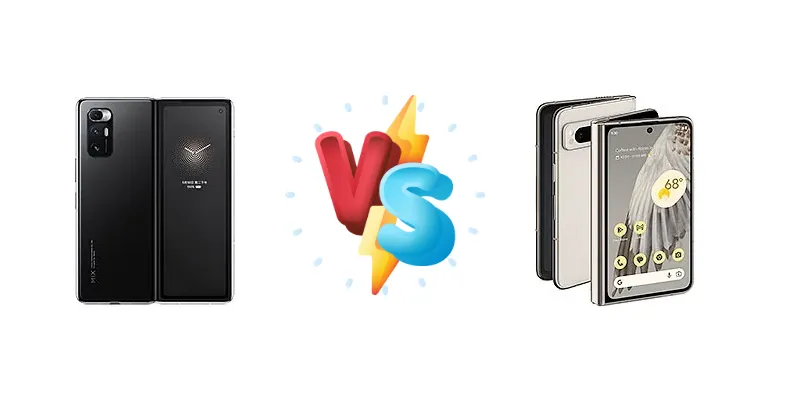
|
🏆 Quick Verdict
For users prioritizing raw performance and faster charging, the Xiaomi Mi Mix Fold offers a compelling package. However, the Google Pixel Fold’s Tensor G2 chip and Google’s software optimizations provide a smoother, more integrated experience, making it the better choice for the average user.
| PHONES | ||
|---|---|---|
| Phone Names | Xiaomi Mi Mix Fold | Google Pixel Fold |
| Network | ||
|---|---|---|
| 2G bands | GSM 850 / 900 / 1800 / 1900 | GSM 850 / 900 / 1800 / 1900 |
| 3G bands | HSDPA 850 / 900 / 1700(AWS) / 1900 / 2100 | HSDPA 800 / 850 / 900 / 1700(AWS) / 1900 / 2100 |
| 4G bands | 1, 2, 3, 4, 5, 7, 8, 12, 17, 18, 19, 20, 26, 28, 34, 38, 39, 40, 41, 42 | 1, 2, 3, 4, 5, 7, 8, 12, 13, 14, 17, 18, 19, 20, 21, 25, 26, 28, 29, 30, 32, 38, 39, 40, 41, 42, 46, 48, 66, 71 |
| 5G bands | 1, 3, 28, 41, 77, 78, 79 SA/NSA | 1, 2, 3, 5, 7, 8, 12, 14, 20, 25, 28, 30, 38, 40, 41, 48, 66, 71, 75, 76, 77, 78, 79, 257, 258, 260, 261 SA/NSA/Sub6/mmWave |
| Speed | HSPA, LTE, 5G | HSPA, LTE, 5G |
| Technology | GSM / CDMA / HSPA / EVDO / LTE / 5G | GSM / CDMA / HSPA / EVDO / LTE / 5G |
| CDMA2000 1xEV-DO | CDMA2000 1xEV-DO | |
| Launch | ||
|---|---|---|
| Announced | 2021, March | 2023, May 10 |
| Status | Available. Released 2021, April 16 | Available. Released 2023, June 27 |
| Body | ||
|---|---|---|
| Build | Glass front (folded), plastic front (unfolded), glass back (Gorilla Glass 5) or ceramic back, aluminum frame | Glass front (Gorilla Glass Victus) (folded), plastic front (unfolded), glass back (Gorilla Glass Victus), aluminum frame |
| Dimensions | Unfolded: 173.3 x 133.4 x 7.6 mm Folded: 173.3 x 69.8 x 17.2 mm | Unfolded: 139.7 x 158.7 x 5.8 mmFolded: 139.7 x 79.5 x 12.1 mm |
| SIM | Nano-SIM + Nano-SIM | Nano-SIM + eSIM |
| Weight | 317 g (Glass)332 g (Ceramic) (11.18 oz) | 283 g (9.98 oz) |
| - | IPX8 water resistant | |
| Display | ||
|---|---|---|
| Resolution | 1860 x 2480 pixels, 4:3 ratio (~387 ppi density) | 1840 x 2208 pixels (~378 ppi density) |
| Size | 8.01 inches, 198.7 cm2 (~85.9% screen-to-body ratio) | 7.6 inches, 183.3 cm2 (~82.7% screen-to-body ratio) |
| Type | Foldable AMOLED, 1B colors, HDR10+, Dolby Vision, 600 nits (typ), 900 nits (peak) | Foldable OLED, 120Hz, HDR10+, 1000 nits (HBM), 1450 nits (peak) |
| Cover display: AMOLED, 90Hz, HDR10+, Dolby Vision, 650 nits (typ), 900 nits (peak) 6.52 inches, 840 x 2520 pixels, 27:9 ratio | Cover display: OLED, 120Hz, HDR, Corning Gorilla Glass Victus 5.8 inches, 1080 x 2092 pixels, 17.4:9 ratio, 408 ppi 1200 nits (HBM), 1550 nits (peak) | |
| Platform | ||
|---|---|---|
| CPU | Octa-core (1x2.84 GHz Cortex-X1 & 3x2.42 GHz Cortex-A78 & 4x1.80 GHz Cortex-A55) | Octa-core (2x2.85 GHz Cortex-X1 & 2x2.35 GHz Cortex-A78 & 4x1.80 GHz Cortex-A55) |
| Chipset | Qualcomm SM8350 Snapdragon 888 5G (5 nm) | Google Tensor G2 (5 nm) |
| GPU | Adreno 660 | Mali-G710 MP7 |
| OS | Android 10, MIUI 12 | Android 13, upgradable to Android 15, up to 5 major Android upgrades |
| Memory | ||
|---|---|---|
| Card slot | No | No |
| Internal | 256GB 12GB RAM, 512GB 12GB RAM, 512GB 16GB RAM | 256GB 12GB RAM, 512GB 12GB RAM |
| UFS 3.1 | UFS 3.1 | |
| Main Camera | ||
|---|---|---|
| Features | Color spectrum sensor, Dual-LED flash, HDR, panorama | Laser AF, Dual-LED flash, HDR, panorama |
| Single | 20 MP, 27mm (wide), 1/3.4", 0.8µm | - |
| Triple | 108 MP, f/1.8, (wide), 1/1.52", 0.7µm, PDAF 8 MP, 80mm (telephoto/macro), liquid lens, PDAF, 3x optical zoom 13 MP, f/2.4, 123˚ (ultrawide), 1.12µm | 48 MP, f/1.7, 25mm (wide), 1/2.0", 0.8µm, dual pixel PDAF, OIS 10.8 MP, f/3.1, 112mm (telephoto), 1/3.1", 1.22µm, dual pixel PDAF, OIS, 5x optical zoom 10.8 MP, f/2.2, 121˚, (ultrawide), 1/3.0", 1.25µm |
| Video | 8K@24/30fps, 4K@30/60fps, 1080p@30/60fps, gyro-EIS | 4K@30/60fps, 1080p@30/60/120/240fps, 10-bit HDR |
| Selfie camera | ||
|---|---|---|
| Features | HDR, panorama | HDR, panorama |
| Single | 20 MP, (wide) | 8 MP, f/2.0, 24mm (wide), 1/4.0", 1.12µm Cover camera: 9.5 MP, f/2.2, 24mm (wide), 1.22µm, dual pixel PDAF |
| Video | 1080p@30/60fps, 720p@120fps | 4K@30/60fps, 1080p@30/60fps |
| Sound | ||
|---|---|---|
| 3.5mm jack | No | No |
| 35mm jack | No | No |
| Loudspeaker | Yes, with stereo speakers (4 speakers) | Yes, with stereo speakers |
| 24-bit/192kHz audio Tuned by Harman Kardon | - | |
| Comms | ||
|---|---|---|
| Bluetooth | 5.2, A2DP, LE, aptX HD, aptX Adaptive | 5.2, A2DP, LE, aptX HD |
| Infrared port | Yes | - |
| NFC | Yes | Yes |
| Positioning | GPS (L1+L5), GLONASS (L1), BDS (B1I+B1c+B2a), GALILEO (E1+E5a), QZSS (L1+L5), NavIC (L5) | GPS, GLONASS, GALILEO, BDS |
| Radio | No | No |
| USB | USB Type-C | USB Type-C 3.2, OTG |
| WLAN | Wi-Fi 802.11 a/b/g/n/ac/6e, dual-band, Wi-Fi Direct | Wi-Fi 802.11 a/b/g/n/ac/6e, tri-band, Wi-Fi Direct |
| Features | ||
|---|---|---|
| Sensors | Fingerprint (side-mounted), accelerometer, gyro, proximity, compass, barometer | Fingerprint (side-mounted), accelerometer, gyro, proximity, compass, barometer |
| - | Ultra Wideband (UWB) support | |
| Battery | ||
|---|---|---|
| Charging | 67W wired, PD3.0, QC4, 100% in 37 min | Wired, PD3.0 Wireless |
| Type | Li-Po 5020 mAh | Li-Po 4821 mAh |
| Misc | ||
|---|---|---|
| Colors | Black, Ceramic | Porcelain, Obsidian |
| Models | M2011J18C | G9FPL |
| Price | About 1300 EUR | € 670.87 / $ 389.26 / £ 899.99 |
Xiaomi Mi Mix Fold
- Significantly faster 67W charging
- Potentially larger display area
- Snapdragon 888 offers strong performance
- Older chipset compared to Tensor G2
- Less optimized software experience
- Potentially less efficient display technology
Google Pixel Fold
- Google Tensor G2 offers AI-powered features
- Seamless software integration with Android
- Long-term software support from Google
- Slower charging speeds
- Potentially less raw processing power in some tasks
- May have a smaller display area
Display Comparison
While specific display specs (resolution, refresh rate) aren't provided, both devices feature foldable OLED panels. The Mi Mix Fold’s larger form factor likely translates to a more immersive viewing experience. However, the Pixel Fold benefits from Google’s display calibration expertise, potentially offering more accurate colors. The absence of LTPO information for the Mi Mix Fold suggests it may not dynamically adjust refresh rates as efficiently as newer foldable displays, impacting battery life during static content viewing.
Camera Comparison
Without detailed camera specs, a direct comparison is challenging. However, Google’s Tensor G2 excels in computational photography, leveraging its AI capabilities for superior image processing. The Mi Mix Fold likely relies more on hardware specifications. Given Google’s track record, the Pixel Fold will likely deliver more consistent and impressive results in challenging lighting conditions. The absence of information regarding sensor sizes makes it difficult to assess low-light performance definitively, but Google’s software prowess is a significant advantage.
Performance
The core difference lies in the chipsets. The Xiaomi Mi Mix Fold utilizes the Qualcomm Snapdragon 888 5G (5nm), while the Google Pixel Fold features the Google Tensor G2 (5nm). Both are octa-core CPUs with a Cortex-X1 prime core, but the Tensor G2’s 2x Cortex-X1 configuration versus the Mi Mix Fold’s 1x suggests a potential advantage in multi-threaded tasks. The Tensor G2 is also optimized for Google’s AI and machine learning features, enhancing camera performance and on-device processing. While the Snapdragon 888 is a capable performer, the Tensor G2’s architecture is more modern and tailored for Google’s software ecosystem.
Battery Life
Battery capacity isn’t specified for either device. However, the Mi Mix Fold’s 67W wired charging is a significant advantage, achieving a full charge in just 37 minutes. The Pixel Fold supports wired and wireless charging, but lacks the Mi Mix Fold’s speed. This means the Mi Mix Fold is more forgiving if you frequently run out of battery, while the Pixel Fold may require more planning around charging schedules. The Tensor G2’s efficiency could partially offset the charging speed difference, but the Mi Mix Fold’s charging capability is a clear win.
Buying Guide
Buy the Xiaomi Mi Mix Fold if you need maximum charging speed (67W) and are comfortable with a slightly older, but still powerful, chipset. It’s ideal for power users who frequently drain their battery and value quick top-ups. Buy the Google Pixel Fold if you prefer a seamless software experience, benefit from Google’s computational photography, and prioritize long-term software support. It’s the better choice for users deeply embedded in the Google ecosystem.