
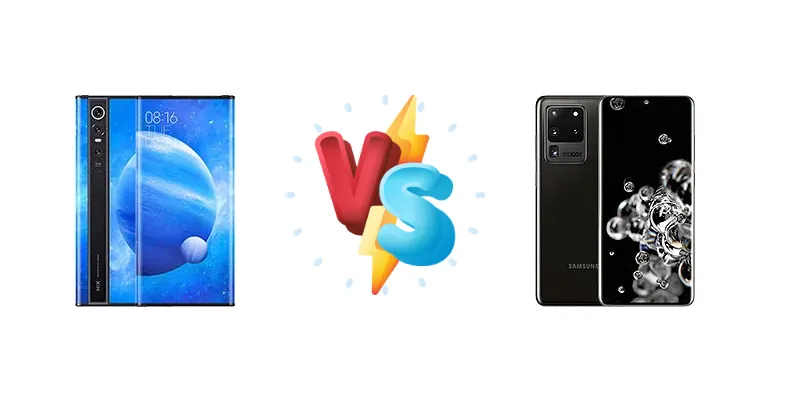
Xiaomi Mi Mix Alpha vs Samsung Galaxy S20 Ultra: A Clash of Innovation and Versatility
| Phones Images | |||||
|---|---|---|---|---|---|
|
🏆 Quick Verdict
For the average user prioritizing a well-rounded experience with a proven track record, the Samsung Galaxy S20 Ultra is the better choice. Its more powerful chipset (Snapdragon 865 variant), superior camera system, and faster charging outweigh the Mi Mix Alpha’s innovative but ultimately impractical design.
| PHONES | ||
|---|---|---|
| Phone Names | Xiaomi Mi Mix Alpha | Samsung Galaxy S20 Ultra |
| Network | ||
|---|---|---|
| 2G bands | GSM 850 / 900 / 1800 / 1900 | GSM 850 / 900 / 1800 / 1900 |
| 3G bands | HSDPA 850 / 900 / 1900 / 2100 | HSDPA 850 / 900 / 1700(AWS) / 1900 / 2100 |
| 4G bands | 1, 2, 3, 4, 5, 7, 8, 34, 38, 39, 40, 41 - China | 1, 2, 3, 4, 5, 7, 8, 12, 13, 17, 18, 19, 20, 25, 26, 28, 32, 38, 39, 40, 41, 66 |
| 5G bands | 41, 78, 79 SA/NSA/Sub6 | - |
| Speed | HSPA 42.2/5.76 Mbps, LTE (7CA) Cat20 2000/150 Mbps, 5G (2+ Gbps DL) | HSPA 42.2/5.76 Mbps, LTE (7CA) Cat20 2000/200 Mbps |
| Technology | GSM / CDMA / HSPA / LTE / 5G | GSM / CDMA / HSPA / EVDO / LTE |
| CDMA 800 & TD-SCDMA | CDMA2000 1xEV-DO | |
| Launch | ||
|---|---|---|
| Announced | 2019, September | 2020, February 11 |
| Status | Cancelled | Available. Released 2020, March 15 |
| Body | ||
|---|---|---|
| Build | Glass front, ceramic/glass back, titanium alloy frame (TC4) | Glass front (Gorilla Glass 6), glass back (Gorilla Glass 6), aluminum frame |
| Dimensions | 154.4 x 72.3 x 10.4 mm (6.08 x 2.85 x 0.41 in) | 166.9 x 76 x 8.8 mm (6.57 x 2.99 x 0.35 in) |
| SIM | Nano-SIM + Nano-SIM | · Nano-SIM + eSIM· Nano-SIM + Nano-SIM |
| Weight | 241 g (8.50 oz) | 220 g (7.76 oz) |
| - | IP68 dust/water resistant (up to 1.5m for 30 min) | |
| Display | ||
|---|---|---|
| Protection | - | Corning Gorilla Glass 6 |
| Resolution | 2088 x 2250 pixels (~388 ppi density) | 1440 x 3200 pixels, 20:9 ratio (~511 ppi density) |
| Size | 7.92 inches, 201.8 cm2 (~180.8% screen-to-body ratio) | 6.9 inches, 114.0 cm2 (~89.9% screen-to-body ratio) |
| Type | Flexible Super AMOLED | Dynamic AMOLED 2X, 120Hz, HDR10+, 1400 nits (peak) |
| - | Always-on display 120Hz@FHD/60Hz@QHD refresh rate | |
| Platform | ||
|---|---|---|
| CPU | Octa-core (1x2.96 GHz Kryo 485 & 3x2.42 GHz Kryo 485 & 4x1.8 GHz Kryo 485) | Octa-core (2x2.73 GHz Mongoose M5 & 2x2.50 GHz Cortex-A76 & 4x2.0 GHz Cortex-A55)Octa-core (1x2.84 GHz Cortex-A77 & 3x2.42 GHz Cortex-A77 & 4x1.80 GHz Cortex-A55) |
| Chipset | Qualcomm SM8150 Snapdragon 855+ (7 nm) | Exynos 990 (7 nm+)Qualcomm SM8250 Snapdragon 865 5G (7 nm+) |
| GPU | Adreno 640 (700 MHz) | Mali-G77 MP11Adreno 650 |
| OS | Android 10, MIUI 11 | Android 10, upgradable to Android 13, One UI 5 |
| Memory | ||
|---|---|---|
| Card slot | No | microSDXC (uses shared SIM slot) |
| Internal | 512GB 12GB RAM | 128GB 12GB RAM, 512GB 16GB RAM |
| UFS 3.0 | UFS 3.0 | |
| Main Camera | ||
|---|---|---|
| Features | Laser AF, Dual-LED flash, HDR, panorama | LED flash, auto-HDR, panorama |
| Triple | 108 MP, f/1.7, (wide), 1/1.33", 0.8µm, PDAF 12 MP, f/2.0, 54mm (telephoto), 1/2.55", 1.4µm, dual pixel PDAF, 2x optical zoom 20 MP, f/2.2, 13mm (ultrawide), 1/2.8", 1.0µm | 108 MP, f/1.8, 26mm (wide), 1/1.33", 0.8µm, PDAF, OIS 48 MP, f/3.5, 103mm (periscope telephoto), 1/2.0", 0.8µm, PDAF, OIS, 4x optical zoom, 10x hybrid zoom 12 MP, f/2.2, 13mm, 120˚ (ultrawide), 1/2.55" 1.4µm, Super Steady video 0.3 MP, TOF 3D, f/1.0, (depth) |
| Video | 6K@30fps, 4K@30/60fps, 1080p@30/120/240fps, 1080p@960fps | 8K@24fps, 4K@30/60fps, 1080p@30/60/240fps, 720p@960fps, HDR10+, stereo sound rec., gyro-EIS & OIS |
| Selfie camera | ||
|---|---|---|
| Features | Dual-LED flash, HDR, panorama | HDR |
| Single | - | 40 MP, f/2.2, 26mm (wide), 1/2.8", 0.7µm, PDAF |
| Triple | No - uses main camera | - |
| Video | 3240p@30fps, 4K@30/60fps, 1080p@30/120/240fps, 1080p@960fps | 4K@30/60fps, 1080p@30fps |
| Sound | ||
|---|---|---|
| 3.5mm jack | No | No |
| 35mm jack | No | No |
| Loudspeaker | Yes | Yes, with stereo speakers |
| - | 32-bit/384kHz audio Tuned by AKG | |
| Comms | ||
|---|---|---|
| Bluetooth | 5.0, A2DP, LE, aptX HD | 5.0, A2DP, LE |
| NFC | No | Yes |
| Positioning | GPS (L1+L5), GLONASS (L1), BDS (B1), GALILEO (E1+E5a) | GPS, GLONASS, BDS, GALILEO |
| Radio | No | FM radio (USA & Canada only) |
| USB | USB Type-C | USB Type-C 3.2, OTG |
| WLAN | Wi-Fi 802.11 a/b/g/n/ac, dual-band, Wi-Fi Direct, DLNA | Wi-Fi 802.11 a/b/g/n/ac/6, dual-band, Wi-Fi Direct |
| Features | ||
|---|---|---|
| Sensors | Fingerprint (under display, optical), accelerometer, gyro, compass, barometer | Fingerprint (under display, ultrasonic), accelerometer, gyro, proximity, compass, barometer |
| Virtual proximity sensing | Samsung DeX, Samsung Wireless DeX (desktop experience support) ANT+ Bixby natural language commands and dictation Samsung Pay (Visa, MasterCard certified) | |
| Battery | ||
|---|---|---|
| Charging | 40W wired | 45W wired, PD3.0 15W wireless (Qi) 4.5W reverse wireless |
| Type | Li-Po 4050 mAh, non-removable | Li-Ion 5000 mAh |
| Misc | ||
|---|---|---|
| Colors | Black | Cosmic Grey, Cosmic Black, Cloud White |
| Models | - | SM-G988B/DS |
| Price | About 2500 EUR | About 690 EUR |
| SAR | - | 0.94 W/kg (head) 0.95 W/kg (body) |
| SAR EU | - | 0.32 W/kg (head) 1.56 W/kg (body) |
Xiaomi Mi Mix Alpha
- Truly innovative wrap-around display
- Unique and eye-catching design
- Powerful Snapdragon 855+ processor
- Fragile and impractical design
- Software issues with accidental touches
- Limited camera versatility
Samsung Galaxy S20 Ultra
- Versatile and high-quality camera system
- Powerful Snapdragon 865 (in some regions)
- Fast charging and wireless charging support
- Exynos 990 variant suffers from throttling
- Large and bulky design
- High price point at launch
Display Comparison
The Mi Mix Alpha’s defining feature is its ‘Surround Screen’ – a display that wraps around the sides of the device, aiming for a 180° visual experience. While visually striking, this design introduces durability concerns and software challenges with accidental touches. The Galaxy S20 Ultra, conversely, features a 6.9-inch Dynamic AMOLED 2X display with a 120Hz refresh rate, offering a smoother and more responsive experience. While lacking the radical design, the S20 Ultra’s display boasts a higher peak brightness and is protected by Gorilla Glass 6, providing superior durability. The S20 Ultra’s 120Hz refresh rate, while potentially impacting battery life, provides a noticeable advantage in scrolling and gaming.
Camera Comparison
The Galaxy S20 Ultra’s camera system is significantly more versatile. Its 108MP main sensor, coupled with a 12MP ultrawide and a 48MP telephoto lens with 10x optical zoom, provides exceptional image quality and zoom capabilities. The Mi Mix Alpha features a 108MP main sensor, but lacks the dedicated telephoto lens and the sophisticated image processing algorithms found in the S20 Ultra. The S20 Ultra’s ‘Single Take’ mode and 8K video recording capabilities further enhance its photographic versatility. While the Mi Mix Alpha can capture detailed images in good lighting, it struggles in low-light conditions and lacks the zoom range of the S20 Ultra. The S20 Ultra’s optical image stabilization (OIS) is also more effective, resulting in sharper images and smoother videos.
Performance
The Galaxy S20 Ultra offered two chipset options: the Exynos 990 and the Qualcomm Snapdragon 865 5G. The Snapdragon 865, built on a 7nm+ process, demonstrably outperforms the Exynos 990 in both CPU and GPU benchmarks, and crucially, thermal management. The Mi Mix Alpha is equipped with the Snapdragon 855+, also a 7nm chip, but a generation behind. The Snapdragon 865’s Cortex-A77 cores offer a significant performance uplift over the Kryo 485 cores in the 855+. While both phones feature ample RAM, the S20 Ultra’s LPDDR5 RAM provides faster data transfer speeds, contributing to a snappier overall experience. The Exynos 990 was known to throttle under sustained load, a problem less prevalent with the Snapdragon 865.
Battery Life
The Galaxy S20 Ultra packs a 5000mAh battery, while the Mi Mix Alpha has a smaller 4000mAh battery. The S20 Ultra also supports 45W wired charging with Power Delivery 3.0, allowing for a faster 0-100% charge time compared to the Mi Mix Alpha’s 40W charging. The S20 Ultra also offers 15W wireless charging and 4.5W reverse wireless charging, features absent in the Mi Mix Alpha. Despite the smaller battery capacity, the S20 Ultra’s more efficient chipset and optimized software contribute to comparable, if not slightly better, real-world battery life.
Buying Guide
Buy the Xiaomi Mi Mix Alpha if you are a technology enthusiast willing to sacrifice practicality for a truly unique and experimental design. Its wrap-around display is a conversation starter, but be prepared for durability concerns and software quirks. Buy the Samsung Galaxy S20 Ultra if you prioritize a reliable, feature-rich flagship with a versatile camera system, powerful performance, and a more conventional, yet refined, user experience.