
Xiaomi Mi Mix Alpha vs. Samsung Galaxy Fold: A Clash of Smartphone Visions
| Phones Images | |||||
|---|---|---|---|---|---|
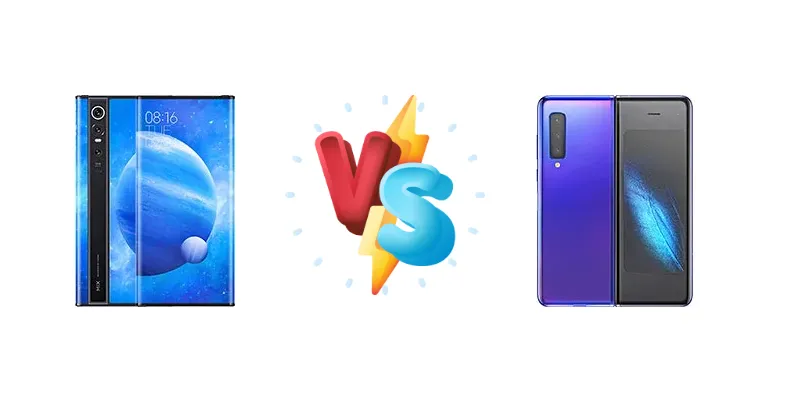
|
🏆 Quick Verdict
For the average user, the Samsung Galaxy Fold is the more practical choice. While the Mi Mix Alpha’s design is undeniably striking, the Fold’s established foldable technology, coupled with its superior battery endurance (90h rating) and more refined software experience, makes it a more reliable daily driver.
| PHONES | ||
|---|---|---|
| Phone Names | Xiaomi Mi Mix Alpha | Samsung Galaxy Fold |
| Network | ||
|---|---|---|
| 2G bands | GSM 850 / 900 / 1800 / 1900 | GSM 850 / 900 / 1800 / 1900 |
| 3G bands | HSDPA 850 / 900 / 1900 / 2100 | HSDPA 850 / 900 / 1700(AWS) / 1900 / 2100 |
| 4G bands | 1, 2, 3, 4, 5, 7, 8, 34, 38, 39, 40, 41 - China | 1, 2, 3, 4, 5, 7, 8, 12, 13, 18, 19, 20, 25, 26, 28, 38, 39, 40, 41, 46, 66, 71 - SM-F900U |
| 5G bands | 41, 78, 79 SA/NSA/Sub6 | - |
| Speed | HSPA 42.2/5.76 Mbps, LTE (7CA) Cat20 2000/150 Mbps, 5G (2+ Gbps DL) | HSPA 42.2/5.76 Mbps, LTE (6CA) Cat18 1200/150 Mbps |
| Technology | GSM / CDMA / HSPA / LTE / 5G | GSM / HSPA / LTE |
| CDMA 800 & TD-SCDMA | HSDPA 850 / 1700(AWS) / 1900 / 2100 - SM-F900U | |
| Launch | ||
|---|---|---|
| Announced | 2019, September | 2019, February. Released 2019, September |
| Status | Cancelled | Discontinued |
| Body | ||
|---|---|---|
| Build | Glass front, ceramic/glass back, titanium alloy frame (TC4) | Glass front (folded), plastic front (unfolded), glass back, aluminum frame |
| Dimensions | 154.4 x 72.3 x 10.4 mm (6.08 x 2.85 x 0.41 in) | Unfolded: 160.9 x 117.9 x 6.9 mm Folded: 160.9 x 62.9 x 15.5 mm |
| SIM | Nano-SIM + Nano-SIM | Nano-SIM + eSIM |
| Weight | 241 g (8.50 oz) | 276 g (9.74 oz) |
| Display | ||
|---|---|---|
| Resolution | 2088 x 2250 pixels (~388 ppi density) | 1536 x 2152 pixels (~362 ppi density) |
| Size | 7.92 inches, 201.8 cm2 (~180.8% screen-to-body ratio) | 7.3 inches, 162.6 cm2 (~85.7% screen-to-body ratio) |
| Type | Flexible Super AMOLED | Foldable Dynamic AMOLED, HDR10+ |
| - | Cover display: Super AMOLED, 4.6 inches, 720 x 1680 pixels, 21:9 ratio | |
| Platform | ||
|---|---|---|
| CPU | Octa-core (1x2.96 GHz Kryo 485 & 3x2.42 GHz Kryo 485 & 4x1.8 GHz Kryo 485) | Octa-core (1x2.84 GHz Kryo 485 & 3x2.42 GHz Kryo 485 & 4x1.78 GHz Kryo 485) |
| Chipset | Qualcomm SM8150 Snapdragon 855+ (7 nm) | Qualcomm SM8150 Snapdragon 855 (7 nm) |
| GPU | Adreno 640 (700 MHz) | Adreno 640 |
| OS | Android 10, MIUI 11 | Android 9.0 (Pie), upgradable to Android 12, One UI 4 |
| Memory | ||
|---|---|---|
| Card slot | No | No |
| Internal | 512GB 12GB RAM | 512GB 12GB RAM |
| UFS 3.0 | UFS 3.0 | |
| Main Camera | ||
|---|---|---|
| Features | Laser AF, Dual-LED flash, HDR, panorama | LED flash, HDR, panorama |
| Triple | 108 MP, f/1.7, (wide), 1/1.33", 0.8µm, PDAF 12 MP, f/2.0, 54mm (telephoto), 1/2.55", 1.4µm, dual pixel PDAF, 2x optical zoom 20 MP, f/2.2, 13mm (ultrawide), 1/2.8", 1.0µm | 12 MP, f/1.5-2.4, 27mm (wide), 1/2.55", 1.4µm, dual pixel PDAF, OIS 12 MP, f/2.4, 52mm (telephoto), 1/3.6", 1.0µm, AF, OIS, 2x optical zoom 16 MP, f/2.2, 12mm (ultrawide), 1/3.1", 1.0µm |
| Video | 6K@30fps, 4K@30/60fps, 1080p@30/120/240fps, 1080p@960fps | 4K@60fps, 1080p@60/240fps (gyro-EIS), 720p@960fps (gyro-EIS), HDR10 |
| Selfie camera | ||
|---|---|---|
| Dual | - | 10 MP, f/2.2, 26mm (wide), 1/3", 1.22µm 8 MP, f/1.9, 24mm (wide), 1.22µm, depth sensor Cover camera: 10 MP, f/2.2, 26mm (wide), 1/3", 1.22µm |
| Features | Dual-LED flash, HDR, panorama | HDR |
| Triple | No - uses main camera | - |
| Video | 3240p@30fps, 4K@30/60fps, 1080p@30/120/240fps, 1080p@960fps | 4K@30/60fps, 1080p@30fps, gyro-EIS |
| Sound | ||
|---|---|---|
| 3.5mm jack | No | No |
| 35mm jack | No | No |
| Loudspeaker | Yes | Yes, with stereo speakers |
| - | 32-bit/384kHz audio Tuned by AKG | |
| Comms | ||
|---|---|---|
| Bluetooth | 5.0, A2DP, LE, aptX HD | 5.0, A2DP, LE, aptX HD |
| NFC | No | Yes |
| Positioning | GPS (L1+L5), GLONASS (L1), BDS (B1), GALILEO (E1+E5a) | GPS, GLONASS, GALILEO, BDS |
| Radio | No | No |
| USB | USB Type-C | USB Type-C 3.1 |
| WLAN | Wi-Fi 802.11 a/b/g/n/ac, dual-band, Wi-Fi Direct, DLNA | Wi-Fi 802.11 a/b/g/n/ac/6, dual-band, Wi-Fi Direct |
| Features | ||
|---|---|---|
| Sensors | Fingerprint (under display, optical), accelerometer, gyro, compass, barometer | Fingerprint (side-mounted), accelerometer, gyro, proximity, compass, barometer |
| Virtual proximity sensing | ANT+ Bixby natural language commands and dictation Samsung DeX (desktop experience support) Samsung Pay (Visa, MasterCard certified) | |
| Battery | ||
|---|---|---|
| Charging | 40W wired | 15W wired 15W wireless 4.5W reverse wireless |
| Type | Li-Po 4050 mAh, non-removable | Li-Po 4380 mAh, non-removable |
| Misc | ||
|---|---|---|
| Colors | Black | Space Silver, Cosmos Black, Martian Green, Astro Blue |
| Models | - | SM-F900F, SM-F9000, SM-F900W, SM-F900U, SM-F900N, SM-F900U1 |
| Price | About 2500 EUR | About 1750 EUR |
| SAR | - | 0.41 W/kg (head) 1.39 W/kg (body) |
| SAR EU | - | 0.49 W/kg (head) 1.58 W/kg (body) |
| Tests | ||
|---|---|---|
| Battery life | - | Endurance rating 90h |
| Camera | - | Photo / Video |
| Display | - | Contrast ratio: 185000:1 (nominal) |
| Loudspeaker | - | Voice 70dB / Noise 73dB / Ring 90dB |
| Performance | - | AnTuTu: 363016 (v7) GeekBench: 11028 (v4.4) GFXBench: 32fps (ES 3.1 onscreen unfolded) |
Xiaomi Mi Mix Alpha
- Truly innovative 'surround screen' design
- Potentially faster CPU clock speed
- 40W fast wired charging
- Unproven display durability
- Limited battery endurance information
- Potential software compatibility issues
Samsung Galaxy Fold
- Excellent 90-hour battery endurance
- Versatile charging options (wired, wireless, reverse wireless)
- More refined and reliable foldable design
- Lower peak CPU clock speed
- Visible crease in the foldable display
- Higher price point at launch
Display Comparison
The Galaxy Fold boasts a 557 nit peak brightness, a respectable figure for outdoor visibility, and a contrast ratio of 185000:1, promising deep blacks and vibrant colors. The Mi Mix Alpha’s ‘surround screen’ is its defining feature, attempting to eliminate bezels entirely. However, the Fold’s foldable display, while having a crease, offers a larger usable area and a more conventional aspect ratio. The Fold’s panel technology is likely a more mature iteration of foldable OLED, while the Alpha’s flexible display was largely unproven at launch, raising concerns about long-term durability. The lack of specific display specs for the Alpha makes a direct brightness or color accuracy comparison difficult, but the Fold’s measured 557 nits provides a concrete benchmark.
Camera Comparison
Both devices feature capable camera systems, but detailed specifications are limited. Both are listed as having Photo/Video capabilities. The Mi Mix Alpha’s camera setup was marketed as innovative, but details on sensor size and aperture are scarce. The Galaxy Fold, while not a camera-centric device, benefits from Samsung’s established image processing expertise. Without specific sensor details for the Alpha, it’s difficult to assess its image quality relative to the Fold. The Fold’s camera likely prioritizes versatility and consistent performance, while the Alpha’s camera may have focused on unique features enabled by its design.
Performance
Both devices utilize the Qualcomm Snapdragon 855+ (7nm), but with slightly different clock speeds. The Mi Mix Alpha’s CPU peaks at 2.96 GHz, marginally faster than the Fold’s 2.84 GHz. However, this difference is unlikely to translate into a noticeable real-world performance gap for most users. Both phones likely share similar RAM configurations, though specifics aren’t provided. The key difference lies in thermal management; the Alpha’s unique design may present challenges for heat dissipation, potentially leading to throttling under sustained load. The Fold, with its more conventional form factor, likely has a more predictable thermal profile. The 7nm process node on both chipsets offers a good balance of performance and efficiency, but the Alpha’s higher clock speed could impact battery life.
Battery Life
The Samsung Galaxy Fold shines in battery endurance, achieving a measured 90-hour rating. This is significantly better than what would be expected from a phone with a large foldable display. The Mi Mix Alpha, with only 40W wired charging, lags behind the Fold’s 15W wired, 15W wireless, and 4.5W reverse wireless charging options. While the Alpha’s faster wired charging can quickly top up the battery, the Fold’s overall endurance and charging versatility provide a more convenient user experience. The Fold’s battery life is a significant advantage for users who rely heavily on their phones throughout the day.
Buying Guide
Buy the Xiaomi Mi Mix Alpha if you prioritize a truly unique and futuristic design, and are willing to accept potential software quirks and durability concerns for a conversation-starting device. Buy the Samsung Galaxy Fold if you value a more polished and practical foldable experience, prioritizing battery life, a more robust hinge mechanism, and a wider range of app compatibility optimized for the larger screen.