
Xiaomi Mi Mix Alpha vs OnePlus 8 Pro: A Detailed Comparison of Flagship Androids
| Phones Images | |||||
|---|---|---|---|---|---|
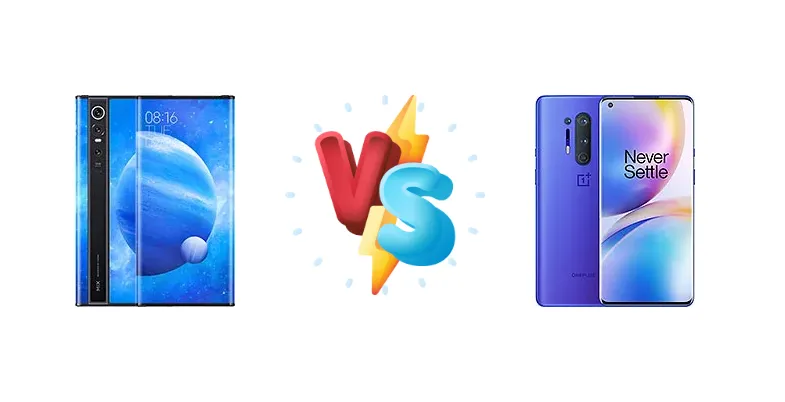
|
🏆 Quick Verdict
For the average user, the OnePlus 8 Pro emerges as the more practical choice. While the Mi Mix Alpha’s design is undeniably striking, the OnePlus 8 Pro’s Snapdragon 865 chipset, coupled with its robust 103-hour endurance rating, provides a smoother, more reliable, and ultimately more usable experience.
| PHONES | ||
|---|---|---|
| Phone Names | Xiaomi Mi Mix Alpha | OnePlus 8 Pro |
| Network | ||
|---|---|---|
| 2G bands | GSM 850 / 900 / 1800 / 1900 | GSM 850 / 900 / 1800 / 1900 |
| 3G bands | HSDPA 850 / 900 / 1900 / 2100 | HSDPA 800 / 850 / 900 / 1700(AWS) / 1800 / 1900 / 2100 |
| 4G bands | 1, 2, 3, 4, 5, 7, 8, 34, 38, 39, 40, 41 - China | 1, 2, 3, 4, 5, 7, 8, 12, 13, 17, 18, 19, 20, 25, 26, 28, 32, 34, 38, 39, 40, 41, 42, 46, 66 - EU |
| 5G bands | 41, 78, 79 SA/NSA/Sub6 | 1, 3, 7, 28, 78 SA/NSA - EU |
| Speed | HSPA 42.2/5.76 Mbps, LTE (7CA) Cat20 2000/150 Mbps, 5G (2+ Gbps DL) | HSPA 42.2/5.76 Mbps, LTE (5CA) Cat18 1200/150 Mbps, 5G 7.5 Gbps DL |
| Technology | GSM / CDMA / HSPA / LTE / 5G | GSM / CDMA / HSPA / LTE / 5G |
| CDMA 800 & TD-SCDMA | 78 SA/NSA - IN | |
| Launch | ||
|---|---|---|
| Announced | 2019, September | 2020, April 14 |
| Status | Cancelled | Available. Released 2020, April 21 |
| Body | ||
|---|---|---|
| Build | Glass front, ceramic/glass back, titanium alloy frame (TC4) | Glass front (Gorilla Glass 5), glass back (Gorilla Glass 5), aluminum frame |
| Dimensions | 154.4 x 72.3 x 10.4 mm (6.08 x 2.85 x 0.41 in) | 165.3 x 74.4 x 8.5 mm (6.51 x 2.93 x 0.33 in) |
| SIM | Nano-SIM + Nano-SIM | Nano-SIM + Nano-SIM |
| Weight | 241 g (8.50 oz) | 199 g (7.02 oz) |
| - | IP68 dust/water resistant | |
| Display | ||
|---|---|---|
| Protection | - | Corning Gorilla Glass 5 |
| Resolution | 2088 x 2250 pixels (~388 ppi density) | 1440 x 3168 pixels (~513 ppi density) |
| Size | 7.92 inches, 201.8 cm2 (~180.8% screen-to-body ratio) | 6.78 inches, 111.7 cm2 (~90.8% screen-to-body ratio) |
| Type | Flexible Super AMOLED | Fluid AMOLED, 1B colors, 120Hz, HDR10+ |
| Platform | ||
|---|---|---|
| CPU | Octa-core (1x2.96 GHz Kryo 485 & 3x2.42 GHz Kryo 485 & 4x1.8 GHz Kryo 485) | Octa-core (1x2.84 GHz Cortex-A77 & 3x2.42 GHz Cortex-A77 & 4x1.80 GHz Cortex-A55) |
| Chipset | Qualcomm SM8150 Snapdragon 855+ (7 nm) | Qualcomm SM8250 Snapdragon 865 5G (7 nm+) |
| GPU | Adreno 640 (700 MHz) | Adreno 650 |
| OS | Android 10, MIUI 11 | Android 10, upgradable to Android 13, OxygenOS 13 |
| Memory | ||
|---|---|---|
| Card slot | No | No |
| Internal | 512GB 12GB RAM | 128GB 8GB RAM, 256GB 12GB RAM |
| UFS 3.0 | UFS 3.0 | |
| Main Camera | ||
|---|---|---|
| Features | Laser AF, Dual-LED flash, HDR, panorama | Laser AF, Dual-LED flash, HDR, panorama |
| Quad | - | 48 MP, f/1.8, 25mm (wide), 1/1.43", 1.12µm, multi-directional PDAF, OIS 8 MP, f/2.4, (telephoto), 1/1.0µm, PDAF, OIS, 3x optical zoom 48 MP, f/2.2, 14mm, 116˚ (ultrawide), 1/2.0", 0.8µm, PDAF 5 MP, f/2.4, (Color filter camera) |
| Triple | 108 MP, f/1.7, (wide), 1/1.33", 0.8µm, PDAF 12 MP, f/2.0, 54mm (telephoto), 1/2.55", 1.4µm, dual pixel PDAF, 2x optical zoom 20 MP, f/2.2, 13mm (ultrawide), 1/2.8", 1.0µm | - |
| Video | 6K@30fps, 4K@30/60fps, 1080p@30/120/240fps, 1080p@960fps | 4K@30/60fps, 1080p@30/60/240fps, Auto HDR, gyro-EIS |
| Selfie camera | ||
|---|---|---|
| Features | Dual-LED flash, HDR, panorama | HDR |
| Single | - | 16 MP, f/2.5, (wide), 1/3.06", 1.0µm |
| Triple | No - uses main camera | - |
| Video | 3240p@30fps, 4K@30/60fps, 1080p@30/120/240fps, 1080p@960fps | 1080p@30fps, gyro-EIS |
| Sound | ||
|---|---|---|
| 3.5mm jack | No | No |
| 35mm jack | No | No |
| Loudspeaker | Yes | Yes, with stereo speakers |
| Comms | ||
|---|---|---|
| Bluetooth | 5.0, A2DP, LE, aptX HD | 5.1, A2DP, LE, aptX HD |
| NFC | No | Yes |
| Positioning | GPS (L1+L5), GLONASS (L1), BDS (B1), GALILEO (E1+E5a) | GPS (L1+L5), GLONASS (G1), BDS (B1), GALILEO (E1+E5a) |
| Radio | No | No |
| USB | USB Type-C | USB Type-C 3.1, OTG |
| WLAN | Wi-Fi 802.11 a/b/g/n/ac, dual-band, Wi-Fi Direct, DLNA | Wi-Fi 802.11 a/b/g/n/ac/6, dual-band, Wi-Fi Direct, DLNA |
| Features | ||
|---|---|---|
| Sensors | Fingerprint (under display, optical), accelerometer, gyro, compass, barometer | Fingerprint (under display, optical), accelerometer, gyro, proximity, compass |
| Virtual proximity sensing | - | |
| Battery | ||
|---|---|---|
| Charging | 40W wired | 30W wired, 50% in 23 min 30W wireless, 50% in 30 min 3W reverse wireless |
| Type | Li-Po 4050 mAh, non-removable | Li-Po 4510 mAh, non-removable |
| Misc | ||
|---|---|---|
| Colors | Black | Glacial Green, Ultramarine Blue, Onyx Black |
| Models | - | IN2023, IN2020, IN2021, IN2025 |
| Price | About 2500 EUR | About 310 EUR |
| Pricing | ||
|---|---|---|
| 128GB 8GB RAM | - | $ 428.39 |
| 256GB 12GB RAM | - | $ 853.51 |
| RENEWED | - | $ 486.00 |
| Tests | ||
|---|---|---|
| Battery life | - | Endurance rating 103h |
| Camera | - | Photo / Video |
| Display | - | Contrast ratio: Infinite (nominal) |
| Loudspeaker | - | -23.5 LUFS (Very good) |
| Performance | - | AnTuTu: 573276 (v8) GeekBench: 3374 (v5.1) GFXBench: 24fps (ES 3.1 onscreen) |
Xiaomi Mi Mix Alpha
- Radically innovative wrap-around display
- Unique and eye-catching design
- 40W fast wired charging
- Potentially impractical wrap-around display
- Older Snapdragon 855+ chipset
- Limited software support compared to OnePlus
OnePlus 8 Pro
- Powerful Snapdragon 865 5G chipset
- Excellent battery life (103h endurance)
- Versatile camera system
- More conventional design
- No reverse wireless charging
- Can be expensive depending on configuration
Display Comparison
Both devices boast 'Infinite' contrast ratios, indicating excellent OLED panel quality. However, the Mi Mix Alpha’s defining feature is its wrap-around display, extending onto the sides of the device. This is a visual spectacle, but introduces usability challenges with accidental touches and a lack of traditional buttons. The OnePlus 8 Pro features a more conventional 6.78-inch Fluid AMOLED display with a 120Hz refresh rate (not specified for the Mi Mix Alpha), offering a smoother scrolling experience. While the Mi Mix Alpha’s display is innovative, the OnePlus 8 Pro’s is demonstrably more practical for everyday use.
Camera Comparison
Both phones feature capable camera systems, but details on the Mi Mix Alpha’s camera are limited. The OnePlus 8 Pro’s camera system is well-documented, offering a versatile setup for both photo and video. The OnePlus 8 Pro’s strengths lie in its image processing, delivering consistently good results in various lighting conditions. Without detailed specifications for the Mi Mix Alpha’s camera, it’s difficult to make a direct comparison, but the OnePlus 8 Pro’s established reputation and feature set (like its ultrawide lens) give it an edge.
Performance
The OnePlus 8 Pro’s Snapdragon 865 5G chipset represents a significant leap over the Mi Mix Alpha’s Snapdragon 855+. The 865, built on a 7nm+ process, offers improved CPU and GPU performance, alongside integrated 5G connectivity. The CPU architecture differs; the OnePlus 8 Pro utilizes Cortex-A77 cores, while the Mi Mix Alpha uses Kryo 485 cores. While both are octa-core designs, the A77 cores generally exhibit higher single-core performance. The OnePlus 8 Pro’s access to faster LPDDR5 RAM (spec not provided for Mi Mix Alpha, but likely LPDDR4X) further enhances responsiveness. This translates to snappier app loading, smoother multitasking, and better gaming performance on the OnePlus 8 Pro.
Battery Life
The OnePlus 8 Pro boasts an endurance rating of 103 hours, indicating excellent battery life. It supports 30W wired charging (50% in 23 minutes) and 30W wireless charging (50% in 30 minutes), alongside 3W reverse wireless charging. The Mi Mix Alpha, with its 40W wired charging, offers faster wired charging speeds, but lacks wireless charging capabilities. The OnePlus 8 Pro’s superior endurance rating suggests it will comfortably last a full day of moderate to heavy use, while the Mi Mix Alpha’s battery life may be more dependent on usage patterns.
Buying Guide
Buy the Xiaomi Mi Mix Alpha if you prioritize a truly unique and futuristic design, and are willing to accept potential software quirks and limited real-world usability due to the wrap-around display. Buy the OnePlus 8 Pro if you value a polished software experience, consistently high performance thanks to the Snapdragon 865, a versatile camera system, and excellent battery life – a combination that caters to a wider range of users.