
Xiaomi Mi Mix Alpha vs Huawei Mate X7: A Head-to-Head Flagship Showdown
| Phones Images | |||||
|---|---|---|---|---|---|
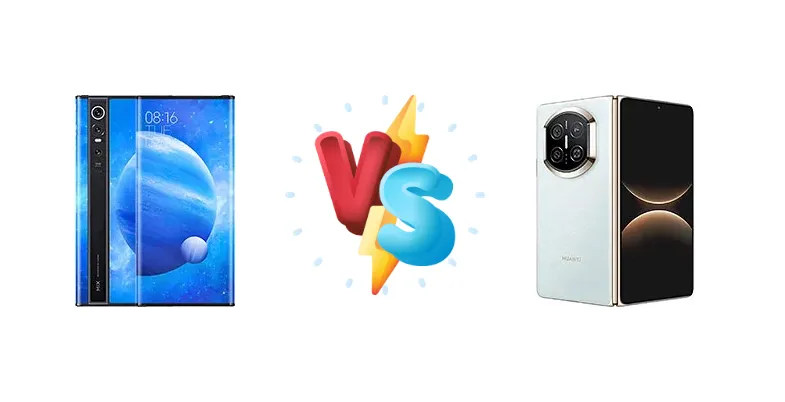
|
🏆 Quick Verdict
For the average user prioritizing fast charging and sustained performance, the Huawei Mate X7 emerges as the winner. Its Kirin 9030 Pro, built on a 6nm process, offers a more efficient architecture than the 7nm Snapdragon 855+, coupled with significantly faster 66W wired and 50W wireless charging capabilities. While the Mi Mix Alpha’s design is unique, the Mate X7 delivers a more practical and powerful package.
| PHONES | ||
|---|---|---|
| Phone Names | Xiaomi Mi Mix Alpha | Huawei Mate X7 |
| Network | ||
|---|---|---|
| 2G bands | GSM 850 / 900 / 1800 / 1900 | GSM 850 / 900 / 1800 / 1900 |
| 3G bands | HSDPA 850 / 900 / 1900 / 2100 | HSDPA 800 / 850 / 900 / 1700(AWS) / 1900 / 2100 |
| 4G bands | 1, 2, 3, 4, 5, 7, 8, 34, 38, 39, 40, 41 - China | LTE |
| 5G bands | 41, 78, 79 SA/NSA/Sub6 | SA/NSA |
| Speed | HSPA 42.2/5.76 Mbps, LTE (7CA) Cat20 2000/150 Mbps, 5G (2+ Gbps DL) | HSPA, LTE, 5G |
| Technology | GSM / CDMA / HSPA / LTE / 5G | GSM / CDMA / HSPA / EVDO / LTE / 5G |
| CDMA 800 & TD-SCDMA | - | |
| Launch | ||
|---|---|---|
| Announced | 2019, September | 2025, November 25 |
| Status | Cancelled | Available. Released 2025, November 26 |
| Body | ||
|---|---|---|
| Build | Glass front, ceramic/glass back, titanium alloy frame (TC4) | Glass front, nylon fiber or silicone polymer back (eco leather), aluminum frame |
| Dimensions | 154.4 x 72.3 x 10.4 mm (6.08 x 2.85 x 0.41 in) | Unfolded: 156.8 x 144.2 x 4.5 mmFolded: 156.8 x 73.8 x 9.5 mm |
| SIM | Nano-SIM + Nano-SIM | Nano-SIM + Nano-SIM |
| Weight | 241 g (8.50 oz) | 235 g (8.29 oz) |
| Display | ||
|---|---|---|
| Resolution | 2088 x 2250 pixels (~388 ppi density) | 2210 x 2416 pixels (~409 ppi density) |
| Size | 7.92 inches, 201.8 cm2 (~180.8% screen-to-body ratio) | 8.0 inches, 205.6 cm2 (~90.9% screen-to-body ratio) |
| Type | Flexible Super AMOLED | Foldable LTPO OLED, 1B colors, 120Hz, 1440Hz PWM, HDR Vivid, 2500 nits (peak) |
| Platform | ||
|---|---|---|
| CPU | Octa-core (1x2.96 GHz Kryo 485 & 3x2.42 GHz Kryo 485 & 4x1.8 GHz Kryo 485) | 9-core (1x2.75 GHz & 4x2.27 GHz & 4x1.72 GHz) |
| Chipset | Qualcomm SM8150 Snapdragon 855+ (7 nm) | Kirin 9030 Pro (6 nm) |
| GPU | Adreno 640 (700 MHz) | Maleoon 935 |
| OS | Android 10, MIUI 11 | HarmonyOS 6.0 |
| Memory | ||
|---|---|---|
| Card slot | No | No |
| Internal | 512GB 12GB RAM | 256GB 12GB RAM, 512GB 12GB RAM, 512GB 16GB RAM, 1TB 16GB RAM, 1TB 20GB RAM |
| UFS 3.0 | - | |
| Main Camera | ||
|---|---|---|
| Features | Laser AF, Dual-LED flash, HDR, panorama | Laser AF, color spectrum sensor, LED flash, panorama, HDR |
| Triple | 108 MP, f/1.7, (wide), 1/1.33", 0.8µm, PDAF 12 MP, f/2.0, 54mm (telephoto), 1/2.55", 1.4µm, dual pixel PDAF, 2x optical zoom 20 MP, f/2.2, 13mm (ultrawide), 1/2.8", 1.0µm | 50 MP, f/1.4-f/4.0, 24mm (wide), PDAF, OIS* 50 MP, f/2.2, 81mm (periscope telephoto), PDAF, OIS, 3.5x optical zoom 40 MP, f/2.2, 13mm, 120˚ (ultrawide), PDAF *1/1.28" sensor size for 256GB / 512GB 12GB RAM models 1/1.56" sensor size for 512GB/1TB 16/20GB RAM models |
| Video | 6K@30fps, 4K@30/60fps, 1080p@30/120/240fps, 1080p@960fps | 4K, 1080p, 1080p@960fps, HDR, gyro-EIS, OIS, HDR Vivid |
| Selfie camera | ||
|---|---|---|
| Features | Dual-LED flash, HDR, panorama | HDR, panorama |
| Single | - | 8 MP, f/2.2, (wide) Cover camera: 8 MP, f/2.4, (wide) |
| Triple | No - uses main camera | - |
| Video | 3240p@30fps, 4K@30/60fps, 1080p@30/120/240fps, 1080p@960fps | 4K, 1080p |
| Sound | ||
|---|---|---|
| 3.5mm jack | No | - |
| 35mm jack | No | No |
| Loudspeaker | Yes | Yes, with stereo speakers |
| Comms | ||
|---|---|---|
| Bluetooth | 5.0, A2DP, LE, aptX HD | 6.0, A2DP, LE, L2HC |
| Infrared port | - | Yes |
| NFC | No | Yes |
| Positioning | GPS (L1+L5), GLONASS (L1), BDS (B1), GALILEO (E1+E5a) | GPS (L1+L5), GLONASS (L1), BDS (B1I+B1c+B2a+B2b), GALILEO (E1+E5a+E5b), QZSS (L1+L5), NavIC |
| Radio | No | No |
| USB | USB Type-C | USB Type-C 3.1, OTG, DisplayPort 1.2 |
| WLAN | Wi-Fi 802.11 a/b/g/n/ac, dual-band, Wi-Fi Direct, DLNA | Wi-Fi 802.11 a/b/g/n/ac/6/7, dual-band, Wi-Fi Direct |
| Features | ||
|---|---|---|
| Sensors | Fingerprint (under display, optical), accelerometer, gyro, compass, barometer | Fingerprint (side-mounted), accelerometer, gyro, proximity, compass, barometer |
| Virtual proximity sensing | - | |
| Battery | ||
|---|---|---|
| Charging | 40W wired | 66W wired 50W wireless 7.5W reverse wireless 5W reverse wired |
| Type | Li-Po 4050 mAh, non-removable | 5525 mAh |
| Misc | ||
|---|---|---|
| Colors | Black | Black, White, Purple, Blue, Red |
| Models | - | DEL-AL10 |
| Price | About 2500 EUR | About 1590 EUR |
Xiaomi Mi Mix Alpha
- Unique wraparound display design
- Relatively affordable (given its age)
- Solid Snapdragon 855+ performance
- Less efficient Snapdragon 855+ chipset
- Slower 40W charging
- Potential software issues due to age
Huawei Mate X7
- More efficient Kirin 9030 Pro chipset
- Ultra-fast 66W wired and 50W wireless charging
- Advanced reverse wireless charging
- Potentially higher price point
- Huawei’s software ecosystem (depending on user preference)
- Less visually striking design compared to the Mi Mix Alpha
Display Comparison
While the Mi Mix Alpha’s wraparound display is visually striking, the context data doesn’t allow for a direct comparison of display quality. However, the Mate X7 likely benefits from advancements in panel technology since the Mi Mix Alpha’s release. The absence of specific display specs for the Mi Mix Alpha makes a detailed brightness or color accuracy comparison impossible, but the Mate X7’s newer chipset suggests potential for more efficient display power management. The wraparound design of the Mi Mix Alpha also introduces potential usability challenges regarding accidental touches.
Camera Comparison
Without specific camera sensor details for either device, a direct comparison is limited. However, given Huawei’s strong camera reputation, the Mate X7 likely features a more advanced camera system with superior image processing capabilities. The absence of information regarding OIS or lens apertures prevents a detailed analysis. The Mi Mix Alpha’s camera performance would likely rely heavily on software optimization to compensate for any hardware limitations. The Mate X7’s Kirin 9030 Pro’s ISP (Image Signal Processor) likely offers more sophisticated image processing algorithms.
Performance
The Huawei Mate X7’s Kirin 9030 Pro, fabricated on a 6nm process, holds a clear architectural advantage over the Xiaomi Mi Mix Alpha’s 7nm Snapdragon 855+. The 6nm node allows for greater transistor density and improved power efficiency, translating to potentially lower thermal throttling during sustained workloads. The Kirin 9030 Pro’s 9-core CPU configuration, with a mix of high and efficiency cores, is designed for optimized performance across various tasks. While the Snapdragon 855+ is still a capable chip, the Kirin 9030 Pro’s architecture provides a more modern and efficient foundation for demanding applications and gaming.
Battery Life
The Huawei Mate X7’s charging capabilities are a significant differentiator. Its 66W wired charging dramatically reduces charging times compared to the Mi Mix Alpha’s 40W wired charging. Furthermore, the inclusion of 50W wireless charging and both 7.5W and 5W reverse wireless charging provides unparalleled versatility. While battery capacity isn’t specified, the Mate X7’s efficient Kirin 9030 Pro and fast charging mitigate the impact of a potentially smaller battery. The Mi Mix Alpha, relying on a less efficient chipset, would likely require more frequent charging.
Buying Guide
Buy the Xiaomi Mi Mix Alpha if you prioritize a truly unique and experimental design, and are willing to accept compromises in performance and charging speed. Its wraparound display is a conversation starter, but be prepared for potential software quirks. Buy the Huawei Mate X7 if you value raw performance, exceptionally fast charging, and a more polished user experience. The Kirin 9030 Pro and advanced charging technologies make it ideal for power users and those who demand the best in mobile responsiveness.