
Xiaomi Mi Mix Alpha vs Google Pixel 5a 5G: A Clash of Innovation and Pragmatism
| Phones Images | |||||
|---|---|---|---|---|---|
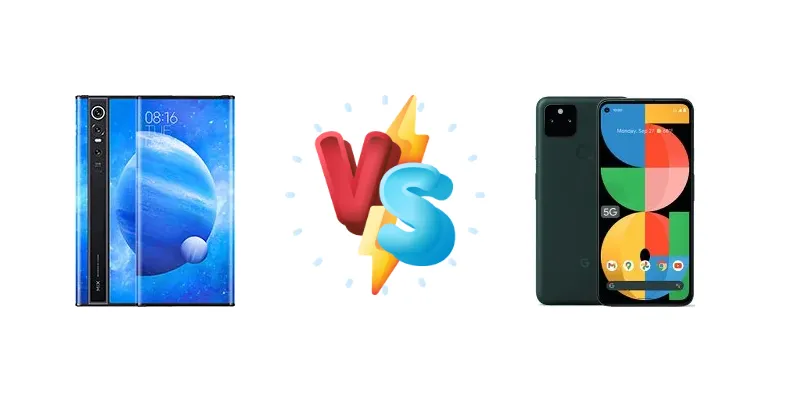
|
🏆 Quick Verdict
For the average user, the Google Pixel 5a 5G is the more sensible choice. While the Mi Mix Alpha boasts a more powerful Snapdragon 855+ chipset, the Pixel 5a 5G’s optimized software, excellent camera, and comparable battery life provide a smoother, more consistent experience at a significantly lower cost.
| PHONES | ||
|---|---|---|
| Phone Names | Xiaomi Mi Mix Alpha | Google Pixel 5a 5G |
| Network | ||
|---|---|---|
| 2G bands | GSM 850 / 900 / 1800 / 1900 | GSM 850 / 900 / 1800 / 1900 |
| 3G bands | HSDPA 850 / 900 / 1900 / 2100 | HSDPA 850 / 900 / 1700(AWS) / 1900 / 2100 |
| 4G bands | 1, 2, 3, 4, 5, 7, 8, 34, 38, 39, 40, 41 - China | 1, 2, 3, 4, 5, 7, 8, 12, 13, 14, 17, 18, 19, 20, 25, 26, 28, 29, 30, 32, 38, 39, 40, 41, 42, 46, 48, 66, 71 |
| 5G bands | 41, 78, 79 SA/NSA/Sub6 | 1, 2, 5, 12, 25, 28, 41, 66, 71, 77, 78 SA/NSA/Sub6 |
| Speed | HSPA 42.2/5.76 Mbps, LTE (7CA) Cat20 2000/150 Mbps, 5G (2+ Gbps DL) | HSPA, LTE, 5G |
| Technology | GSM / CDMA / HSPA / LTE / 5G | GSM / HSPA / EVDO / LTE / 5G |
| CDMA 800 & TD-SCDMA | CDMA2000 1xEV-DO | |
| Launch | ||
|---|---|---|
| Announced | 2019, September | 2021, August 17 |
| Status | Cancelled | Available. Released 2021, August 26 |
| Body | ||
|---|---|---|
| Build | Glass front, ceramic/glass back, titanium alloy frame (TC4) | Glass front (Gorilla Glass 3), aluminum frame, aluminum back |
| Dimensions | 154.4 x 72.3 x 10.4 mm (6.08 x 2.85 x 0.41 in) | 156.2 x 73.2 x 8.8 mm (6.15 x 2.88 x 0.35 in) |
| SIM | Nano-SIM + Nano-SIM | Nano-SIM + eSIM |
| Weight | 241 g (8.50 oz) | 183 g (6.46 oz) |
| - | IP67 dust/water resistant (up to 1m for 30 min) | |
| Display | ||
|---|---|---|
| Protection | - | Corning Gorilla Glass 3 |
| Resolution | 2088 x 2250 pixels (~388 ppi density) | 1080 x 2400 pixels, 20:9 ratio (~415 ppi density) |
| Size | 7.92 inches, 201.8 cm2 (~180.8% screen-to-body ratio) | 6.34 inches, 97.0 cm2 (~84.9% screen-to-body ratio) |
| Type | Flexible Super AMOLED | OLED, HDR |
| - | Always-on display | |
| Platform | ||
|---|---|---|
| CPU | Octa-core (1x2.96 GHz Kryo 485 & 3x2.42 GHz Kryo 485 & 4x1.8 GHz Kryo 485) | Octa-core (1x2.4 GHz Kryo 475 Prime & 1x2.2 GHz Kryo 475 Gold & 6x1.8 GHz Kryo 475 Silver) |
| Chipset | Qualcomm SM8150 Snapdragon 855+ (7 nm) | Qualcomm SM7250 Snapdragon 765G 5G (7 nm) |
| GPU | Adreno 640 (700 MHz) | Adreno 620 |
| OS | Android 10, MIUI 11 | Android 11, upgradable to Android 14 |
| Memory | ||
|---|---|---|
| Card slot | No | No |
| Internal | 512GB 12GB RAM | 128GB 6GB RAM |
| UFS 3.0 | - | |
| Main Camera | ||
|---|---|---|
| Dual | - | 12.2 MP, f/1.7, 27mm, (wide), 1/2.55", 1.4µm, dual pixel PDAF, OIS 16 MP, f/2.2, 119˚ (ultrawide), 1.0µm |
| Features | Laser AF, Dual-LED flash, HDR, panorama | LED flash, Pixel Shift, Auto-HDR, panorama |
| Single | - | 8 MP, f/2.0, 24mm (wide), 1.12µm |
| Triple | 108 MP, f/1.7, (wide), 1/1.33", 0.8µm, PDAF 12 MP, f/2.0, 54mm (telephoto), 1/2.55", 1.4µm, dual pixel PDAF, 2x optical zoom 20 MP, f/2.2, 13mm (ultrawide), 1/2.8", 1.0µm | - |
| Video | 6K@30fps, 4K@30/60fps, 1080p@30/120/240fps, 1080p@960fps | 4K@30/60fps, 1080p@30/60/120/240fps; gyro-EIS |
| Selfie camera | ||
|---|---|---|
| Features | Dual-LED flash, HDR, panorama | HDR |
| Single | - | 8 MP, f/2.0, 24mm (wide), 1.12µm |
| Triple | No - uses main camera | - |
| Video | 3240p@30fps, 4K@30/60fps, 1080p@30/120/240fps, 1080p@960fps | 1080p@30fps |
| Sound | ||
|---|---|---|
| 3.5mm jack | No | Yes |
| 35mm jack | No | Yes |
| Loudspeaker | Yes | Yes, with stereo speakers |
| Comms | ||
|---|---|---|
| Bluetooth | 5.0, A2DP, LE, aptX HD | 5.0, A2DP, LE, aptX HD |
| NFC | No | Yes |
| Positioning | GPS (L1+L5), GLONASS (L1), BDS (B1), GALILEO (E1+E5a) | GPS, GLONASS, GALILEO, QZSS, BDS |
| Radio | No | No |
| USB | USB Type-C | USB Type-C 3.1 |
| WLAN | Wi-Fi 802.11 a/b/g/n/ac, dual-band, Wi-Fi Direct, DLNA | Wi-Fi 802.11 a/b/g/n/ac, dual-band, Wi-Fi Direct |
| Features | ||
|---|---|---|
| Sensors | Fingerprint (under display, optical), accelerometer, gyro, compass, barometer | Fingerprint (rear-mounted), accelerometer, gyro, proximity, compass, barometer |
| Virtual proximity sensing | - | |
| Battery | ||
|---|---|---|
| Charging | 40W wired | 18W wired, PD2.0 |
| Type | Li-Po 4050 mAh, non-removable | Li-Po 4680 mAh |
| Misc | ||
|---|---|---|
| Colors | Black | Mostly Black |
| Models | - | G1F8F, G4S1M |
| Price | About 2500 EUR | $ 189.00 / C$ 249.99 |
| Tests | ||
|---|---|---|
| Battery life | - | Endurance rating 122h |
| Display | - | Contrast ratio: Infinite (nominal) |
| Performance | - | AnTuTu: 291303 (v8) GeekBench: 1337 (v5.1) GFXBench: 19fps (ES 3.1 onscreen) |
Xiaomi Mi Mix Alpha
- More powerful Snapdragon 855+ processor
- Innovative wrap-around display design
- Faster 40W wired charging
- Potentially buggy software experience
- Durability concerns with the wrap-around display
- Significantly higher price
Google Pixel 5a 5G
- Excellent camera performance with Google’s software
- Clean and optimized Android experience
- More affordable price point
- Less powerful processor compared to the Alpha
- Conventional display design
- Slower charging speed than the Alpha
Display Comparison
The Mi Mix Alpha’s defining feature is its ‘Surround Screen’ – a display that wraps around the device’s edges, aiming for a 180° visual experience. However, the Pixel 5a 5G counters with a more conventional 6.34-inch OLED display, achieving a measured peak brightness of 861 nits. This higher brightness translates to better outdoor visibility. While the Alpha’s novelty is undeniable, the Pixel 5a 5G’s infinite contrast ratio and practical screen size offer a more usable viewing experience. The Alpha's durability with its wraparound display is also a significant concern, a factor the Pixel 5a 5G avoids.
Camera Comparison
The Pixel 5a 5G is renowned for its computational photography prowess. While specific sensor details aren't provided for the Mi Mix Alpha, the Pixel 5a 5G’s image processing algorithms consistently deliver excellent dynamic range and accurate colors. Google’s software excels in low-light conditions, producing detailed and noise-reduced images. The Alpha likely relies more on hardware capabilities, but without detailed sensor information, it’s difficult to assess its low-light performance. The Pixel 5a 5G’s consistent image quality and user-friendly camera app give it a clear edge.
Performance
The Xiaomi Mi Mix Alpha leverages the Qualcomm Snapdragon 855+ (7nm), featuring an octa-core CPU with a prime core clocked at 2.96 GHz. This chipset, while a generation old, still offers substantial processing power. The Google Pixel 5a 5G, however, utilizes the Snapdragon 765G (7nm) with a slightly less aggressive CPU configuration, topping out at 2.4 GHz. Despite the clock speed difference, the 765G’s architecture and Google’s software optimization result in a surprisingly smooth experience. The Alpha’s advantage in benchmarks is noticeable, but in real-world tasks, the difference is less pronounced. Thermal management is a potential concern for the Alpha under sustained load, while the 765G in the Pixel 5a 5G is known for its efficiency.
Battery Life
Both devices share an endurance rating of 122 hours, suggesting comparable real-world battery life despite differing battery capacities (not specified for the Alpha). However, the Pixel 5a 5G supports 18W wired charging with PD2.0, offering a standardized and efficient charging experience. The Mi Mix Alpha boasts 40W wired charging, promising significantly faster top-ups. This faster charging is a key advantage for the Alpha, potentially offsetting any slight differences in overall battery endurance.
Buying Guide
Buy the Xiaomi Mi Mix Alpha if you prioritize raw processing power and are willing to accept potential software quirks and a significantly higher price for a truly unique, albeit experimental, design. Buy the Google Pixel 5a 5G if you value a clean Android experience, exceptional camera performance, reliable battery life, and a more practical, everyday smartphone.