
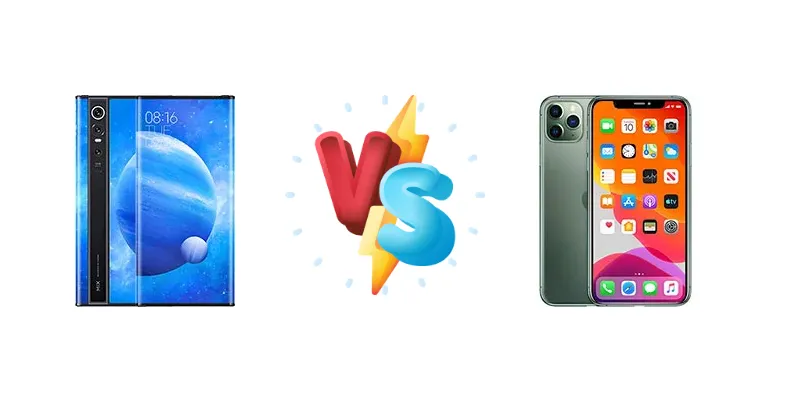
Xiaomi Mi Mix Alpha vs. iPhone 11 Pro Max: A Clash of Design and Ecosystem
| Phones Images | |||||
|---|---|---|---|---|---|
|
🏆 Quick Verdict
For the average user prioritizing reliability, software support, and a mature ecosystem, the iPhone 11 Pro Max remains the stronger choice. While the Mi Mix Alpha’s innovative display is visually striking, its limited availability, software quirks, and reliance on the Snapdragon 855+ chipset ultimately fall short of Apple’s consistently polished experience.
| PHONES | ||
|---|---|---|
| Phone Names | Xiaomi Mi Mix Alpha | Apple iPhone 11 Pro Max |
| Network | ||
|---|---|---|
| 2G bands | GSM 850 / 900 / 1800 / 1900 | GSM 850 / 900 / 1800 / 1900 |
| 3G bands | HSDPA 850 / 900 / 1900 / 2100 | HSDPA 850 / 900 / 1700(AWS) / 1900 / 2100 |
| 4G bands | 1, 2, 3, 4, 5, 7, 8, 34, 38, 39, 40, 41 - China | 1, 2, 3, 4, 5, 7, 8, 11, 12, 13, 17, 18, 19, 20, 21, 25, 26, 28, 29, 30, 32, 34, 38, 39, 40, 41, 42, 46, 48, 66 - A2218 |
| 5G bands | 41, 78, 79 SA/NSA/Sub6 | - |
| Speed | HSPA 42.2/5.76 Mbps, LTE (7CA) Cat20 2000/150 Mbps, 5G (2+ Gbps DL) | HSPA, LTE 1.6 Gbps DL, EV-DO Rev.A 3.1 Mbps |
| Technology | GSM / CDMA / HSPA / LTE / 5G | GSM / CDMA / HSPA / EVDO / LTE |
| CDMA 800 & TD-SCDMA | 1, 2, 3, 4, 5, 7, 8, 12, 13, 14, 17, 18, 19, 20, 25, 26, 29, 30, 34, 38, 39, 40, 41, 42, 46, 48, 66, 71 - A2161, A2220 | |
| Launch | ||
|---|---|---|
| Announced | 2019, September | 2019, September 10 |
| Status | Cancelled | Available. Released 2019, September 20 |
| Body | ||
|---|---|---|
| Build | Glass front, ceramic/glass back, titanium alloy frame (TC4) | Glass front (Corning-made glass), glass back (Corning-made glass), stainless steel frame |
| Dimensions | 154.4 x 72.3 x 10.4 mm (6.08 x 2.85 x 0.41 in) | 158 x 77.8 x 8.1 mm (6.22 x 3.06 x 0.32 in) |
| SIM | Nano-SIM + Nano-SIM | · Nano-SIM + eSIM· Nano-SIM + Nano-SIM (China) |
| Weight | 241 g (8.50 oz) | 226 g (7.97 oz) |
| - | IP68 dust/water resistant (up to 4m for 30 min) Apple Pay (Visa, MasterCard, AMEX certified) | |
| Display | ||
|---|---|---|
| Protection | - | Scratch-resistant glass |
| Resolution | 2088 x 2250 pixels (~388 ppi density) | 1242 x 2688 pixels, 19.5:9 ratio (~458 ppi density) |
| Size | 7.92 inches, 201.8 cm2 (~180.8% screen-to-body ratio) | 6.5 inches, 102.9 cm2 (~83.7% screen-to-body ratio) |
| Type | Flexible Super AMOLED | Super Retina XDR OLED, HDR10, Dolby Vision, 800 nits (HBM), 1200 nits (peak) |
| Platform | ||
|---|---|---|
| CPU | Octa-core (1x2.96 GHz Kryo 485 & 3x2.42 GHz Kryo 485 & 4x1.8 GHz Kryo 485) | Hexa-core (2x2.65 GHz Lightning + 4x1.8 GHz Thunder) |
| Chipset | Qualcomm SM8150 Snapdragon 855+ (7 nm) | Apple A13 Bionic (7 nm+) |
| GPU | Adreno 640 (700 MHz) | Apple GPU (4-core graphics) |
| OS | Android 10, MIUI 11 | iOS 13, upgradable to iOS 26.1 |
| Memory | ||
|---|---|---|
| Card slot | No | No |
| Internal | 512GB 12GB RAM | 64GB 4GB RAM, 256GB 4GB RAM, 512GB 4GB RAM |
| UFS 3.0 | NVMe | |
| Main Camera | ||
|---|---|---|
| Features | Laser AF, Dual-LED flash, HDR, panorama | Dual-LED dual-tone flash, HDR (photo/panorama) |
| Single | - | 13 MP, f/2.2, PDAF |
| Triple | 108 MP, f/1.7, (wide), 1/1.33", 0.8µm, PDAF 12 MP, f/2.0, 54mm (telephoto), 1/2.55", 1.4µm, dual pixel PDAF, 2x optical zoom 20 MP, f/2.2, 13mm (ultrawide), 1/2.8", 1.0µm | 12 MP, f/1.8, 26mm (wide), 1/2.55", 1.4µm, dual pixel PDAF, OIS 12 MP, f/2.0, 52mm (telephoto), 1/3.4", 1.0µm, PDAF, OIS, 2x optical zoom 12 MP, f/2.4, 120˚, 13mm (ultrawide), 1/3.6" |
| Video | 6K@30fps, 4K@30/60fps, 1080p@30/120/240fps, 1080p@960fps | 4K@24/25/30/60fps, 1080p@25/30/60/120/240fps, HDR, stereo sound rec. |
| Selfie camera | ||
|---|---|---|
| Features | Dual-LED flash, HDR, panorama | HDR |
| Single | - | 12 MP, f/2.2, 23mm (wide), 1/3.6", 1.0µm SL 3D, (depth/biometrics sensor) |
| Triple | No - uses main camera | - |
| Video | 3240p@30fps, 4K@30/60fps, 1080p@30/120/240fps, 1080p@960fps | 4K@24/25/30/60fps, 1080p@25/30/60/120fps, gyro-EIS |
| Sound | ||
|---|---|---|
| 3.5mm jack | No | No |
| 35mm jack | No | No |
| Loudspeaker | Yes | Yes, with stereo speakers |
| Comms | ||
|---|---|---|
| Bluetooth | 5.0, A2DP, LE, aptX HD | 5.0, A2DP, LE |
| NFC | No | Yes |
| Positioning | GPS (L1+L5), GLONASS (L1), BDS (B1), GALILEO (E1+E5a) | GPS, GLONASS, GALILEO, QZSS |
| Radio | No | No |
| USB | USB Type-C | Lightning, USB 2.0 |
| WLAN | Wi-Fi 802.11 a/b/g/n/ac, dual-band, Wi-Fi Direct, DLNA | Wi-Fi 802.11 a/b/g/n/ac/6, dual-band, hotspot |
| Features | ||
|---|---|---|
| Sensors | Fingerprint (under display, optical), accelerometer, gyro, compass, barometer | Face ID, accelerometer, gyro, proximity, compass, barometer |
| Virtual proximity sensing | Ultra Wideband (UWB) support | |
| Battery | ||
|---|---|---|
| Charging | 40W wired | Wired, PD2.0, 50% in 30 min Wireless (Qi) |
| Type | Li-Po 4050 mAh, non-removable | Li-Ion 3969 mAh, non-removable (15.04 Wh) |
| Misc | ||
|---|---|---|
| Colors | Black | Matte Space Gray, Matte Silver, Matte Gold, Matte Midnight Green |
| Models | - | A2218, A2161, A2220, iPhone12,5 |
| Price | About 2500 EUR | $ 233.00 / C$ 369.75 / £ 226.95 / € 249.00 |
| SAR | - | 1.16 W/kg (head) 1.17 W/kg (body) |
| SAR EU | - | 0.95 W/kg (head) 0.99 W/kg (body) |
| Pricing | ||
|---|---|---|
| 256GB 4GB RAM | - | $ 874.46 |
| 512GB 4GB RAM | - | $ 1,004.31 |
| 64GB 4GB RAM | - | $ 435.00 |
| RENEWED | - | $ 485.00 |
| Tests | ||
|---|---|---|
| Audio quality | - | Noise -94.3dB / Crosstalk -81.5dB |
| Battery life | - | Endurance rating 102h |
| Camera | - | Photo / Video |
| Display | - | Contrast ratio: Infinite (nominal) |
| Loudspeaker | - | -25.6 LUFS (Very good) |
| Performance | - | AnTuTu: 459713 (v7), 536883 (v8) GeekBench: 13870 (v4.4), 3503 (v5.1) GFXBench: 57fps (ES 3.1 onscreen) |
Xiaomi Mi Mix Alpha
- Groundbreaking 'surround screen' design
- 40W fast wired charging
- Unique and attention-grabbing aesthetic
- Limited availability and high price
- Software instability and lack of updates
- Fragile display and potential usability issues
Apple iPhone 11 Pro Max
- Excellent battery life and efficiency
- Powerful A13 Bionic chipset
- Mature and reliable iOS ecosystem
- Relatively slow 18W charging
- Notch design (dated by today's standards)
- Less visually striking design
Display Comparison
The Mi Mix Alpha’s defining feature is its ‘surround screen’ – a display that wraps almost entirely around the device. While visually impressive, this design presents usability challenges, particularly with accidental touches and the lack of a traditional earpiece. The iPhone 11 Pro Max, in contrast, features a 6.5-inch Super Retina XDR display with a peak brightness of 820 nits (measured), offering excellent visibility even in direct sunlight. The iPhone’s infinite contrast ratio, typical of OLED panels, delivers deep blacks and vibrant colors. The Mi Mix Alpha’s display technology, while innovative, lacked the refinement and color accuracy of Apple’s panel.
Camera Comparison
Both devices offer excellent camera systems, but approach image processing differently. The iPhone 11 Pro Max excels in video recording, offering cinematic-quality footage with excellent stabilization. Its photo capabilities are also strong, with a focus on natural-looking images. The Mi Mix Alpha’s camera system, while boasting high megapixel counts, relied heavily on software processing to compensate for its sensor limitations. While capable of producing impressive results in ideal conditions, it often struggled with dynamic range and detail in challenging lighting scenarios. The iPhone’s consistent image quality and superior video capabilities give it an edge.
Performance
The iPhone 11 Pro Max is powered by the Apple A13 Bionic chipset, a 7nm+ processor with a hexa-core CPU. This chip consistently outperformed the Snapdragon 855+ in real-world tasks and benchmarks at the time of release, and that advantage persists. The A13’s neural engine also provided superior machine learning capabilities. The Mi Mix Alpha utilizes the Qualcomm SM8150 Snapdragon 855+ (7 nm), a capable processor but one that is now several generations behind. While the Snapdragon 855+ offers respectable performance, it lacks the efficiency and raw power of the A13 Bionic, potentially leading to more noticeable throttling during sustained workloads. The iPhone 11 Pro Max’s 4GB of RAM is sufficient for iOS, while the Mi Mix Alpha’s RAM capacity isn’t specified, but the Snapdragon 855+ benefits from faster LPDDR4X memory.
Battery Life
The iPhone 11 Pro Max boasts an impressive endurance rating of 102 hours, a testament to its efficient chipset and optimized software. It supports 18W wired charging with PD2.0, achieving 50% charge in 30 minutes, as well as Qi wireless charging. The Mi Mix Alpha features 40W wired charging, offering faster charging speeds, but lacks wireless charging capabilities. While the Mi Mix Alpha’s faster charging is a plus, the iPhone 11 Pro Max’s superior battery life and overall efficiency provide a more reliable and convenient experience.
Buying Guide
Buy the Xiaomi Mi Mix Alpha if you are a technology enthusiast willing to accept potential software instability and limited support in exchange for a truly unique and futuristic design. You value pushing boundaries over everyday practicality. Buy the Apple iPhone 11 Pro Max if you prioritize a seamless user experience, long-term software updates, a robust app ecosystem, and a proven track record of reliability. You need a phone that 'just works' and will continue to do so for years to come.