
Xiaomi Mi Mix 3 5G vs Google Pixel 7a: A Head-to-Head Showdown
| Phones Images | |||||
|---|---|---|---|---|---|
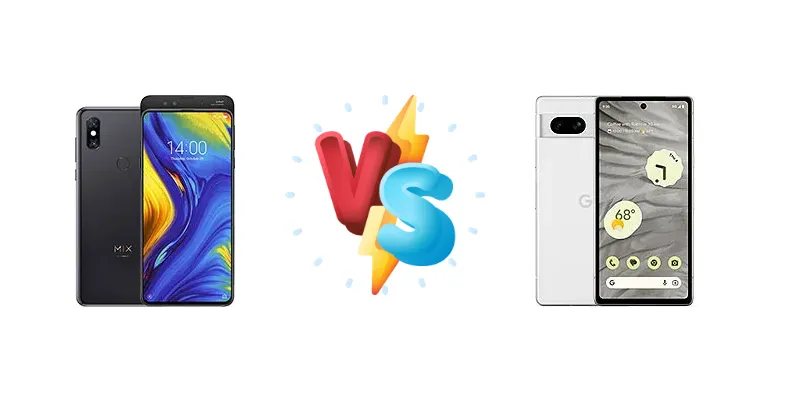
|
🏆 Quick Verdict
The Google Pixel 7a is the clear winner. While the Mi Mix 3 5G offers a compelling chipset for its time, the Pixel 7a's superior camera, modern software, and longer support outweigh the Xiaomi's strengths, especially considering its age.
| PHONES | ||
|---|---|---|
| Phone Names | Xiaomi Mi Mix 3 5G | Google Pixel 7a |
| Network | ||
|---|---|---|
| 2G bands | GSM 850 / 900 / 1800 / 1900 | GSM 850 / 900 / 1800 / 1900 |
| 3G bands | HSDPA 850 / 900 / 1700(AWS) / 1900 / 2100 | HSDPA 800 / 850 / 900 / 1700(AWS) / 1900 / 2100 |
| 4G bands | 1, 2, 3, 4, 5, 7, 8, 20, 28, 34, 38, 39, 40, 41 | 1, 2, 3, 4, 5, 7, 8, 12, 13, 14, 17, 20, 25, 26, 28, 29, 30, 38, 40, 41, 48, 66, 71 - GWKK3, G0DZQ |
| 5G bands | 78 NSA/Sub6 | 1, 2, 3, 5, 7, 8, 12, 14, 20, 25, 28, 30, 38, 41, 48, 66, 71, 77, 78 SA/NSA/Sub6 - GWKK3 |
| Speed | HSPA 42.2/5.76 Mbps, LTE (5CA) Cat18 1200/150 Mbps, 5G (2+ Gbps DL) | HSPA, LTE, 5G |
| Technology | GSM / CDMA / HSPA / EVDO / LTE / 5G | GSM / HSPA / LTE / 5G |
| CDMA2000 1xEV-DO | 1, 2, 3, 5, 7, 8, 12, 20, 25, 28, 38, 40, 41, 66, 75, 76, 77, 78, 79 SA/NSA/Sub6 - GHL1X, G82U8 | |
| Launch | ||
|---|---|---|
| Announced | 2019, February. Released 2019, May | 2023, May 10 |
| Status | Discontinued | Available. Released 2023, May 10 |
| Body | ||
|---|---|---|
| Build | Glass front (Gorilla Glass 5), ceramic back, aluminum frame (7000 series) | Glass front (Gorilla Glass 3), aluminum frame, plastic back |
| Dimensions | 157.9 x 74.7 x 9.4 mm (6.22 x 2.94 x 0.37 in) | 152 x 72.9 x 9 mm (5.98 x 2.87 x 0.35 in) |
| SIM | Nano-SIM | Nano-SIM + eSIM |
| Weight | 225 g (7.94 oz) | 193.5 g (6.84 oz) |
| - | IP67 dust/water resistant (up to 1m for 30 min) | |
| Display | ||
|---|---|---|
| Protection | Corning Gorilla Glass 5 | Corning Gorilla Glass 3 |
| Resolution | 1080 x 2340 pixels, 19.5:9 ratio (~403 ppi density) | 1080 x 2400 pixels, 20:9 ratio (~429 ppi density) |
| Size | 6.39 inches, 100.2 cm2 (~85.0% screen-to-body ratio) | 6.1 inches, 90.7 cm2 (~81.8% screen-to-body ratio) |
| Type | Super AMOLED, HDR | OLED, HDR, 90Hz |
| - | Always-on display | |
| Platform | ||
|---|---|---|
| CPU | Octa-core (1x2.84 GHz Kryo 485 & 3x2.42 GHz Kryo 485 & 4x1.78 GHz Kryo 485) | Octa-core (2x2.85 GHz Cortex-X1 & 2x2.35 GHz Cortex-A78 & 4x1.80 GHz Cortex-A55) |
| Chipset | Qualcomm SM8150 Snapdragon 855 (7 nm) | Google Tensor G2 (5 nm) |
| GPU | Adreno 640 | Mali-G710 MP7 |
| OS | Android 9.0 (Pie), MIUI 12 | Android 13, upgradable to Android 15, up to 5 major Android upgrades |
| Memory | ||
|---|---|---|
| Card slot | No | No |
| Internal | 64GB 6GB RAM, 128GB 6GB RAM | 128GB 8GB RAM |
| UFS 2.1 | UFS 3.1 | |
| Main Camera | ||
|---|---|---|
| Dual | 12 MP (wide), f/1.8, 1/2.55", 1.4µm, dual pixel PDAF, 4-axis OIS 12 MP (telephoto), 1/3.4", 1.0µm | 64 MP, f/1.9, 26mm (wide), 1/1.73", 0.8µm, dual pixel PDAF, OIS 13 MP, f/2.2, 120˚ (ultrawide), 1.12µm |
| Features | LED flash, HDR, panorama | Dual-LED flash, Pixel Shift, Auto-HDR, panorama |
| Video | 4K@30/60fps, 1080p@30/60/240fps, 1080p@960fps; gyro-EIS | 4K@30/60fps, 1080p@30/60/120/240fps, OIS |
| Selfie camera | ||
|---|---|---|
| Dual | Manual pop-up 24 MP, f/2.0, 26mm (wide), 1/2.8", 0.9µm Manual pop-up 2 MP, depth sensor | - |
| Features | LED flash, HDR | HDR, panorama |
| Single | - | 13 MP, f/2.2, 20mm (ultrawide), 1.12µm |
| Video | 1080p@30fps | 4K@30fps, 1080p@30fps |
| Sound | ||
|---|---|---|
| 3.5mm jack | No | No |
| 35mm jack | No | No |
| Loudspeaker | Yes | Yes, with stereo speakers |
| Comms | ||
|---|---|---|
| Bluetooth | 5.0, A2DP, LE, aptX HD | 5.3, A2DP, LE |
| NFC | Yes | Yes |
| Positioning | GPS (L1+L5), GLONASS (L1), BDS (B1), GALILEO (E1+E5a), QZSS (L1+L5) | GPS, GLONASS, GALILEO, BDS, QZSS, NavIC |
| Radio | No | No |
| USB | USB Type-C | USB Type-C 3.2 |
| WLAN | Wi-Fi 802.11 a/b/g/n/ac, dual-band, Wi-Fi Direct | Wi-Fi 802.11 a/b/g/n/ac/6e, tri-band |
| Features | ||
|---|---|---|
| Sensors | Fingerprint (rear-mounted), accelerometer, gyro, compass | Fingerprint (under display, optical), accelerometer, gyro, proximity, compass, barometer |
| Virtual proximity sensing | - | |
| Battery | ||
|---|---|---|
| Charging | 18W wired, QC4 | 18W wired, PD3.0 7.5W wireless |
| Type | Li-Po 3800 mAh, non-removable | Li-Po 4385 mAh |
| Misc | ||
|---|---|---|
| Colors | Sapphire Blue | Charcoal, Snow, Sea, Coral |
| Models | M1810E5GG | GWKK3, GHL1X, G0DZQ, G82U8 |
| Price | About 410 EUR | € 179.90 / $ 150.00 / £ 170.00 / ₹ 25,980 |
| SAR | 1.56 W/kg (head) 1.58 W/kg (body) | - |
Xiaomi Mi Mix 3 5G
- Flagship Snapdragon 855 chipset
- Unique sliding design
- Relatively affordable (used)
- Outdated software support
- Lower display brightness
- Inferior camera
- Likely shorter battery life
- Older design
Google Pixel 7a
- Excellent camera with Google's computational photography
- Clean and up-to-date Android experience
- Guaranteed software updates
- Bright and vibrant display
- Wireless charging
- Tensor G2 chipset not as powerful as flagship Snapdragon chips
- Charging speed could be faster
- Design is somewhat generic
Display Comparison
The Pixel 7a's display shines with a measured 1070 nits peak brightness, offering excellent visibility even in direct sunlight. The Mi Mix 3 5G's display, while decent, lacks the same level of brightness and color accuracy. The Pixel 7a also likely has a more modern panel with better color reproduction.
Camera Comparison
This is where the Pixel 7a truly dominates. Google's computational photography is unmatched, delivering consistently excellent photos and videos in various conditions. The Mi Mix 3 5G's camera is adequate but lacks the Pixel's dynamic range, detail, and overall image quality. The Pixel 7a also benefits from features like Magic Eraser and Photo Unblur.
Performance
The Snapdragon 855 in the Mi Mix 3 5G was a flagship chipset in its time and still holds up reasonably well. However, the Google Tensor G2 in the Pixel 7a, while not as rawly powerful, is optimized for Google's AI and machine learning tasks, resulting in a smoother and more responsive user experience, particularly with camera features and voice assistant integration. The Tensor G2's efficiency also contributes to better battery life.
Battery Life
The Pixel 7a boasts an impressive endurance rating of 76 hours, indicating significantly better battery life than the Mi Mix 3 5G. While the Mi Mix 3 5G's battery capacity is unknown, the Snapdragon 855's power consumption and the age of the battery likely contribute to shorter runtimes.
Buying Guide
The Xiaomi Mi Mix 3 5G is best for budget-conscious users who prioritize raw processing power and are comfortable with an older device. The Google Pixel 7a is ideal for those seeking a fantastic camera, clean Android experience, and guaranteed software updates.