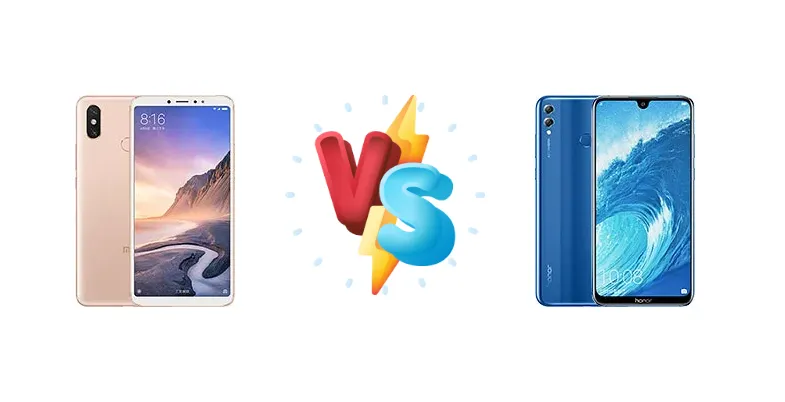
Looking for a phone with a massive display and long-lasting battery? The Xiaomi Mi Max 3 and Honor 8X Max both offer compelling options in the large-screen smartphone market. But which one delivers the best overall experience? Let's dive into a detailed comparison.
🏆 Quick Verdict
The Honor 8X Max edges out the Mi Max 3 thanks to its slightly more powerful Snapdragon 660 chipset and reverse charging capability. While both offer excellent battery life and large displays, the Honor's performance advantage makes it the more appealing choice for most users.
| Network |
|---|
| 2G bands | GSM 850 / 900 / 1800 / 1900 - SIM 1 & SIM 2 | GSM 850 / 900 / 1800 / 1900 |
| 3G bands | HSDPA 850 / 900 / 1900 / 2100 | HSDPA 850 / 900 / 2100 |
| 4G bands | 1, 3, 4, 5, 7, 8, 20, 34, 38, 39, 40, 41 | 1, 3, 5, 7, 8, 20, 38, 40, 41 - Global |
| Speed | HSPA, LTE | HSPA 42.2/5.76 Mbps, LTE Cat4 150/50 Mbps |
| Technology | GSM / CDMA / HSPA / EVDO / LTE | GSM / CDMA / HSPA / LTE |
| | CDMA2000 1xEV-DO | 1, 3, 5, 8, 38, 39, 40, 41 - China |
| Launch |
|---|
| Announced | 2018, July. Released 2018, July | 2018, September. Released 2018, September |
| Status | Discontinued | Discontinued |
| Body |
|---|
| Build | Glass front, aluminum back, aluminum frame | - |
| Dimensions | 176.2 x 87.4 x 8 mm (6.94 x 3.44 x 0.31 in) | 177.6 x 86.3 x 8.1 mm (6.99 x 3.40 x 0.32 in) |
| SIM | Nano-SIM + Nano-SIM | Nano-SIM + Nano-SIM |
| Weight | 221 g (7.80 oz) | 210 g (7.41 oz) |
| Display |
|---|
| Protection | To be confirmed | - |
| Resolution | 1080 x 2160 pixels, 18:9 ratio (~350 ppi density) | 1080 x 2244 pixels, 18.7:9 ratio (~350 ppi density) |
| Size | 6.9 inches, 122.9 cm2 (~79.8% screen-to-body ratio) | 7.12 inches, 127.8 cm2 (~83.4% screen-to-body ratio) |
| Type | IPS LCD | IPS LCD |
| Platform |
|---|
| CPU | Octa-core (4x1.8 GHz Kryo 260 Gold & 4x1.6 GHz Kryo 260 Silver) | Octa-core (4x1.95 GHz Kryo 260 Gold & 4x1.8 GHz Kryo 260 Silver) |
| Chipset | Qualcomm SDM636 Snapdragon 636 (14 nm) | Qualcomm SDM660 Snapdragon 660 (14 nm) |
| GPU | Adreno 509 | Adreno 512 |
| OS | Android 8.1 (Oreo), upgradable to Android 10, MIUI 12 | Android 8.1 (Oreo), upgradable to Android 9 (Pie), EMUI 9 |
| Memory |
|---|
| Card slot | microSDXC (uses shared SIM slot) | microSDXC (dedicated slot) |
| Internal | 64GB 4GB RAM, 128GB 6GB RAM | 64GB 4GB RAM, 64GB 6GB RAM, 128GB 4GB RAM, 128GB 6GB RAM |
| | eMMC 5.1 | eMMC 5.1 |
| Main Camera |
|---|
| Dual | 12 MP, f/1.9, 1/2.55", 1.4µm, dual pixel PDAF
Auxiliary lens | 16 MP, f/2.0, PDAF
Auxiliary lens |
| Features | Dual-LED flash, HDR, panorama | LED flash, panorama, HDR |
| Video | 4K@30fps, 720p/1080p@30fps (gyro-EIS), 720p@120fps | 1080p@30fps |
| Selfie camera |
|---|
| Features | - | HDR |
| Single | 8 MP, f/2.0, 1/4.0", 1.12µm | 8 MP, f/2.0 |
| Video | 1080p@30fps | 1080p@30fps |
| Sound |
|---|
| 3.5mm jack | Yes | Yes |
| 35mm jack | Yes | Yes |
| Loudspeaker | Yes, with stereo speakers | Yes, with stereo speakers |
| Comms |
|---|
| Bluetooth | 5.0, A2DP, LE | 4.2, A2DP, LE |
| Infrared port | Yes | - |
| NFC | No | No |
| Positioning | GPS, GLONASS, BDS | GPS, GLONASS, BDS |
| Radio | FM radio | FM radio |
| USB | USB Type-C | microUSB 2.0, OTG |
| WLAN | Wi-Fi 802.11 a/b/g/n/ac, dual-band, Wi-Fi Direct, DLNA | Wi-Fi 802.11 a/b/g/n/ac, Wi-Fi Direct |
| Features |
|---|
| Sensors | Fingerprint (rear-mounted), accelerometer, gyro, proximity, compass | Fingerprint (rear-mounted), accelerometer, gyro, proximity, compass |
| Battery |
|---|
| Charging | 18W wired, QC3 | 18W wired
5W reverse wired |
| Type | Li-Ion 5500 mAh, non-removable | Li-Po 5000 mAh, non-removable |
| Misc |
|---|
| Colors | Black, Champagne Gold, Blue | Black, Blue, Red |
| Models | M1804E4A | ARE-AL00, ARE-L22HN, ARE-AL10 |
| Price | About 310 EUR | About 250 EUR |
| SAR | 1.58 W/kg (head) 1.42 W/kg (body) | - |
| Tests |
|---|
| Audio quality |
Noise -93.7dB / Crosstalk -94.0dB | - |
| Battery life |
Endurance rating 115h
| - |
| Camera |
Photo / Video | - |
| Display |
Contrast ratio: 1462 (nominal), 3.061 (sunlight) | - |
| Loudspeaker |
Voice 68dB / Noise 71dB / Ring 83dB
| - |
| Performance |
AnTuTu: 119229 (v7)
GeekBench: 4907 (v4.4)
GFXBench: 6fps (ES 3.1 onscreen) | - |
Xiaomi Mi Max 3
- Massive 6.93-inch display
- Exceptional battery life (115h endurance)
- Good contrast ratio for outdoor visibility
- Dual camera setup
- Older Snapdragon 636 chipset
- No reverse charging
- Design can feel bulky
Honor 8X Max
- Slightly more powerful Snapdragon 660 chipset
- 5W reverse wired charging
- Large 6.8-inch display
- Good value for money
- Display contrast slightly lower than Mi Max 3
- Camera performance potentially slightly behind
Display Comparison
Both phones boast large displays, but the Mi Max 3's contrast ratio (1462 nominal, 3061 sunlight) suggests slightly better outdoor visibility. The Mi Max 3 has a 6.93-inch display, while the Honor 8X Max has a 6.8-inch display. Resolution is likely FHD+ on both, offering a sharp image. While both are good, the Mi Max 3's contrast gives it a slight edge.
Camera Comparison
Camera specs are not fully detailed, but both phones feature a dual-camera setup. Image quality will likely be comparable in good lighting conditions. Low-light performance is likely similar, relying on software processing. The Honor 8X Max might have a slight edge due to its newer chipset's image processing capabilities.
Performance
The Honor 8X Max's Snapdragon 660 chipset provides a noticeable performance boost over the Mi Max 3's Snapdragon 636. Expect smoother multitasking, faster app loading times, and a more responsive user experience on the Honor. Both phones have 8GB of RAM, which helps with multitasking, but the CPU difference is significant.
Battery Life
Battery life is a strong point for both devices. The Mi Max 3 boasts an impressive endurance rating of 115 hours. The Honor 8X Max, while not explicitly stated, is expected to offer similar all-day battery life. The Honor's inclusion of 5W reverse wired charging is a valuable bonus.
Buying Guide
The Xiaomi Mi Max 3 is ideal for users prioritizing a truly massive display and exceptional battery endurance above all else. The Honor 8X Max is a better fit for those who want a balance of performance, battery life, and the added convenience of reverse charging.
Frequently Asked Questions
❓ Which phone is better for gaming?
The Honor 8X Max is the better choice for gaming due to its more powerful Snapdragon 660 chipset.
❓ Can the Honor 8X Max charge other devices?
Yes, the Honor 8X Max features 5W reverse wired charging, allowing it to charge other devices.
❓ Is the Mi Max 3 still worth buying in 2024?
If you prioritize a massive display and long battery life above all else, the Mi Max 3 can still be a viable option, especially at a discounted price. However, the Honor 8X Max offers a more modern and well-rounded experience.