
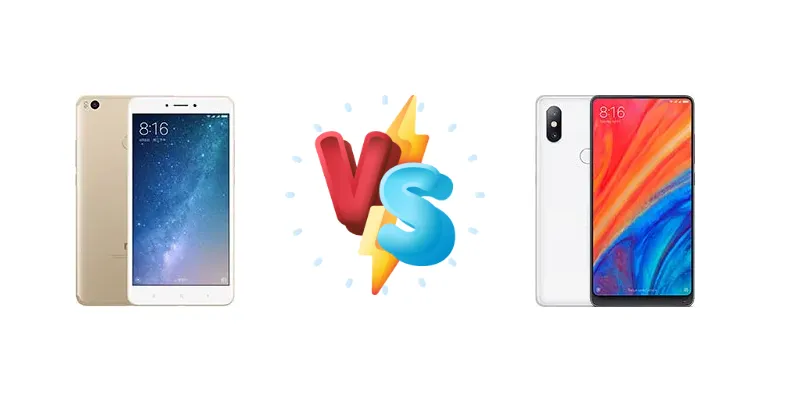
Xiaomi Mi Max 2 vs Mi Mix 2S: A Clash of Titans
| Phones Images | |||||
|---|---|---|---|---|---|
|
🏆 Quick Verdict
The Mi Mix 2S is the clear winner. While the Mi Max 2 offers incredible battery life, the Mi Mix 2S's Snapdragon 845 processor, improved camera, and wireless charging provide a significantly better overall experience, justifying its higher price point.
| PHONES | ||
|---|---|---|
| Phone Names | Xiaomi Mi Max 2 | Xiaomi Mi Mix 2S |
| Network | ||
|---|---|---|
| 2G bands | GSM 850 / 900 / 1800 / 1900 - SIM 1 & SIM 2 | GSM 850 / 900 / 1800 / 1900 |
| 3G bands | HSDPA 850 / 900 / 1900 / 2100 | HSDPA 800 / 850 / 900 / 1700(AWS) / 1800 / 1900 / 2100 |
| 4G bands | 1, 3, 5, 7, 8, 38, 39, 40, 41 | 1, 2, 3, 4, 5, 7, 8, 12, 13, 17, 18, 19, 20, 25, 26, 27, 28, 29, 30, 34, 38, 39, 40, 41 |
| Speed | HSPA 42.2/5.76 Mbps, LTE (2CA) Cat6 300/50 Mbps | HSPA 42.2/5.76 Mbps, LTE (3CA) Cat18 1200/100 Mbps |
| Technology | GSM / CDMA / HSPA / EVDO / LTE | GSM / CDMA / HSPA / EVDO / LTE |
| CDMA2000 1xEV-DO | CDMA2000 1xEV-DO | |
| Launch | ||
|---|---|---|
| Announced | 2017, May. Released 2017, June | 2018, March. Released 2018, April |
| Status | Discontinued | Discontinued |
| Body | ||
|---|---|---|
| Build | Glass front (Gorilla Glass 3), aluminum back, aluminum frame | Glass front (Gorilla Glass 4), ceramic back, aluminum frame |
| Dimensions | 174.1 x 88.7 x 7.6 mm (6.85 x 3.49 x 0.30 in) | 150.9 x 74.9 x 8.1 mm (5.94 x 2.95 x 0.32 in) |
| SIM | Nano-SIM + Micro-SIM | Nano-SIM + Nano-SIM |
| Weight | 211 g (7.44 oz) | 191 g (6.74 oz) |
| Display | ||
|---|---|---|
| Protection | Corning Gorilla Glass 3 | Corning Gorilla Glass 4 |
| Resolution | 1080 x 1920 pixels, 16:9 ratio (~342 ppi density) | 1080 x 2160 pixels, 18:9 ratio (~403 ppi density) |
| Size | 6.44 inches, 114.3 cm2 (~74.0% screen-to-body ratio) | 5.99 inches, 92.6 cm2 (~81.9% screen-to-body ratio) |
| Type | IPS LCD | IPS LCD |
| Platform | ||
|---|---|---|
| CPU | Octa-core 2.0 GHz Cortex-A53 | Octa-core (4x2.8 GHz Kryo 385 Gold & 4x1.8 GHz Kryo 385 Silver) |
| Chipset | Qualcomm MSM8953 Snapdragon 625 (14 nm) | Qualcomm SDM845 Snapdragon 845 (10 nm) |
| GPU | Adreno 506 | Adreno 630 |
| OS | Android 7.1.1 (Nougat), MIUI 11 | Android 8.0 (Oreo), upgradable to Android 10, MIUI 12 |
| Memory | ||
|---|---|---|
| Card slot | microSDXC (uses shared SIM slot) | No |
| Internal | 32GB 4GB RAM, 64GB 4GB RAM, 128GB 4GB RAM | 64GB 6GB RAM, 128GB 6GB RAM, 256GB 8GB RAM |
| eMMC 5.1 | UFS 2.1 | |
| Main Camera | ||
|---|---|---|
| Dual | - | 12 MP, f/1.8, (wide), 1/2.55", 1.4µm, dual pixel PDAF, 4-axis OIS 12 MP, f/2.4, (telephoto), 1/3.4", 1.0µm, AF, 2x optical zoom |
| Features | Dual-LED dual-tone flash, HDR, panorama | Dual-LED dual-tone flash, HDR, panorama |
| Single | 12 MP, f/2.2, 1/2.9", 1.25µm, PDAF | - |
| Video | 4K@30fps, 720p@120fps | 4K@30fps, 1080p@30/120fps, 720p@240fps |
| Selfie camera | ||
|---|---|---|
| Single | 5 MP, f/2.0 | 5 MP, f/2.0, (wide), 1/4.0", 1.4µm |
| Video | 1080p@30fps | 1080p@30fps |
| Sound | ||
|---|---|---|
| 3.5mm jack | Yes | No |
| 35mm jack | Yes | No |
| Loudspeaker | Yes, with stereo speakers | Yes |
| Comms | ||
|---|---|---|
| Bluetooth | 4.2, A2DP, LE | 5.0, A2DP, LE |
| Infrared port | Yes | - |
| NFC | No | Yes |
| Positioning | GPS, GLONASS, BDS | GPS, GLONASS, BDS |
| Radio | FM radio | No |
| USB | USB Type-C | USB Type-C 2.0 |
| WLAN | Wi-Fi 802.11 a/b/g/n/ac, dual-band, Wi-Fi Direct, DLNA | Wi-Fi 802.11 a/b/g/n/ac, dual-band, Wi-Fi Direct |
| Features | ||
|---|---|---|
| Sensors | Fingerprint (rear-mounted), accelerometer, gyro, proximity, compass | Fingerprint (rear-mounted), accelerometer, gyro, compass |
| - | Virtual proximity sensing | |
| Battery | ||
|---|---|---|
| Charging | 18W wired, QC3 | 18W wired, QC3 7.5W wireless (Qi) |
| Type | Li-Ion 5300 mAh, non-removable | Li-Ion 3400 mAh, non-removable |
| Misc | ||
|---|---|---|
| Colors | Gold, Matte Black | Black, White |
| Models | MDE40, MDI40 | M1803D5XA |
| Price | About 200 EUR | About 270 EUR |
| SAR | 1.22 W/kg (head) 0.71 W/kg (body) | 0.54 W/kg (head) 1.59 W/kg (body) |
| Tests | ||
|---|---|---|
| Audio quality | Noise -93.4dB / Crosstalk -98.8dB | Noise -93.0dB / Crosstalk -92.5dB |
| Battery life | Endurance rating 126h | Endurance rating 59h |
| Camera | Photo / Video | - |
| Display | Contrast ratio: 1294:1 (nominal), 2.561 (sunlight) | - |
| Loudspeaker | Voice 78dB / Noise 71dB / Ring 79dB | Voice 68dB / Noise 70dB / Ring 81dB |
| Performance | GeekBench: 2445 (v4.4) GFXBench: 3.5fps (ES 3.1 onscreen) | AnTuTu: 270814 (v7) GeekBench: 9158 (v4.4) GFXBench: 34fps (ES 3.1 onscreen) |
Xiaomi Mi Max 2
- Exceptional battery life
- Large display
- Affordable price
- Outdated processor
- Mediocre camera
- IPS LCD display
Xiaomi Mi Mix 2S
- Flagship performance
- Excellent camera
- Wireless charging
- Vibrant AMOLED display
- Shorter battery life than Mi Max 2
- Higher price
Display Comparison
The Mi Mix 2S features a slightly smaller 6.01-inch AMOLED display with a resolution of 2160 x 1080, offering vibrant colors and deep blacks. The Mi Max 2 has a larger 6.44-inch IPS LCD display with a resolution of 2560 x 1440. While the Mi Max 2's resolution is higher, the Mi Mix 2S's AMOLED panel generally provides a superior viewing experience due to its better contrast and color accuracy. Both have excellent sunlight readability, with the Mi Mix 2S boasting a contrast ratio of 2.561.
Camera Comparison
The Mi Mix 2S features a dual-camera setup with a 12MP primary sensor and a 12MP secondary sensor, offering improved low-light performance and better portrait mode capabilities. It also boasts a 20MP front-facing camera. The Mi Max 2's camera is decent but lacks the advanced features and image quality of the Mi Mix 2S. Video recording on the Mi Mix 2S is also superior.
Performance
This is where the Mi Mix 2S truly shines. Its Snapdragon 845 chipset and Octa-core Kryo 385 processor offer significantly faster performance than the Mi Max 2's Snapdragon 625. Expect smoother multitasking, quicker app loading times, and better gaming performance on the Mi Mix 2S. The Mi Max 2 is still capable for everyday tasks, but it struggles with more demanding applications.
Battery Life
The Mi Max 2's biggest strength is its massive battery, offering an impressive endurance rating of 126 hours. The Mi Mix 2S, with its 3300mAh battery, achieves an endurance rating of 59 hours. While significantly less than the Mi Max 2, the Mi Mix 2S still provides a full day of usage for most users. The Mi Mix 2S also benefits from 7.5W wireless charging.
Buying Guide
The Xiaomi Mi Max 2 is ideal for users prioritizing battery life above all else, those who need a large screen for media consumption, and budget-conscious buyers. The Xiaomi Mi Mix 2S is perfect for users who demand flagship performance, a better camera, and modern features like wireless charging, even if it means sacrificing some battery endurance.