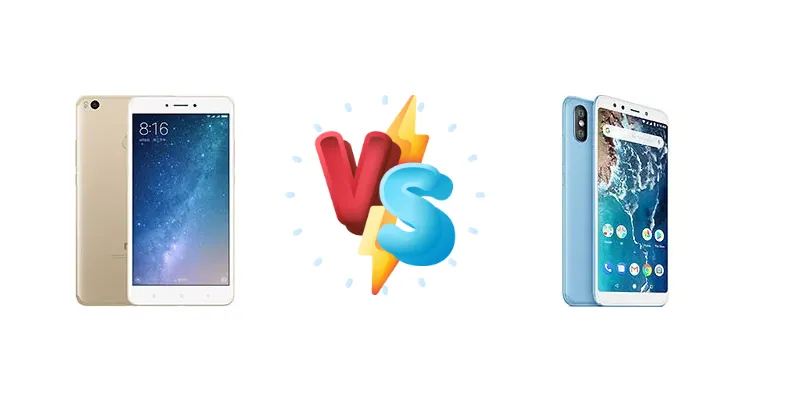
Xiaomi consistently delivers impressive value, and the Mi Max 2 and Mi A2 (Mi 6X) are prime examples. Both offer compelling features at competitive prices, but cater to different user needs. This comparison dives deep into their strengths and weaknesses to help you decide which phone is right for you.
🏆 Quick Verdict
The Mi A2 (Mi 6X) edges out the Mi Max 2 thanks to its superior processor, improved camera, and more modern design. While the Mi Max 2 boasts incredible battery life and a massive display, the Mi A2's overall performance and camera quality make it the better choice for most users.
| Network |
|---|
| 2G bands | GSM 850 / 900 / 1800 / 1900 - SIM 1 & SIM 2 | GSM 850 / 900 / 1800 / 1900 |
| 3G bands | HSDPA 850 / 900 / 1900 / 2100 | HSDPA 850 / 900 / 1700(AWS) / 1900 / 2100 - Global |
| 4G bands | 1, 3, 5, 7, 8, 38, 39, 40, 41 | 1, 2, 3, 4, 5, 7, 8, 20, 38, 40 - Global |
| Speed | HSPA 42.2/5.76 Mbps, LTE (2CA) Cat6 300/50 Mbps | HSPA 42.2/5.76 Mbps, LTE (3CA) Cat12 600/150 Mbps |
| Technology | GSM / CDMA / HSPA / EVDO / LTE | GSM / CDMA / HSPA / LTE |
| | CDMA2000 1xEV-DO | 1, 3, 5, 7, 8, 34, 38, 39, 40, 41 - China |
| Launch |
|---|
| Announced | 2017, May. Released 2017, June | 2018, July 24. Released 2018, July |
| Status | Discontinued | Discontinued |
| Body |
|---|
| Build | Glass front (Gorilla Glass 3), aluminum back, aluminum frame | Glass front, aluminum back, aluminum frame |
| Dimensions | 174.1 x 88.7 x 7.6 mm (6.85 x 3.49 x 0.30 in) | 158.7 x 75.4 x 7.3 mm (6.25 x 2.97 x 0.29 in) |
| SIM | Nano-SIM + Micro-SIM | Nano-SIM + Nano-SIM |
| Weight | 211 g (7.44 oz) | 166 g (5.86 oz) |
| Display |
|---|
| Protection | Corning Gorilla Glass 3 | - |
| Resolution | 1080 x 1920 pixels, 16:9 ratio (~342 ppi density) | 1080 x 2160 pixels, 18:9 ratio (~403 ppi density) |
| Size | 6.44 inches, 114.3 cm2 (~74.0% screen-to-body ratio) | 5.99 inches, 92.6 cm2 (~77.4% screen-to-body ratio) |
| Type | IPS LCD | IPS LCD |
| Platform |
|---|
| CPU | Octa-core 2.0 GHz Cortex-A53 | Octa-core (4x2.2 GHz Kryo 260 Gold & 4x1.8 GHz Kryo 260 Silver) |
| Chipset | Qualcomm MSM8953 Snapdragon 625 (14 nm) | Qualcomm SDM660 Snapdragon 660 (14 nm) |
| GPU | Adreno 506 | Adreno 512 |
| OS | Android 7.1.1 (Nougat), MIUI 11 | Android 8.1 (Oreo), upgradable to Android 9.0 (Pie), Android One |
| Memory |
|---|
| Card slot | microSDXC (uses shared SIM slot) | No |
| Internal | 32GB 4GB RAM, 64GB 4GB RAM, 128GB 4GB RAM | 32GB 4GB RAM, 64GB 4GB RAM, 128GB 6GB RAM |
| | eMMC 5.1 | eMMC 5.1 |
| Main Camera |
|---|
| Dual | - | 12 MP, f/1.8, 1/2.9", 1.25µm
20 MP, f/1.8, 1/2.8", 1.0µm, PDAF |
| Features | Dual-LED dual-tone flash, HDR, panorama | Dual-LED flash, HDR, panorama |
| Single | 12 MP, f/2.2, 1/2.9", 1.25µm, PDAF | - |
| Video | 4K@30fps, 720p@120fps | 4K@30fps, 1080p@30fps (gyro-EIS), 720p@120fps |
| Selfie camera |
|---|
| Features | - | LED flash, HDR |
| Single | 5 MP, f/2.0 | 20 MP, f/2.2, (wide), 1/3", 0.9µm |
| Video | 1080p@30fps | 1080p@30fps |
| Sound |
|---|
| 3.5mm jack | Yes | No |
| 35mm jack | Yes | No |
| Loudspeaker | Yes, with stereo speakers | Yes |
| Comms |
|---|
| Bluetooth | 4.2, A2DP, LE | 5.0, A2DP, LE |
| Infrared port | Yes | Yes |
| NFC | No | No |
| Positioning | GPS, GLONASS, BDS | GPS, GLONASS, BDS |
| Radio | FM radio | No |
| USB | USB Type-C | USB Type-C 2.0 |
| WLAN | Wi-Fi 802.11 a/b/g/n/ac, dual-band, Wi-Fi Direct, DLNA | Wi-Fi 802.11 a/b/g/n/ac, dual-band, Wi-Fi Direct |
| Features |
|---|
| Sensors | Fingerprint (rear-mounted), accelerometer, gyro, proximity, compass | Fingerprint (rear-mounted), accelerometer, gyro, proximity, compass |
| Battery |
|---|
| Charging | 18W wired, QC3 | 18W wired, QC3 (Global)
18W wired, QC4 (India) |
| Type | Li-Ion 5300 mAh, non-removable | Li-Po 3000 mAh, non-removable |
| Misc |
|---|
| Colors | Gold, Matte Black | Black, Gold, Blue, Red, Rose Gold |
| Models | MDE40, MDI40 | M1804D2SG, M1804D2SI, Mi A2, Mi 6X |
| Price | About 200 EUR | About 270 EUR |
| SAR | 1.22 W/kg (head) 0.71 W/kg (body) | 0.96 W/kg (head) 0.64 W/kg (body) |
| SAR EU | - | 1.16 W/kg (head) 0.66 W/kg (body) |
| Tests |
|---|
| Audio quality |
Noise -93.4dB / Crosstalk -98.8dB | - |
| Battery life |
Endurance rating 126h
|
Endurance rating 73h
|
| Camera |
Photo / Video |
Photo / Video |
| Display |
Contrast ratio: 1294:1 (nominal), 2.561 (sunlight) | - |
| Loudspeaker |
Voice 78dB / Noise 71dB / Ring 79dB
|
Voice 89dB / Noise 72dB / Ring 89dB
|
| Performance |
GeekBench: 2445 (v4.4)
GFXBench: 3.5fps (ES 3.1 onscreen) |
AnTuTu: 130927 (v7), 172886 (v8)
GeekBench: 4625 (v4.4), 1157 (v5.1)
GFXBench: 8.6fps (ES 3.1 onscreen) |
Xiaomi Mi Max 2
- Exceptional battery life
- Large, immersive display
- Good value for money
- Expandable storage (microSD card slot)
- Slower processor
- Less impressive camera
- Larger and heavier design
- Outdated design
Xiaomi Mi A2 (Mi 6X)
- Faster processor (Snapdragon 660)
- Better camera quality
- More compact and modern design
- Clean Android One experience
- Shorter battery life
- No microSD card slot
- Smaller display compared to Mi Max 2
Display Comparison
The Mi Max 2 takes the display crown with its massive 6.44-inch screen. Its contrast ratio of 1294:1 (nominal) and impressive 2561 (sunlight) reading suggest excellent outdoor visibility. The Mi A2 features a smaller 5.99-inch display, which is more pocketable but offers a slightly less immersive experience. Both displays are LCD panels, not OLED, so color accuracy and black levels aren't as deep as on premium phones.
Camera Comparison
The Mi A2 (Mi 6X) boasts a superior camera system. While both phones offer decent photo and video capabilities, the Mi A2's improved image processing and dual-lens setup (typically 12MP + 5MP) result in better image quality, especially in low light. The Mi Max 2's camera is adequate but lacks the Mi A2's sharpness and dynamic range. The Mi A2 also often features better software and AI enhancements.
Performance
The Mi A2 (Mi 6X) clearly wins in the performance department. Its Snapdragon 660 chipset is significantly faster and more efficient than the Mi Max 2's Snapdragon 625. The Mi A2's Kryo 260 cores offer a noticeable boost in responsiveness and multitasking capabilities. The Mi Max 2, while capable, can feel sluggish at times, especially with demanding apps.
Battery Life
The Mi Max 2 is the undisputed champion of battery life. Its massive 5300mAh battery delivers exceptional endurance, as evidenced by its 126h endurance rating. The Mi A2's 3010mAh battery is respectable but falls far short of the Mi Max 2's longevity, with an endurance rating of 73h.
Buying Guide
The Xiaomi Mi Max 2 is ideal for users prioritizing battery life and a large screen for media consumption. It's a great option for those who value longevity over raw performance. The Xiaomi Mi A2 (Mi 6X) is perfect for users who want a balanced smartphone experience with a good camera, snappy performance, and a more compact design. It's a solid choice for everyday use and photography.
Frequently Asked Questions
❓ Is the Mi A2 worth the upgrade from an older Xiaomi phone?
Yes, especially if you're coming from a phone with an older processor or a less capable camera. The Snapdragon 660 and improved camera make a noticeable difference.
❓ Does the Mi Max 2 still get software updates?
Software updates for the Mi Max 2 are less frequent now, as it's an older device. The Mi A2, being an Android One phone, generally receives updates for a longer period.