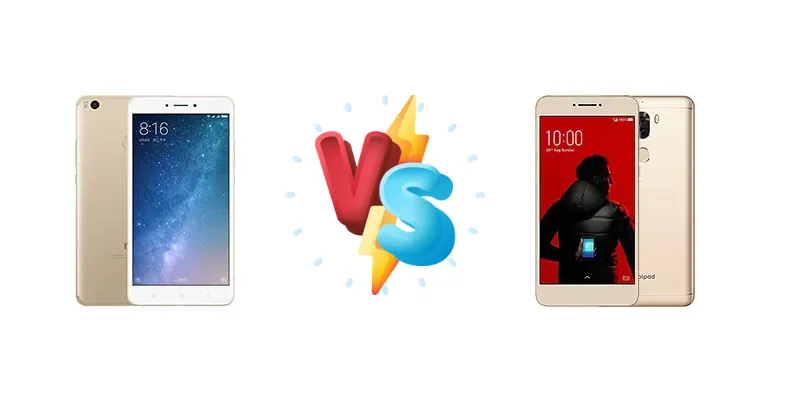
The Xiaomi Mi Max 2 and Coolpad Cool Play 6 were both contenders in the budget smartphone market. Both offered large screens and decent specs, but which one ultimately delivered a better experience? This comprehensive comparison dives deep into their features to help you decide.
🏆 Quick Verdict
The Xiaomi Mi Max 2 edges out the Coolpad Cool Play 6 thanks to its superior battery life and excellent sunlight display performance. While the Coolpad boasts a slightly more modern chipset, the Mi Max 2's longevity and screen visibility make it the more practical choice for most users.
| Network |
|---|
| 2G bands | GSM 850 / 900 / 1800 / 1900 - SIM 1 & SIM 2 | GSM 850 / 900 / 1800 / 1900 - SIM 1 & SIM 2 |
| 3G bands | HSDPA 850 / 900 / 1900 / 2100 | HSDPA 850 / 900 / 1900 / 2100 |
| 4G bands | 1, 3, 5, 7, 8, 38, 39, 40, 41 | 1, 3, 5, 7, 8, 38, 39, 40, 41 |
| Speed | HSPA 42.2/5.76 Mbps, LTE (2CA) Cat6 300/50 Mbps | HSPA, LTE |
| Technology | GSM / CDMA / HSPA / EVDO / LTE | GSM / CDMA / HSPA / LTE |
| | CDMA2000 1xEV-DO | CDMA 800 / 1900 & TD-SCDMA |
| Launch |
|---|
| Announced | 2017, May. Released 2017, June | 2017, August. Released 2017, September |
| Status | Discontinued | Discontinued |
| Body |
|---|
| Build | Glass front (Gorilla Glass 3), aluminum back, aluminum frame | - |
| Dimensions | 174.1 x 88.7 x 7.6 mm (6.85 x 3.49 x 0.30 in) | 152 x 75.2 x 8.5 mm (5.98 x 2.96 x 0.33 in) |
| SIM | Nano-SIM + Micro-SIM | Nano-SIM + Nano-SIM |
| Weight | 211 g (7.44 oz) | 175 g (6.17 oz) |
| Display |
|---|
| Protection | Corning Gorilla Glass 3 | - |
| Resolution | 1080 x 1920 pixels, 16:9 ratio (~342 ppi density) | 1080 x 1920 pixels, 16:9 ratio (~401 ppi density) |
| Size | 6.44 inches, 114.3 cm2 (~74.0% screen-to-body ratio) | 5.5 inches, 83.4 cm2 (~73.0% screen-to-body ratio) |
| Type | IPS LCD | IPS LCD |
| Platform |
|---|
| CPU | Octa-core 2.0 GHz Cortex-A53 | Octa-core (4x1.5 GHz Cortex-A53 & 4x2.0 GHz Cortex-A72) |
| Chipset | Qualcomm MSM8953 Snapdragon 625 (14 nm) | Qualcomm MSM8976 Pro Snapdragon 653 (28 nm) |
| GPU | Adreno 506 | Adreno 510 |
| OS | Android 7.1.1 (Nougat), MIUI 11 | Android 7.1.1 (Nougat), Journey UI |
| Memory |
|---|
| Card slot | microSDXC (uses shared SIM slot) | No |
| Internal | 32GB 4GB RAM, 64GB 4GB RAM, 128GB 4GB RAM | 64GB 6GB RAM |
| | eMMC 5.1 | eMMC 5.1 |
| Main Camera |
|---|
| Features | Dual-LED dual-tone flash, HDR, panorama | Dual-LED dual-tone flash, panorama, HDR |
| Single | 12 MP, f/2.2, 1/2.9", 1.25µm, PDAF | 13 MP, f/2.0, PDAF
13 MP |
| Video | 4K@30fps, 720p@120fps | 4K@30fps, 1080p@30fps |
| Selfie camera |
|---|
| Single | 5 MP, f/2.0 | 8 MP, f/2.2, 1/3.2", 1.4µm |
| Video | 1080p@30fps | 1080p@30fps |
| Sound |
|---|
| 3.5mm jack | Yes | Yes |
| 35mm jack | Yes | Yes |
| Loudspeaker | Yes, with stereo speakers | Yes |
| Comms |
|---|
| Bluetooth | 4.2, A2DP, LE | 4.1, A2DP, LE |
| Infrared port | Yes | Yes |
| NFC | No | No |
| Positioning | GPS, GLONASS, BDS | GPS |
| Radio | FM radio | No |
| USB | USB Type-C | USB Type-C 2.0 |
| WLAN | Wi-Fi 802.11 a/b/g/n/ac, dual-band, Wi-Fi Direct, DLNA | Wi-Fi 802.11 a/b/g/n, dual-band, Wi-Fi Direct |
| Features |
|---|
| Sensors | Fingerprint (rear-mounted), accelerometer, gyro, proximity, compass | Fingerprint (rear-mounted), accelerometer, gyro, proximity, compass |
| Battery |
|---|
| Charging | 18W wired, QC3 | - |
| Type | Li-Ion 5300 mAh, non-removable | Li-Ion 4060 mAh, non-removable |
| Misc |
|---|
| Colors | Gold, Matte Black | Gold, Black |
| Models | MDE40, MDI40 | COR-I0 |
| Price | About 200 EUR | About 15000 INR |
| SAR | 1.22 W/kg (head) 0.71 W/kg (body) | - |
| Tests |
|---|
| Audio quality |
Noise -93.4dB / Crosstalk -98.8dB | - |
| Battery life |
Endurance rating 126h
| - |
| Camera |
Photo / Video | - |
| Display |
Contrast ratio: 1294:1 (nominal), 2.561 (sunlight) | - |
| Loudspeaker |
Voice 78dB / Noise 71dB / Ring 79dB
| - |
| Performance |
GeekBench: 2445 (v4.4)
GFXBench: 3.5fps (ES 3.1 onscreen) | - |
Xiaomi Mi Max 2
- Exceptional battery life (126h endurance)
- Excellent sunlight display readability
- Large, immersive display
- Efficient Snapdragon 625 chipset
- Camera details are limited
- Design may feel bulky due to large size
- Potentially slower than Coolpad in some benchmarks
Coolpad Cool Play 6
- Slightly more modern chipset (Snapdragon 653)
- More compact size
- Potentially better multi-core performance
- Significantly shorter battery life
- Inferior sunlight display performance
- Camera details are limited
- Less immersive display
Display Comparison
The Xiaomi Mi Max 2 features a massive 6.44-inch display with a contrast ratio of 1294:1 (nominal) and an impressive 2561:1 in sunlight. This exceptional sunlight readability is a major advantage. The Coolpad Cool Play 6 has a 5.5-inch display, offering a more compact experience, but lacks the Mi Max 2's superior contrast and sunlight performance. Resolution is likely similar, but the Mi Max 2's size provides a more immersive viewing experience.
Camera Comparison
Camera details are limited for both devices. Both likely feature standard camera setups for their time. Image quality will depend on software processing and sensor size, which are not explicitly detailed. Expect decent photos in good lighting conditions from both, but low-light performance will likely be average.
Performance
The Coolpad Cool Play 6 utilizes a Snapdragon 653 chipset with a combination of Cortex-A53 and Cortex-A72 cores, potentially offering a slight edge in multi-core performance. However, the Xiaomi Mi Max 2's Snapdragon 625 is still a capable performer, known for its efficiency. Real-world performance differences are likely minimal for everyday tasks.
Battery Life
The Xiaomi Mi Max 2 shines in this category. Its endurance rating of 126 hours is exceptional, indicating significantly longer battery life than the Coolpad Cool Play 6. This is a major selling point for users who need a phone that can last through multiple days on a single charge.
Buying Guide
The Xiaomi Mi Max 2 is ideal for users prioritizing battery life, a large screen for media consumption, and excellent outdoor visibility. The Coolpad Cool Play 6 might appeal to those seeking a slightly faster processor for gaming, though the difference is marginal and often outweighed by the Mi Max 2's strengths.
Frequently Asked Questions
❓ Which phone is better for gaming?
The Coolpad Cool Play 6's Snapdragon 653 might offer a slight edge in some games, but the difference is likely minimal. The Mi Max 2's larger screen could be beneficial for certain games.
❓ Is the Xiaomi Mi Max 2 worth buying in 2024?
Given its age, finding a new Mi Max 2 is unlikely. If you can find a used one in good condition and at a very low price, the battery life and large screen still make it a decent option for basic use. However, newer budget phones offer significantly better features and performance.