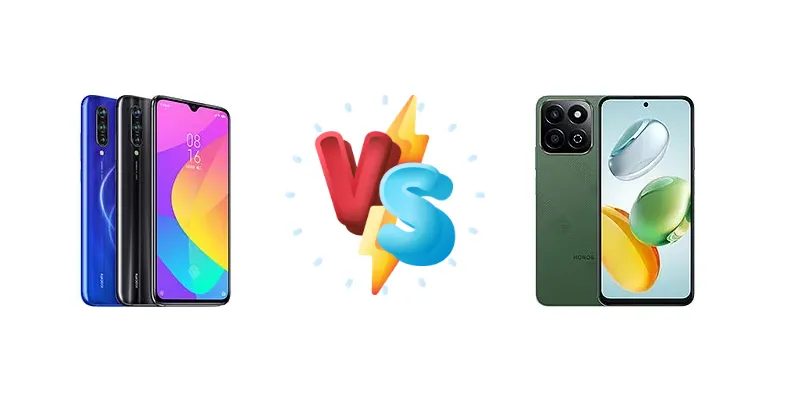
The Xiaomi Mi CC9, released in 2019, represents a mature design from a period of rapid innovation. The Honor 200 Smart, a more recent offering, aims to deliver modern features at an accessible price point. This comparison dissects the core differences between these two Snapdragon-powered devices, focusing on how their chipsets and charging capabilities impact the user experience.
🏆 Quick Verdict
For the average user prioritizing fast charging and a more modern chipset, the Honor 200 Smart is the clear winner. Its Snapdragon 4 Gen 2, built on a 4nm process, offers improved efficiency and performance over the Mi CC9’s older Snapdragon 710, and the 35W charging significantly reduces downtime.
| Network |
|---|
| 2G bands | GSM 850 / 900 / 1800 / 1900 | GSM 850 / 900 / 1800 / 1900 |
| 3G bands | HSDPA 850 / 900 / 1900 / 2100 | HSDPA 850 / 900 / 1700(AWS) / 1900 / 2100 |
| 4G bands | 1, 3, 5, 8, 34, 38, 39, 40, 41 | LTE |
| 5G bands | - | SA/NSA |
| Speed | HSPA, LTE | HSPA, LTE, 5G |
| Technology | GSM / CDMA / HSPA / LTE | GSM / HSPA / LTE / 5G |
| | CDMA 800 & TD-SCDMA | - |
| Launch |
|---|
| Announced | 2019, July. Released 2019, July | 2024, September 17 |
| Status | Discontinued | Available. Released 2024, September 23 |
| Body |
|---|
| Build | Glass front (Gorilla Glass 5), glass back (Gorilla Glass 5), aluminum frame | - |
| Dimensions | 156.8 x 74.5 x 8.7 mm (6.17 x 2.93 x 0.34 in) | 166.9 x 76.8 x 8.1 mm (6.57 x 3.02 x 0.32 in) |
| SIM | Nano-SIM + Nano-SIM | Nano-SIM + Nano-SIM |
| Weight | 179 g (6.31 oz) | 191 g or 193 g (6.74 oz) |
| Display |
|---|
| Protection | Corning Gorilla Glass 5 | Aluminosilicate glass |
| Resolution | 1080 x 2340 pixels, 19.5:9 ratio (~403 ppi density) | 1080 x 2412 pixels, 20:9 ratio (~389 ppi density) |
| Size | 6.39 inches, 100.2 cm2 (~85.8% screen-to-body ratio) | 6.8 inches, 111.3 cm2 (~86.8% screen-to-body ratio) |
| Type | Super AMOLED, HDR, 430 nits (typ) | TFT LCD, 120Hz, 850 nits (peak) |
| Platform |
|---|
| CPU | Octa-core (2x2.2 GHz Kryo 360 Gold & 6x1.7 GHz Kryo 360 Silver) | Octa-core (2x2.2 GHz Cortex-A78 & 6x1.95 GHz Cortex-A55) |
| Chipset | Qualcomm SDM710 Snapdragon 710 (10 nm) | Qualcomm SM4450 Snapdragon 4 Gen 2 (4 nm) |
| GPU | Adreno 616 | Adreno 613 |
| OS | Android 9.0 (Pie), upgradable to Android 10, MIUI 11 | Android 14, Magic OS 8 |
| Memory |
|---|
| Card slot | microSDXC (uses shared SIM slot) | No |
| Internal | 64GB 6GB RAM, 128GB 6GB RAM, 256GB 8GB RAM | 256GB 4GB RAM, 256GB 8GB RAM |
| | UFS 2.1 | - |
| Main Camera |
|---|
| Dual | - | 50 MP, f/1.8, (wide), PDAF
Auxiliary lens |
| Features | LED flash, HDR, panorama | LED flash, HDR |
| Triple | 48 MP, f/1.8, (wide), 1/2.0", 0.8µm, PDAF
8 MP, (ultrawide), 1/4.0", 1.12µm
Auxiliary lens | - |
| Video | 4K@30fps, 1080p@30/60/120fps, 720p@960fps | 1080p@30fps |
| Selfie camera |
|---|
| Features | HDR | - |
| Single | 32 MP, f/2.0, 26mm (wide), 1/2.8", 0.8µm | 5 MP, f/2.2, (wide) |
| Video | 1080p@30fps | 1080p@30fps |
| Sound |
|---|
| 3.5mm jack | Yes | - |
| 35mm jack | Yes | Yes |
| Loudspeaker | Yes | Yes, with stereo speakers |
| Comms |
|---|
| Bluetooth | 5.0, A2DP, LE, aptX HD | 5.0, A2DP, LE |
| Infrared port | Yes | - |
| NFC | Yes | No |
| Positioning | GPS, GLONASS, GALILEO, BDS | GPS, GLONASS, GALILEO, BDS |
| Radio | FM radio | No |
| USB | USB Type-C 2.0 | USB Type-C 2.0, OTG |
| WLAN | Wi-Fi 802.11 a/b/g/n/ac, dual-band, Wi-Fi Direct | Wi-Fi 802.11 a/b/g/n/ac, dual-band, Wi-Fi Direct |
| Features |
|---|
| Sensors | Fingerprint (under display, optical), accelerometer, gyro, proximity, compass | Fingerprint (side-mounted), accelerometer, proximity, compass |
| Battery |
|---|
| Charging | 18W wired | 35W wired |
| Type | Li-Po 4030 mAh, non-removable | Li-Po 5200 mAh |
| Misc |
|---|
| Colors | Black, Blue, White | Midnight Black, Forest Green |
| Models | - | ALT-NX1 |
| Price | About 260 EUR | € 109.99 / £ 114.99 |
Xiaomi Mi CC9
- Proven reliability and software support (despite age)
- Potentially vibrant AMOLED display (based on Xiaomi's history)
- Established user base and community
- Older Snapdragon 710 chipset is less efficient
- Slow 18W charging
- Likely limited software updates
Honor 200 Smart
- More efficient Snapdragon 4 Gen 2 (4nm)
- Significantly faster 35W charging
- Modern chipset with improved performance
- May have less refined software experience compared to Xiaomi
- Potentially lower build quality to meet price point
- Long-term software support is uncertain
Display Comparison
Neither device's display specifications are provided, so a direct comparison is limited. However, given the Mi CC9's release date, it likely features an AMOLED panel, a common feature for Xiaomi at the time. The Honor 200 Smart, being newer, may benefit from advancements in panel technology, potentially offering higher peak brightness and improved color accuracy. The absence of refresh rate data suggests both likely operate at a standard 60Hz.
Camera Comparison
Without specific camera sensor details, a detailed comparison is challenging. However, the market positioning of both devices suggests a focus on affordability. The Mi CC9 likely features a primary sensor capable of decent image quality in good lighting conditions. The Honor 200 Smart, benefiting from newer image processing algorithms, may offer improved low-light performance and dynamic range. It's reasonable to assume both phones include multiple rear cameras, but the quality of secondary sensors (ultrawide, depth) is likely to be modest.
Performance
The core difference lies in the chipsets. The Xiaomi Mi CC9’s Snapdragon 710 (10nm) utilizes Kryo 360 cores, offering a balance between performance and efficiency for its time. The Honor 200 Smart’s Snapdragon 4 Gen 2 (4nm) represents a significant leap in process technology. The 4nm node allows for greater transistor density and improved power efficiency, meaning the 4 Gen 2 can deliver comparable or better performance than the 710 while consuming less power. The Cortex-A78 cores in the 4 Gen 2 also offer a performance advantage over the Kryo 360 Gold cores in the 710. This translates to snappier app launches and smoother multitasking for the Honor 200 Smart.
Battery Life
Battery capacity isn't specified for either device. However, the charging speeds are a key differentiator. The Mi CC9’s 18W wired charging is relatively slow by today’s standards, requiring a significant amount of time to fully charge. The Honor 200 Smart’s 35W wired charging is considerably faster, allowing for a substantial top-up in a short period. This faster charging is particularly beneficial for users who frequently find themselves with low battery levels and need a quick power boost. Even with a similar battery capacity, the Honor 200 Smart’s charging speed provides a more convenient user experience.
Buying Guide
Buy the Xiaomi Mi CC9 if you prioritize a proven track record and are comfortable with slower charging speeds. It’s a solid choice for users who need a reliable device for basic tasks and aren’t demanding gamers. Buy the Honor 200 Smart if you value faster charging, a more efficient processor, and a device that feels more current, making it ideal for users who frequently use their phone on the go and appreciate quicker power-ups.
Frequently Asked Questions
❓ Will the Snapdragon 4 Gen 2 in the Honor 200 Smart handle demanding games like PUBG Mobile?
The Snapdragon 4 Gen 2 is a capable chipset for casual gaming. While it won't deliver the highest frame rates at maximum settings, it should provide a playable experience in PUBG Mobile at medium settings. The 4nm process also helps with thermal management, reducing the likelihood of significant throttling during extended gaming sessions.
❓ Is the slower 18W charging on the Xiaomi Mi CC9 a dealbreaker for everyday use?
For users who don't mind charging their phone overnight or have ample time to top up throughout the day, the 18W charging on the Mi CC9 isn't necessarily a dealbreaker. However, if you frequently find yourself needing a quick charge, the Honor 200 Smart’s 35W charging will be significantly more convenient.
❓ How does the older Snapdragon 710 compare to the Snapdragon 4 Gen 2 in terms of long-term software support?
The Snapdragon 710, being an older chipset, is likely nearing the end of its software support lifecycle. The Snapdragon 4 Gen 2, being newer, will likely receive updates for a longer period, ensuring compatibility with future Android versions and security patches.