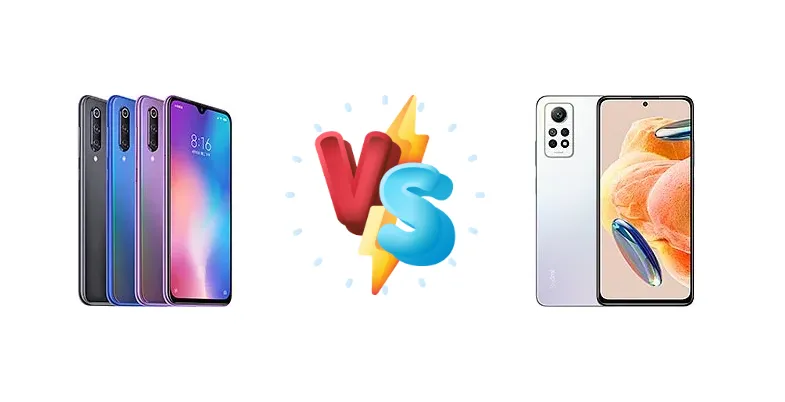
Choosing a new smartphone can be overwhelming, especially with so many options from Xiaomi. The Mi 9 SE was a compact powerhouse, while the Redmi Note 12 Pro 4G offers modern features and fast charging. Let's break down these two devices to see which one reigns supreme.
🏆 Quick Verdict
The Redmi Note 12 Pro 4G takes the win thanks to its significantly faster charging, more modern chipset, and improved overall feature set. While the Mi 9 SE boasts impressive battery life, the Note 12 Pro's advancements make it the better choice for most users.
| Network |
|---|
| 2G bands | GSM 850 / 900 / 1800 / 1900 | GSM 850 / 900 / 1800 / 1900 |
| 3G bands | HSDPA 850 / 900 / 1900 / 2100 | HSDPA 850 / 900 / 1700(AWS) / 1900 / 2100 |
| 4G bands | 1, 3, 4, 5, 7, 8, 20, 38, 40 - Global | 1, 2, 3, 4, 5, 7, 8, 20, 28, 38, 40, 41, 66 |
| Speed | HSPA, LTE | HSPA, LTE |
| Technology | GSM / CDMA / HSPA / LTE | GSM / HSPA / LTE |
| | 1, 3, 5, 7, 8, 34, 38, 39, 40, 41 - China | - |
| Launch |
|---|
| Announced | 2019, February 20. Released 2019, March | 2023, March 03 |
| Status | Discontinued | Available. Released 2023, April 11 |
| Body |
|---|
| Build | Glass front (Gorilla Glass 5), glass back, aluminum frame | - |
| Dimensions | 147.5 x 70.5 x 7.5 mm (5.81 x 2.78 x 0.30 in) | 164.2 x 76.1 x 8.1 mm (6.46 x 3.00 x 0.32 in) |
| SIM | Nano-SIM + Nano-SIM | Nano-SIM + Nano-SIM |
| Weight | 155 g (5.47 oz) | 201.8 g (7.13 oz) |
| Display |
|---|
| Protection | Corning Gorilla Glass 5 | - |
| Resolution | 1080 x 2340 pixels, 19.5:9 ratio (~432 ppi density) | 1080 x 2400 pixels, 20:9 ratio (~395 ppi density) |
| Size | 5.97 inches, 87.5 cm2 (~84.1% screen-to-body ratio) | 6.67 inches, 107.4 cm2 (~86.0% screen-to-body ratio) |
| Type | Super AMOLED, HDR | AMOLED, 120Hz, Dolby Vision, 700 nits (HBM), 1100 nits (peak) |
| Platform |
|---|
| CPU | Octa-core (2x2.3 GHz Kryo 360 Gold & 6x1.7 GHz Kryo 360 Silver) | Octa-core (2x2.2 GHz Kryo 470 Gold & 6x1.8 GHz Kryo 470 Silver) |
| Chipset | Qualcomm SDM712 Snapdragon 712 (10 nm) | Qualcomm SM7150 Snapdragon 732G (8 nm) |
| GPU | Adreno 616 | Adreno 618 |
| OS | Android 9.0 (Pie), upgradable to Android 11, MIUI 12.5 | Android 11, MIUI 13 |
| Memory |
|---|
| Card slot | No | microSDXC (uses shared SIM slot) |
| Internal | 64GB 6GB RAM, 128GB 6GB RAM | 128GB 6GB RAM, 128GB 8GB RAM, 256GB 8GB RAM |
| | UFS 2.0 | UFS 2.2 |
| Main Camera |
|---|
| Features | Dual-LED flash, HDR, panorama | LED flash, HDR, panorama |
| Quad | - | 108 MP, f/1.9, (wide), 1/1.52", 0.7µm, PDAF
8 MP, 120˚, (ultrawide)
2 MP (macro)
Auxiliary lens |
| Triple | 48 MP, f/1.8, (wide), 1/2.0", 0.8µm, PDAF
8 MP, f/2.4, (telephoto), 1/4.0", 1.12µm, PDAF
13 MP, f/2.4, (ultrawide), 1/3.1", 1.12µm | - |
| Video | 4K@30fps, 1080p@30/60/120fps, 720p@960fps, gyro-EIS | 4K@30fps, 1080p@30/60fps |
| Selfie camera |
|---|
| Features | HDR | - |
| Single | 20 MP, f/2.0, (wide), 1/3", 0.9µm | 16 MP, f/2.4, (wide) |
| Video | 1080p@30fps | 1080p@30fps |
| Sound |
|---|
| 3.5mm jack | No | Yes |
| 35mm jack | No | Yes |
| Loudspeaker | Yes | Yes, with stereo speakers |
| Comms |
|---|
| Bluetooth | 5.0, A2DP, LE, aptX HD | 5.0, A2DP, LE |
| Infrared port | Yes | Yes |
| NFC | Yes | Yes (market/region dependent) |
| Positioning | GPS, GLONASS, GALILEO, BDS | GPS, GLONASS, GALILEO, BDS |
| Radio | No | Unspecified |
| USB | USB Type-C 2.0, OTG | USB Type-C 2.0, OTG |
| WLAN | Wi-Fi 802.11 a/b/g/n/ac, dual-band, Wi-Fi Direct, DLNA | Wi-Fi 802.11 a/b/g/n/ac, dual-band |
| Features |
|---|
| Sensors | Fingerprint (under display, optical), accelerometer, gyro, compass | Fingerprint (side-mounted), accelerometer, gyro, compass |
| | Virtual proximity sensing | - |
| Battery |
|---|
| Charging | 18W wired | 67W wired |
| Type | Li-Po 3070 mAh, non-removable | Li-Po 5000 mAh |
| Misc |
|---|
| Colors | Violet, Blue, Gray | Star Blue, Graphite Gray, Polar White, Ice blue |
| Models | M1903F2G | 2209116AG, 2209116AG |
| Price | About 460 EUR | About 150 EUR |
| SAR | 1.39 W/kg (head) 1.39 W/kg (body) | - |
| SAR EU | 1.19 W/kg (head) 1.17 W/kg (body) | - |
| Tests |
|---|
| Audio quality |
Noise -93.5dB / Crosstalk -93.5dB | - |
| Battery life |
Endurance rating 73h
| - |
| Camera |
Photo / Video | - |
| Display |
Contrast ratio: Infinite (nominal) | - |
| Loudspeaker |
Voice 86dB / Noise 79dB / Ring 87dB
| - |
| Performance |
AnTuTu: 180057 (v7)
GeekBench: 6017 (v4.4)
GFXBench: 14fps (ES 3.1 onscreen) | - |
Xiaomi Mi 9 SE
- Compact and lightweight
- Excellent battery life
- Smooth performance for everyday tasks
- Good value (if found used)
- Older chipset
- Slower charging
- Outdated design
- Limited software updates
Xiaomi Redmi Note 12 Pro 4G
- Fast 67W charging
- More powerful Snapdragon 732G chipset
- Modern design
- Likely better camera system
- More frequent software updates
- Larger size
- Potentially less impressive battery life than Mi 9 SE (though charging compensates)
- May lack some premium features
Display Comparison
The Redmi Note 12 Pro 4G likely features a more modern AMOLED display with vibrant colors and deeper blacks, a significant upgrade over the Mi 9 SE's LCD. While the Mi 9 SE's 637 nits brightness is respectable, the Note 12 Pro's display will likely offer better outdoor visibility and a more immersive viewing experience. Resolution and refresh rate are also likely higher on the Note 12 Pro.
Camera Comparison
While both phones offer capable cameras, the Redmi Note 12 Pro 4G likely has a more versatile camera system with a higher resolution main sensor and potentially improved image processing. Expect better low-light performance and more detailed photos from the Note 12 Pro. The Mi 9 SE's camera is still good, but it shows its age.
Performance
The Snapdragon 732G in the Redmi Note 12 Pro 4G provides a noticeable performance boost over the Mi 9 SE's Snapdragon 712. Expect smoother multitasking, faster app loading times, and better gaming performance on the Note 12 Pro. The 8nm process also contributes to improved efficiency.
Battery Life
The Mi 9 SE's endurance rating of 73h is exceptional, suggesting incredible battery life. However, the Redmi Note 12 Pro 4G's 67W charging capability more than compensates for any potential battery life difference. You'll be able to top up the Note 12 Pro incredibly quickly, minimizing downtime.
Buying Guide
The Xiaomi Mi 9 SE is ideal for users prioritizing compact size, excellent battery life, and a smooth, albeit older, user experience. The Redmi Note 12 Pro 4G is perfect for those seeking fast charging, a more powerful processor, and a modern design, even if it's slightly larger.
Frequently Asked Questions
❓ Is the Mi 9 SE still worth buying?
If you prioritize a compact size and exceptional battery life and can find it at a very low price, the Mi 9 SE can still be a decent option. However, be aware of its age and limited software support.
❓ Which phone has better gaming performance?
The Redmi Note 12 Pro 4G's Snapdragon 732G offers significantly better gaming performance than the Mi 9 SE's Snapdragon 712.