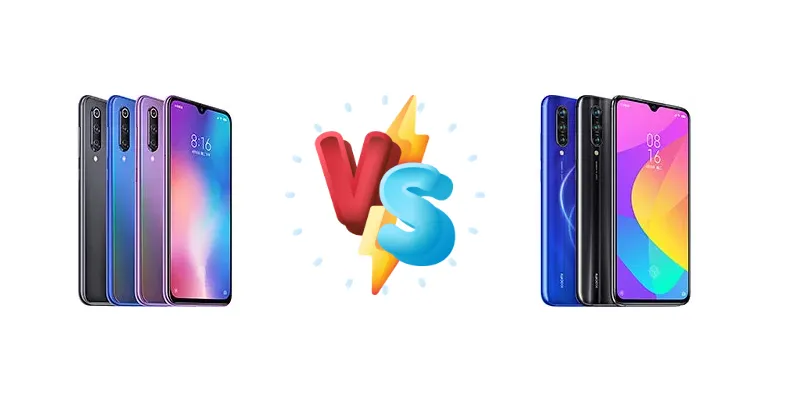
Xiaomi's Mi series consistently delivers impressive value, and the Mi 9 SE and Mi 9 Lite are no exception. Both offer compelling features at competitive prices, but cater to slightly different users. This comparison breaks down the key differences to help you choose the right phone for your needs.
🏆 Quick Verdict
The Xiaomi Mi 9 Lite edges out the Mi 9 SE thanks to its significantly longer battery life and slightly more modern design. While the Mi 9 SE boasts a marginally brighter display, the Mi 9 Lite's endurance and overall package make it the better choice for most users.
| Network |
|---|
| 2G bands | GSM 850 / 900 / 1800 / 1900 | GSM 850 / 900 / 1800 / 1900 |
| 3G bands | HSDPA 850 / 900 / 1900 / 2100 | HSDPA 850 / 900 / 1700(AWS) / 1900 / 2100 |
| 4G bands | 1, 3, 4, 5, 7, 8, 20, 38, 40 - Global | 1, 2, 3, 4, 5, 7, 8, 20, 28, 38, 40 |
| Speed | HSPA, LTE | HSPA, LTE |
| Technology | GSM / CDMA / HSPA / LTE | GSM / HSPA / LTE |
| | 1, 3, 5, 7, 8, 34, 38, 39, 40, 41 - China | - |
| Launch |
|---|
| Announced | 2019, February 20. Released 2019, March | 2019, September 16. Released 2019, September 16 |
| Status | Discontinued | Discontinued |
| Body |
|---|
| Build | Glass front (Gorilla Glass 5), glass back, aluminum frame | Glass front (Gorilla Glass 5), glass back (Gorilla Glass 5), aluminum frame |
| Dimensions | 147.5 x 70.5 x 7.5 mm (5.81 x 2.78 x 0.30 in) | 156.8 x 74.5 x 8.7 mm (6.17 x 2.93 x 0.34 in) |
| SIM | Nano-SIM + Nano-SIM | Nano-SIM + Nano-SIM |
| Weight | 155 g (5.47 oz) | 179 g (6.31 oz) |
| Display |
|---|
| Protection | Corning Gorilla Glass 5 | Corning Gorilla Glass 5 |
| Resolution | 1080 x 2340 pixels, 19.5:9 ratio (~432 ppi density) | 1080 x 2340 pixels, 19.5:9 ratio (~403 ppi density) |
| Size | 5.97 inches, 87.5 cm2 (~84.1% screen-to-body ratio) | 6.39 inches, 100.2 cm2 (~85.8% screen-to-body ratio) |
| Type | Super AMOLED, HDR | Super AMOLED, HDR, 430 nits (typ) |
| Platform |
|---|
| CPU | Octa-core (2x2.3 GHz Kryo 360 Gold & 6x1.7 GHz Kryo 360 Silver) | Octa-core (2x2.2 GHz Kryo 360 Gold & 6x1.7 GHz Kryo 360 Silver) |
| Chipset | Qualcomm SDM712 Snapdragon 712 (10 nm) | Qualcomm SDM710 Snapdragon 710 (10 nm) |
| GPU | Adreno 616 | Adreno 616 |
| OS | Android 9.0 (Pie), upgradable to Android 11, MIUI 12.5 | Android 9.0 (Pie), upgradable to Android 11, MIUI 12.5 |
| Memory |
|---|
| Card slot | No | microSDXC (uses shared SIM slot) |
| Internal | 64GB 6GB RAM, 128GB 6GB RAM | 64GB 6GB RAM, 128GB 6GB RAM |
| | UFS 2.0 | UFS 2.1 |
| Main Camera |
|---|
| Features | Dual-LED flash, HDR, panorama | LED flash, HDR, panorama |
| Triple | 48 MP, f/1.8, (wide), 1/2.0", 0.8µm, PDAF
8 MP, f/2.4, (telephoto), 1/4.0", 1.12µm, PDAF
13 MP, f/2.4, (ultrawide), 1/3.1", 1.12µm | 48 MP, f/1.8, (wide), 1/2.0", 0.8µm, PDAF
8 MP, (ultrawide), 1/4.0", 1.12µm
Auxiliary lens |
| Video | 4K@30fps, 1080p@30/60/120fps, 720p@960fps, gyro-EIS | 4K@30fps, 1080p@30/60/120fps, 720p@960fps |
| Selfie camera |
|---|
| Features | HDR | HDR |
| Single | 20 MP, f/2.0, (wide), 1/3", 0.9µm | 32 MP, f/2.0, 26mm (wide), 1/2.8", 0.8µm |
| Video | 1080p@30fps | 1080p@30fps |
| Sound |
|---|
| 3.5mm jack | No | Yes |
| 35mm jack | No | Yes |
| Loudspeaker | Yes | Yes |
| Comms |
|---|
| Bluetooth | 5.0, A2DP, LE, aptX HD | 5.0, A2DP, LE, aptX HD |
| Infrared port | Yes | Yes |
| NFC | Yes | Yes |
| Positioning | GPS, GLONASS, GALILEO, BDS | GPS, GLONASS, GALILEO, BDS |
| Radio | No | FM radio |
| USB | USB Type-C 2.0, OTG | USB Type-C 2.0 |
| WLAN | Wi-Fi 802.11 a/b/g/n/ac, dual-band, Wi-Fi Direct, DLNA | Wi-Fi 802.11 a/b/g/n/ac, dual-band, Wi-Fi Direct |
| Features |
|---|
| Sensors | Fingerprint (under display, optical), accelerometer, gyro, compass | Fingerprint (under display, optical), accelerometer, gyro, proximity, compass |
| | Virtual proximity sensing | - |
| Battery |
|---|
| Charging | 18W wired | 18W wired |
| Type | Li-Po 3070 mAh, non-removable | Li-Po 4030 mAh, non-removable |
| Misc |
|---|
| Colors | Violet, Blue, Gray | Pearl White, Aurora Blue, Onyx Grey |
| Models | M1903F2G | M1904F3BG |
| Price | About 460 EUR | About 320 EUR |
| SAR | 1.39 W/kg (head) 1.39 W/kg (body) | 1.19 W/kg (head) 1.15 W/kg (body) |
| SAR EU | 1.19 W/kg (head) 1.17 W/kg (body) | 1.42 W/kg (head) 1.40 W/kg (body) |
| Tests |
|---|
| Audio quality |
Noise -93.5dB / Crosstalk -93.5dB |
Noise -90.3dB / Crosstalk -93.1dB |
| Battery life |
Endurance rating 73h
|
Endurance rating 106h
|
| Camera |
Photo / Video |
Photo / Video |
| Display |
Contrast ratio: Infinite (nominal) |
Contrast ratio: Infinite (nominal) |
| Loudspeaker |
Voice 86dB / Noise 79dB / Ring 87dB
|
-30.2 LUFS (Below average)
|
| Performance |
AnTuTu: 180057 (v7)
GeekBench: 6017 (v4.4)
GFXBench: 14fps (ES 3.1 onscreen) |
AnTuTu: 175478 (v7), 215277 (v8)
GeekBench: 5989 (v4.4), 1518 (v5.1)
GFXBench: 12fps (ES 3.1 onscreen) |
Xiaomi Mi 9 SE
- Slightly brighter display
- More compact size
- Slightly better performance (Snapdragon 712)
- Shorter battery life
- Older chipset compared to some competitors
- Less modern design
Xiaomi Mi 9 Lite
- Excellent battery life
- Larger display
- More modern design
- Slightly better value
- Slightly dimmer display
- Slightly older chipset (Snapdragon 710)
Display Comparison
Both phones feature AMOLED displays, offering vibrant colors and deep blacks. The Mi 9 SE has a slightly higher peak brightness of 637 nits compared to the Mi 9 Lite's 597 nits, resulting in marginally better visibility in direct sunlight. However, both have an 'infinite' contrast ratio, a nominal value indicating excellent contrast. The Mi 9 Lite's slightly larger screen (6.39 inches vs 6.01 inches) also provides a more immersive viewing experience.
Camera Comparison
Both phones feature a triple-camera setup, typically including a main sensor, ultrawide lens, and depth sensor. While specific sensor details are not provided, both phones are capable of producing good quality photos in well-lit conditions. Low-light performance is adequate but not exceptional. Video recording capabilities are similar on both devices, supporting up to 4K resolution.
Performance
The Mi 9 SE utilizes the Snapdragon 712, while the Mi 9 Lite uses the Snapdragon 710. While both are based on the Kryo 360 architecture, the 712 offers a slight performance advantage in both CPU and GPU benchmarks. However, in real-world usage, the difference is often negligible for everyday tasks. Both phones handle multitasking and moderate gaming well.
Battery Life
This is where the Mi 9 Lite truly shines. It boasts a significantly larger battery and an endurance rating of 106 hours, compared to the Mi 9 SE's 73 hours. This translates to considerably longer battery life for the Mi 9 Lite, easily lasting a full day even with heavy usage.
Buying Guide
The Xiaomi Mi 9 SE is ideal for users prioritizing a slightly brighter screen and a more compact form factor. It's a good option for those who don't heavily rely on their phone throughout the day. The Xiaomi Mi 9 Lite is better suited for users who need all-day battery life and appreciate a more contemporary aesthetic, making it a great choice for everyday use.
Frequently Asked Questions
❓ What is the difference in size between the Mi 9 SE and Mi 9 Lite?
The Mi 9 SE has a 6.01-inch display, while the Mi 9 Lite has a 6.39-inch display. The Mi 9 SE is also slightly more compact overall.
❓ Which phone is better for gaming?
The Mi 9 SE has a slightly more powerful chipset (Snapdragon 712), but the difference in gaming performance is likely to be minimal. Both phones can handle most mobile games well.