
Xiaomi Mi 9 SE vs Samsung Galaxy S22 5G: A Clash of Titans
| Phones Images | |||||
|---|---|---|---|---|---|
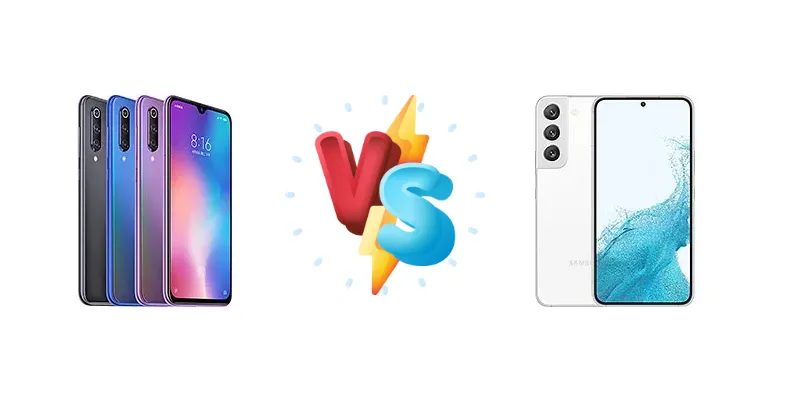
|
🏆 Quick Verdict
The Samsung Galaxy S22 5G is the clear winner, offering superior performance, a brighter display, a more versatile camera system, and faster charging. However, the Mi 9 SE remains a compelling option for budget-conscious buyers seeking a compact and reliable phone.
| PHONES | ||
|---|---|---|
| Phone Names | Xiaomi Mi 9 SE | Samsung Galaxy S22 5G |
| Network | ||
|---|---|---|
| 2G bands | GSM 850 / 900 / 1800 / 1900 | GSM 850 / 900 / 1800 / 1900 |
| 3G bands | HSDPA 850 / 900 / 1900 / 2100 | HSDPA 850 / 900 / 1700(AWS) / 1900 / 2100 |
| 4G bands | 1, 3, 4, 5, 7, 8, 20, 38, 40 - Global | 1, 2, 3, 4, 5, 7, 8, 12, 13, 17, 18, 19, 20, 25, 26, 28, 32, 38, 39, 40, 41, 66 - International |
| 5G bands | - | 1, 2, 3, 5, 7, 8, 12, 20, 25, 28, 38, 40, 41, 66, 75, 77, 78 SA/NSA/Sub6 - International |
| Speed | HSPA, LTE | HSPA 42.2/5.76 Mbps, LTE (7CA) Cat20 2000/200 Mbps, 5G (5+ Gbps DL) |
| Technology | GSM / CDMA / HSPA / LTE | GSM / CDMA / HSPA / EVDO / LTE / 5G |
| 1, 3, 5, 7, 8, 34, 38, 39, 40, 41 - China | 1, 3, 5, 7, 8, 20, 28, 38, 41, 66, 71, 260, 261 SA/NSA/Sub6/mmWave - USA | |
| Launch | ||
|---|---|---|
| Announced | 2019, February 20. Released 2019, March | 2022, February 09 |
| Status | Discontinued | Available. Released 2022, February 25 |
| Body | ||
|---|---|---|
| Build | Glass front (Gorilla Glass 5), glass back, aluminum frame | Glass front (Gorilla Glass Victus+), glass back (Gorilla Glass Victus+), aluminum frame |
| Dimensions | 147.5 x 70.5 x 7.5 mm (5.81 x 2.78 x 0.30 in) | 146 x 70.6 x 7.6 mm (5.75 x 2.78 x 0.30 in) |
| SIM | Nano-SIM + Nano-SIM | Nano-SIM + eSIM· Nano-SIM + Nano-SIM + eSIM (max 2 at a time) |
| Weight | 155 g (5.47 oz) | 167 g / 168 g (mmWave) (5.89 oz) |
| - | IP68 dust/water resistant (up to 1.5m for 30 min) Armor aluminum frame with tougher drop and scratch resistance (advertised) | |
| Display | ||
|---|---|---|
| Protection | Corning Gorilla Glass 5 | Corning Gorilla Glass Victus+ |
| Resolution | 1080 x 2340 pixels, 19.5:9 ratio (~432 ppi density) | 1080 x 2340 pixels, 19.5:9 ratio (~425 ppi density) |
| Size | 5.97 inches, 87.5 cm2 (~84.1% screen-to-body ratio) | 6.1 inches, 90.1 cm2 (~87.4% screen-to-body ratio) |
| Type | Super AMOLED, HDR | Dynamic AMOLED 2X, 120Hz, HDR10+, 1300 nits (peak) |
| - | Always-on display | |
| Platform | ||
|---|---|---|
| CPU | Octa-core (2x2.3 GHz Kryo 360 Gold & 6x1.7 GHz Kryo 360 Silver) | Octa-core (1x2.8 GHz Cortex-X2 & 3x2.50 GHz Cortex-A710 & 4x1.8 GHz Cortex-A510) - EuropeOcta-core (1x3.00 GHz Cortex-X2 & 3x2.50 GHz Cortex-A710 & 4x1.80 GHz Cortex-A510) - ROW |
| Chipset | Qualcomm SDM712 Snapdragon 712 (10 nm) | Exynos 2200 (4 nm) - EuropeQualcomm SM8450 Snapdragon 8 Gen 1 (4 nm) - ROW |
| GPU | Adreno 616 | Xclipse 920 - EuropeAdreno 730 - ROW |
| OS | Android 9.0 (Pie), upgradable to Android 11, MIUI 12.5 | Android 12, up to 4 major Android upgrades, One UI 8 |
| Memory | ||
|---|---|---|
| Card slot | No | No |
| Internal | 64GB 6GB RAM, 128GB 6GB RAM | 128GB 8GB RAM, 256GB 8GB RAM |
| UFS 2.0 | UFS 3.1 | |
| Main Camera | ||
|---|---|---|
| Features | Dual-LED flash, HDR, panorama | LED flash, auto-HDR, panorama |
| Single | - | 10 MP, f/2.2, 26mm (wide), 1/3.24", 1.22µm, Dual Pixel PDAF |
| Triple | 48 MP, f/1.8, (wide), 1/2.0", 0.8µm, PDAF 8 MP, f/2.4, (telephoto), 1/4.0", 1.12µm, PDAF 13 MP, f/2.4, (ultrawide), 1/3.1", 1.12µm | 50 MP, f/1.8, 23mm (wide), 1/1.56", 1.0µm, dual pixel PDAF, OIS 10 MP, f/2.4, 70mm (telephoto), 1/3.94", 1.0µm, PDAF, OIS, 3x optical zoom 12 MP, f/2.2, 13mm, 120˚ (ultrawide), 1/2.55" 1.4µm, Super Steady video |
| Video | 4K@30fps, 1080p@30/60/120fps, 720p@960fps, gyro-EIS | 8K@24fps, 4K@30/60fps, 1080p@30/60/120/240fps, HDR10+, stereo sound rec., gyro-EIS |
| Selfie camera | ||
|---|---|---|
| Features | HDR | HDR |
| Single | 20 MP, f/2.0, (wide), 1/3", 0.9µm | 10 MP, f/2.2, 26mm (wide), 1/3.24", 1.22µm, dual pixel PDAF |
| Video | 1080p@30fps | 4K@30/60fps, 1080p@30fps |
| Sound | ||
|---|---|---|
| 3.5mm jack | No | No |
| 35mm jack | No | No |
| Loudspeaker | Yes | Yes, with stereo speakers |
| - | 32-bit/384kHz audio Tuned by AKG | |
| Comms | ||
|---|---|---|
| Bluetooth | 5.0, A2DP, LE, aptX HD | 5.2, A2DP, LE |
| Infrared port | Yes | - |
| NFC | Yes | Yes |
| Positioning | GPS, GLONASS, GALILEO, BDS | GPS, GLONASS, BDS, GALILEO |
| Radio | No | No |
| USB | USB Type-C 2.0, OTG | USB Type-C 3.2, OTG |
| WLAN | Wi-Fi 802.11 a/b/g/n/ac, dual-band, Wi-Fi Direct, DLNA | Wi-Fi 802.11 a/b/g/n/ac/6, dual-band, Wi-Fi Direct |
| Features | ||
|---|---|---|
| Sensors | Fingerprint (under display, optical), accelerometer, gyro, compass | Fingerprint (under display, ultrasonic), accelerometer, gyro, proximity, compass, barometer |
| Virtual proximity sensing | Samsung DeX, Samsung Wireless DeX (desktop experience support) Bixby natural language commands and dictation Samsung Pay (Visa, MasterCard certified) | |
| Battery | ||
|---|---|---|
| Charging | 18W wired | 25W wired, PD3.0 15W wireless (Qi) 4.5W reverse wireless |
| Type | Li-Po 3070 mAh, non-removable | Li-Ion 3700 mAh |
| Misc | ||
|---|---|---|
| Colors | Violet, Blue, Gray | Phantom Black, White, Pink Gold, Green, Graphite, Sky Blue, Violet, Cream, Bora Purple |
| Models | M1903F2G | SM-S901B, SM-S901B/DS, SM-S901U, SM-S901U1, SM-S901W, SM-S901N, SM-S9010, SM-S901E, SM-S901E/DS |
| Price | About 460 EUR | $ 172.63 / C$ 304.00 / £ 186.11 / € 198.01 |
| SAR | 1.39 W/kg (head) 1.39 W/kg (body) | 1.03 W/kg (head) 1.15 W/kg (body) |
| SAR EU | 1.19 W/kg (head) 1.17 W/kg (body) | 1.21 W/kg (head) 1.59 W/kg (body) |
| Tests | ||
|---|---|---|
| Audio quality | Noise -93.5dB / Crosstalk -93.5dB | - |
| Battery life | Endurance rating 73h | Endurance rating 85h |
| Camera | Photo / Video | Photo / Video |
| Display | Contrast ratio: Infinite (nominal) | Contrast ratio: Infinite (nominal) |
| Loudspeaker | Voice 86dB / Noise 79dB / Ring 87dB | -26.4 LUFS (Good) |
| Performance | AnTuTu: 180057 (v7) GeekBench: 6017 (v4.4) GFXBench: 14fps (ES 3.1 onscreen) | AnTuTu: 745496 (v8), 881428 (v9) GeekBench: 3682 (v5.1) GFXBench: 69fps (ES 3.1 onscreen) |
Xiaomi Mi 9 SE
- Affordable
- Compact size
- Decent performance for everyday tasks
- Good battery life
- Outdated chipset
- Less impressive camera
- Slower charging
- Lower display brightness
Samsung Galaxy S22 5G
- Flagship performance
- Stunning display
- Excellent camera system
- Fast charging
- Premium design
- Expensive
- Can be bulky for some
- Battery life could be better (though still good)
Display Comparison
The Galaxy S22 5G’s display is significantly brighter (982 nits vs 637 nits) and offers a more vibrant and immersive viewing experience. Both have excellent contrast ratios (infinite nominal), but the S22’s higher resolution and dynamic AMOLED technology give it a noticeable edge. The Mi 9 SE’s display is perfectly adequate, but it can't match the flagship quality of the S22.
Camera Comparison
The Galaxy S22 5G’s camera system is far more advanced, offering better image quality, more features (like improved zoom and night mode), and more versatile video recording capabilities. While the Mi 9 SE takes decent photos in good lighting, it falls short in challenging conditions. The S22 consistently delivers superior results.
Performance
The Galaxy S22 5G’s Exynos 2200 or Snapdragon 8 Gen 1 chipset (depending on region) blows the Mi 9 SE’s Snapdragon 712 out of the water. Expect significantly faster app loading times, smoother multitasking, and better gaming performance on the S22. The Mi 9 SE is still capable for basic tasks, but struggles with demanding applications.
Battery Life
Both phones offer a respectable endurance rating of 73h, indicating similar battery life in typical usage. However, the S22 5G supports faster wired (25W) and wireless (15W) charging, as well as reverse wireless charging, providing greater convenience.
Buying Guide
The Xiaomi Mi 9 SE is ideal for users prioritizing affordability, a smaller form factor, and decent performance for everyday tasks. The Samsung Galaxy S22 5G is perfect for those who demand top-tier performance, a stunning display, a flagship camera, and are willing to pay a premium.