
Xiaomi Mi 9 SE vs Google Pixel 7a: A Head-to-Head Showdown
| Phones Images | |||||
|---|---|---|---|---|---|
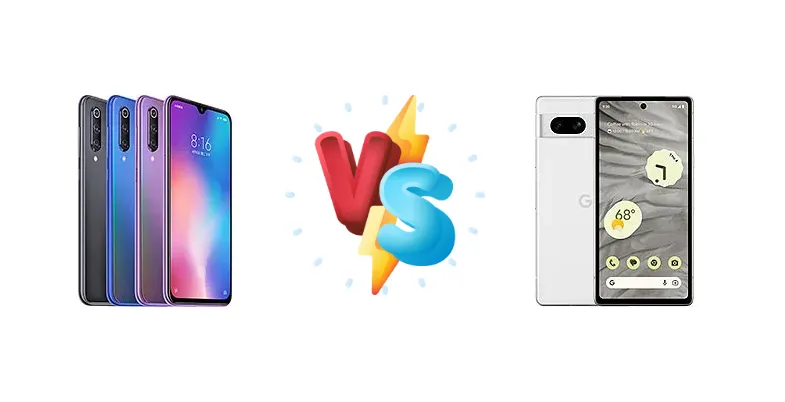
|
🏆 Quick Verdict
The Google Pixel 7a is the clear winner, offering a superior camera, faster processor, brighter display, and wireless charging. While the Mi 9 SE remains a capable device, the Pixel 7a's modern features and Google's software support make it the more compelling choice for most users.
| PHONES | ||
|---|---|---|
| Phone Names | Xiaomi Mi 9 SE | Google Pixel 7a |
| Network | ||
|---|---|---|
| 2G bands | GSM 850 / 900 / 1800 / 1900 | GSM 850 / 900 / 1800 / 1900 |
| 3G bands | HSDPA 850 / 900 / 1900 / 2100 | HSDPA 800 / 850 / 900 / 1700(AWS) / 1900 / 2100 |
| 4G bands | 1, 3, 4, 5, 7, 8, 20, 38, 40 - Global | 1, 2, 3, 4, 5, 7, 8, 12, 13, 14, 17, 20, 25, 26, 28, 29, 30, 38, 40, 41, 48, 66, 71 - GWKK3, G0DZQ |
| 5G bands | - | 1, 2, 3, 5, 7, 8, 12, 14, 20, 25, 28, 30, 38, 41, 48, 66, 71, 77, 78 SA/NSA/Sub6 - GWKK3 |
| Speed | HSPA, LTE | HSPA, LTE, 5G |
| Technology | GSM / CDMA / HSPA / LTE | GSM / HSPA / LTE / 5G |
| 1, 3, 5, 7, 8, 34, 38, 39, 40, 41 - China | 1, 2, 3, 5, 7, 8, 12, 20, 25, 28, 38, 40, 41, 66, 75, 76, 77, 78, 79 SA/NSA/Sub6 - GHL1X, G82U8 | |
| Launch | ||
|---|---|---|
| Announced | 2019, February 20. Released 2019, March | 2023, May 10 |
| Status | Discontinued | Available. Released 2023, May 10 |
| Body | ||
|---|---|---|
| Build | Glass front (Gorilla Glass 5), glass back, aluminum frame | Glass front (Gorilla Glass 3), aluminum frame, plastic back |
| Dimensions | 147.5 x 70.5 x 7.5 mm (5.81 x 2.78 x 0.30 in) | 152 x 72.9 x 9 mm (5.98 x 2.87 x 0.35 in) |
| SIM | Nano-SIM + Nano-SIM | Nano-SIM + eSIM |
| Weight | 155 g (5.47 oz) | 193.5 g (6.84 oz) |
| - | IP67 dust/water resistant (up to 1m for 30 min) | |
| Display | ||
|---|---|---|
| Protection | Corning Gorilla Glass 5 | Corning Gorilla Glass 3 |
| Resolution | 1080 x 2340 pixels, 19.5:9 ratio (~432 ppi density) | 1080 x 2400 pixels, 20:9 ratio (~429 ppi density) |
| Size | 5.97 inches, 87.5 cm2 (~84.1% screen-to-body ratio) | 6.1 inches, 90.7 cm2 (~81.8% screen-to-body ratio) |
| Type | Super AMOLED, HDR | OLED, HDR, 90Hz |
| - | Always-on display | |
| Platform | ||
|---|---|---|
| CPU | Octa-core (2x2.3 GHz Kryo 360 Gold & 6x1.7 GHz Kryo 360 Silver) | Octa-core (2x2.85 GHz Cortex-X1 & 2x2.35 GHz Cortex-A78 & 4x1.80 GHz Cortex-A55) |
| Chipset | Qualcomm SDM712 Snapdragon 712 (10 nm) | Google Tensor G2 (5 nm) |
| GPU | Adreno 616 | Mali-G710 MP7 |
| OS | Android 9.0 (Pie), upgradable to Android 11, MIUI 12.5 | Android 13, upgradable to Android 15, up to 5 major Android upgrades |
| Memory | ||
|---|---|---|
| Card slot | No | No |
| Internal | 64GB 6GB RAM, 128GB 6GB RAM | 128GB 8GB RAM |
| UFS 2.0 | UFS 3.1 | |
| Main Camera | ||
|---|---|---|
| Dual | - | 64 MP, f/1.9, 26mm (wide), 1/1.73", 0.8µm, dual pixel PDAF, OIS 13 MP, f/2.2, 120˚ (ultrawide), 1.12µm |
| Features | Dual-LED flash, HDR, panorama | Dual-LED flash, Pixel Shift, Auto-HDR, panorama |
| Triple | 48 MP, f/1.8, (wide), 1/2.0", 0.8µm, PDAF 8 MP, f/2.4, (telephoto), 1/4.0", 1.12µm, PDAF 13 MP, f/2.4, (ultrawide), 1/3.1", 1.12µm | - |
| Video | 4K@30fps, 1080p@30/60/120fps, 720p@960fps, gyro-EIS | 4K@30/60fps, 1080p@30/60/120/240fps, OIS |
| Selfie camera | ||
|---|---|---|
| Features | HDR | HDR, panorama |
| Single | 20 MP, f/2.0, (wide), 1/3", 0.9µm | 13 MP, f/2.2, 20mm (ultrawide), 1.12µm |
| Video | 1080p@30fps | 4K@30fps, 1080p@30fps |
| Sound | ||
|---|---|---|
| 3.5mm jack | No | No |
| 35mm jack | No | No |
| Loudspeaker | Yes | Yes, with stereo speakers |
| Comms | ||
|---|---|---|
| Bluetooth | 5.0, A2DP, LE, aptX HD | 5.3, A2DP, LE |
| Infrared port | Yes | - |
| NFC | Yes | Yes |
| Positioning | GPS, GLONASS, GALILEO, BDS | GPS, GLONASS, GALILEO, BDS, QZSS, NavIC |
| Radio | No | No |
| USB | USB Type-C 2.0, OTG | USB Type-C 3.2 |
| WLAN | Wi-Fi 802.11 a/b/g/n/ac, dual-band, Wi-Fi Direct, DLNA | Wi-Fi 802.11 a/b/g/n/ac/6e, tri-band |
| Features | ||
|---|---|---|
| Sensors | Fingerprint (under display, optical), accelerometer, gyro, compass | Fingerprint (under display, optical), accelerometer, gyro, proximity, compass, barometer |
| Virtual proximity sensing | - | |
| Battery | ||
|---|---|---|
| Charging | 18W wired | 18W wired, PD3.0 7.5W wireless |
| Type | Li-Po 3070 mAh, non-removable | Li-Po 4385 mAh |
| Misc | ||
|---|---|---|
| Colors | Violet, Blue, Gray | Charcoal, Snow, Sea, Coral |
| Models | M1903F2G | GWKK3, GHL1X, G0DZQ, G82U8 |
| Price | About 460 EUR | € 179.90 / $ 150.00 / £ 170.00 / ₹ 25,980 |
| SAR | 1.39 W/kg (head) 1.39 W/kg (body) | - |
| SAR EU | 1.19 W/kg (head) 1.17 W/kg (body) | - |
| Tests | ||
|---|---|---|
| Audio quality | Noise -93.5dB / Crosstalk -93.5dB | - |
| Battery life | Endurance rating 73h | - |
| Camera | Photo / Video | - |
| Display | Contrast ratio: Infinite (nominal) | - |
| Loudspeaker | Voice 86dB / Noise 79dB / Ring 87dB | - |
| Performance | AnTuTu: 180057 (v7) GeekBench: 6017 (v4.4) GFXBench: 14fps (ES 3.1 onscreen) | - |
Xiaomi Mi 9 SE
- Compact and lightweight design
- Affordable price
- Decent performance for everyday tasks
- Good battery life
- Outdated chipset
- Dim display
- Less impressive camera
- No wireless charging
Google Pixel 7a
- Excellent camera with Google's computational photography
- Fast and responsive performance with Tensor G2
- Bright and vibrant display
- Wireless charging
- Guaranteed software updates
- Slightly higher price
- Charging speed could be faster
Display Comparison
The Pixel 7a's display shines with a measured peak brightness of 1070 nits, significantly brighter than the Mi 9 SE's 637 nits. This makes the Pixel 7a much easier to view outdoors. Both offer good contrast, but the Pixel 7a's higher resolution and brightness provide a noticeably better visual experience. The Mi 9 SE's display is adequate, but lacks the vibrancy and clarity of the Pixel 7a.
Camera Comparison
Google's Pixel phones are renowned for their cameras, and the 7a is no exception. Its computational photography capabilities produce stunning images with excellent dynamic range and detail. The Mi 9 SE's camera is decent, but lacks the Pixel 7a's image processing prowess. The Pixel 7a consistently delivers better photos in various lighting conditions, making it the clear winner in this category.
Performance
The Google Pixel 7a's Google Tensor G2 chipset (5nm) blows the Mi 9 SE's Snapdragon 712 (10nm) out of the water. The Tensor G2's octa-core architecture, featuring Cortex-X1 and Cortex-A78 cores, delivers significantly faster processing speeds and smoother multitasking. The Mi 9 SE is still capable for everyday tasks, but struggles with demanding games and applications. The Pixel 7a offers a much more fluid and responsive user experience.
Battery Life
Both phones offer similar endurance ratings (73h vs 76h), suggesting comparable battery life in real-world usage. However, the Pixel 7a's more efficient chipset and the ability to charge wirelessly give it a slight edge in overall battery management.
Buying Guide
The Xiaomi Mi 9 SE is ideal for users prioritizing a compact form factor and a budget-friendly price. It's a good option for those who don't need the latest and greatest features. The Google Pixel 7a is perfect for photography enthusiasts, those seeking a smooth and responsive experience, and anyone who values Google's software updates and support.