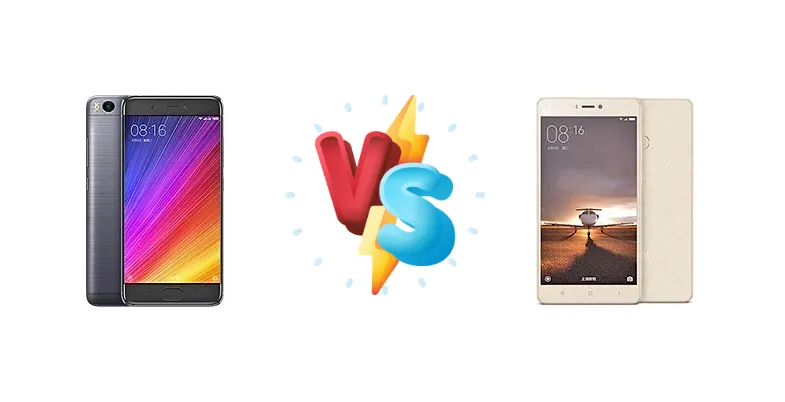
Xiaomi's Mi series has consistently offered impressive value for money. The Mi 4s and Mi 5s were popular choices, but which one holds up better today? This comprehensive comparison dives deep into their specs, performance, and features to help you decide.
🏆 Quick Verdict
The Xiaomi Mi 5s edges out the Mi 4s thanks to its superior Snapdragon 821 chipset, brighter display in sunlight, and slightly better battery endurance. While the Mi 4s remains a capable device, the Mi 5s offers a noticeable performance upgrade and a more modern experience.
| Network |
|---|
| 2G bands | GSM 850 / 900 / 1800 / 1900 - SIM 1 & SIM 2 | GSM 850 / 900 / 1800 / 1900 - SIM 1 & SIM 2 |
| 3G bands | HSDPA 850 / 900 / 1900 / 2100 | HSDPA 850 / 1900 / 2100 |
| 4G bands | 1, 3, 5, 7, 8, 38, 39, 40, 41 | 1, 3, 7, 38, 39, 40, 41 |
| Speed | HSPA 42.2/5.76 Mbps, LTE (4CA) Cat12 600/150 Mbps | HSPA, LTE Cat4 150/50 Mbps |
| Technology | GSM / CDMA / HSPA / EVDO / LTE | GSM / CDMA / HSPA / LTE |
| | CDMA2000 1xEV-DO | TD-SCDMA |
| Launch |
|---|
| Announced | 2016, September. Released 2016, October | 2016, February. Released 2016, March |
| Status | Discontinued | Discontinued |
| Body |
|---|
| Build | Glass front, aluminum back, aluminum frame | - |
| Dimensions | 145.6 x 70.3 x 8.3 mm (5.73 x 2.77 x 0.33 in) | 139.3 x 70.8 x 7.8 mm (5.48 x 2.79 x 0.31 in) |
| SIM | Nano-SIM + Nano-SIM | Nano-SIM + Micro-SIM |
| Weight | 145 g (5.11 oz) | 133 g (4.69 oz) |
| Display |
|---|
| Protection | To be confirmed | - |
| Resolution | 1080 x 1920 pixels, 16:9 ratio (~428 ppi density) | 1080 x 1920 pixels, 16:9 ratio (~441 ppi density) |
| Size | 5.15 inches, 73.1 cm2 (~71.4% screen-to-body ratio) | 5.0 inches, 68.9 cm2 (~69.9% screen-to-body ratio) |
| Type | IPS LCD | IPS LCD |
| | 3D Touch display (128 GB, 4 GB RAM model) | - |
| Platform |
|---|
| CPU | Quad-core (2x2.15 GHz Kryo & 2x1.6 GHz Kryo) | Hexa-core (4x1.4 GHz Cortex-A53 & 2x1.8 GHz Cortex-A57) |
| Chipset | Qualcomm MSM8996 Snapdragon 821 (14 nm) | Qualcomm MSM8992 Snapdragon 808 (20 nm) |
| GPU | Adreno 530 | Adreno 418 |
| OS | Android 6.0 (Marshmallow), upgradable to 7.0 (Nougat), MIUI 10 | Android 5.1 (Lollipop), upgradable to 7.0 (Nougat), MIUI 10 |
| Memory |
|---|
| Card slot | No | microSDXC (uses shared SIM slot) |
| Internal | 64GB 3GB RAM, 128GB 4GB RAM | 64GB 3GB RAM |
| | - | eMMC 5.0 |
| Main Camera |
|---|
| Features | Dual-LED dual-tone flash, panorama | Dual-LED dual-tone flash, panorama, HDR |
| Single | 12 MP, f/2.0, 1/2.3", 1.55µm, PDAF | 13 MP, f/2.0, PDAF |
| Triple | 16 MP, f/1.8, (wide), PDAF
8 MP, f/2.2, 13mm (ultrawide)
2 MP, f/2.4, (macro) | - |
| Video | 4K@30fps, 1080p@120fps | 1080p@30fps, 720p@120fps |
| Selfie camera |
|---|
| Features | HDR | - |
| Single | 4 MP, f/2.0, 1/3", 2µm | 5 MP, f/2.0 |
| Video | 1080p@30fps | 1080p@30fps |
| Sound |
|---|
| 3.5mm jack | Yes | Yes |
| 35mm jack | Yes | Yes |
| Loudspeaker | Yes | Yes |
| Comms |
|---|
| Bluetooth | 4.2, A2DP, LE | 4.1, A2DP |
| Infrared port | - | Yes |
| NFC | Yes | No |
| Positioning | GPS, GLONASS, BDS | GPS, GLONASS, BDS |
| Radio | No | No |
| USB | USB Type-C | USB Type-C |
| WLAN | Wi-Fi 802.11 a/b/g/n/ac, dual-band, Wi-Fi Direct, DLNA | Wi-Fi 802.11 a/b/g/n/ac, dual-band, Wi-Fi Direct, hotspot |
| Features |
|---|
| Sensors | Fingerprint (front-mounted), accelerometer, gyro, proximity, compass, barometer | Fingerprint (rear-mounted), accelerometer, gyro, proximity, compass |
| Battery |
|---|
| Charging | 18W wired, QC3 | 18W wired, QC2, 40% in 60 min |
| Type | Li-Ion 3200 mAh, non-removable | Li-Ion 3260 mAh, non-removable |
| Misc |
|---|
| Colors | Silver, Gray, Gold, Rose Gold | Black, White, Gold, Pink |
| Models | 2015711 | - |
| Price | About 250 EUR | About 220 EUR |
| SAR | 0.77 W/kg (head) 1.01 W/kg (body) | - |
| Tests |
|---|
| Audio quality |
Noise -89.6dB / Crosstalk -85.5dB |
Noise -94.9dB / Crosstalk -82.6dB |
| Battery life |
Endurance rating 84h
|
Endurance rating 75h
|
| Camera |
Photo / Video |
Photo / Video |
| Display |
Contrast ratio: 1294:1 (nominal), 3.276 (sunlight) |
Contrast ratio: 975:1 (nominal), 2.095 (sunlight) |
| Loudspeaker |
Voice 64dB / Noise 70dB / Ring 84dB
|
Voice 73dB / Noise 68dB / Ring 82dB
|
| Performance |
Basemark OS II 2.0: 2378Basemark X: 36240 |
Basemark OS II 2.0: 1545Basemark X: 12990 |
Xiaomi Mi 5s
- Superior Performance (Snapdragon 821)
- Brighter Display (especially in sunlight)
- Slightly Better Battery Life
- QC3 Charging
- Older Model (potential software support limitations)
- Design may feel dated
Xiaomi Mi 4s
- More Affordable (potentially)
- Decent Battery Life
- Reliable Performance for everyday tasks
- Slower Performance (Snapdragon 808)
- Less Vibrant Display
- Slower Charging (QC2)
- Older Model (potential software support limitations)
Display Comparison
The Mi 5s boasts a significantly better display, particularly in direct sunlight. Its contrast ratio of 1294:1 (nominal) and 3.276 (sunlight) surpasses the Mi 4s's 975:1 (nominal) and 2.095 (sunlight). This translates to better visibility and more vibrant colors, especially outdoors. Both phones feature similar screen sizes and resolutions, but the Mi 5s's superior contrast makes a noticeable difference.
Camera Comparison
While both phones offer 'Photo / Video' capabilities (specific details are missing from the provided data), the Mi 5s's more powerful processor likely contributes to better image processing and potentially improved low-light performance. Without detailed camera specs, a definitive comparison is difficult, but the Mi 5s is generally expected to have a slight edge.
Performance
The Mi 5s's Snapdragon 821 chipset and Kryo CPU provide a substantial performance boost over the Mi 4s's Snapdragon 808 and Cortex-A53/A57 combination. Expect smoother multitasking, faster app loading times, and better gaming performance on the Mi 5s. The Mi 4s is still capable, but the Mi 5s feels more responsive and modern.
Battery Life
The Mi 5s demonstrates a slightly better endurance rating (84h) compared to the Mi 4s (75h). While both offer decent battery life, the Mi 5s provides a bit more peace of mind for all-day usage. The Mi 4s's QC2 charging is slower than the Mi 5s's QC3.
Buying Guide
The Xiaomi Mi 5s is ideal for users who prioritize performance, a vibrant display, and a slightly longer battery life. The Mi 4s is a good option for budget-conscious buyers seeking a reliable smartphone with decent features, especially if found at a significantly lower price.
Frequently Asked Questions
❓ Is the Xiaomi Mi 5s still worth buying in [current year]?
The Mi 5s remains a capable device, but its age means software support may be limited. If you prioritize performance and a good display on a budget, it can still be a decent option, but consider newer alternatives if available.
❓ What's the main difference between the Mi 4s and Mi 5s?
The primary difference lies in the processor. The Mi 5s has the more powerful Snapdragon 821, resulting in significantly better performance compared to the Mi 4s's Snapdragon 808.