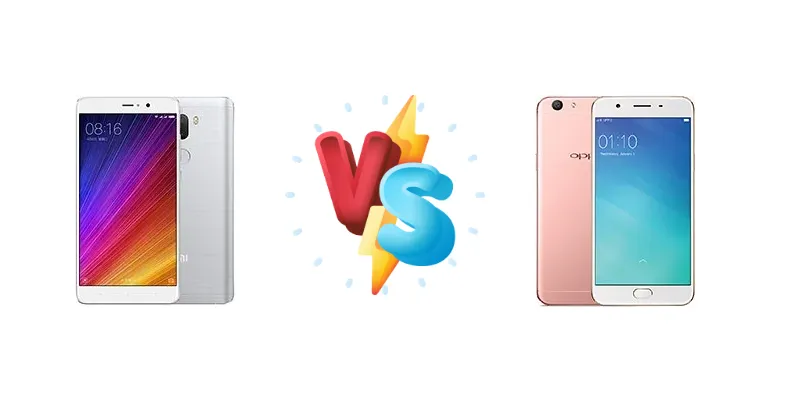
Choosing a new smartphone can be overwhelming. The Xiaomi Mi 5s Plus and Oppo F1s were popular choices in their time, offering different strengths. This comparison breaks down their key features to help you decide which one best suits your needs.
🏆 Quick Verdict
The Xiaomi Mi 5s Plus clearly wins due to its significantly more powerful Snapdragon 821 processor, superior display contrast, and impressive battery endurance. While the Oppo F1s offers a sleek design, it falls short in performance and overall specifications.
| Network |
|---|
| 2G bands | GSM 850 / 900 / 1800 / 1900 - SIM 1 & SIM 2 | GSM 850 / 900 / 1800 / 1900 |
| 3G bands | HSDPA 850 / 900 / 1900 / 2100 | HSDPA 850 / 900 / 2100 |
| 4G bands | 1, 3, 5, 7, 38, 39, 40, 41 | 1, 3, 5, 7, 8, 20, 28, 38, 39, 40, 41 - Global |
| Speed | HSPA, LTE | HSPA 42.2/5.76 Mbps, LTE (2CA) Cat6 300/50 Mbps or LTE Cat4 150/50 Mbps |
| Technology | GSM / CDMA / HSPA / EVDO / LTE | GSM / HSPA / LTE |
| | CDMA2000 1xEV-DO | 1, 3, 5, 40 - India |
| Launch |
|---|
| Announced | 2016, September. Released 2016, October | 2016, August 03. Released 2016, August |
| Status | Discontinued | Discontinued |
| Body |
|---|
| Build | Glass front, aluminum back, aluminum frame | Glass front (Gorilla Glass 4), aluminum back, aluminum frame |
| Dimensions | 154.6 x 77.7 x 8 mm (6.09 x 3.06 x 0.31 in) | 154.5 x 76 x 7.4 mm (6.08 x 2.99 x 0.29 in) |
| SIM | Nano-SIM + Nano-SIM | Nano-SIM + Nano-SIM |
| Weight | 168 g (5.93 oz) | 160 g (5.64 oz) |
| Display |
|---|
| Protection | - | Corning Gorilla Glass 4 |
| Resolution | 1080 x 1920 pixels, 16:9 ratio (~386 ppi density) | 720 x 1280 pixels, 16:9 ratio (~267 ppi density) |
| Size | 5.7 inches, 89.6 cm2 (~74.6% screen-to-body ratio) | 5.5 inches, 83.4 cm2 (~71.0% screen-to-body ratio) |
| Type | IPS LCD | IPS LCD |
| Platform |
|---|
| CPU | Quad-core (2x2.35 GHz Kryo & 2x2.2 GHz Kryo) | Octa-core 1.5 GHz Cortex-A53 |
| Chipset | Qualcomm MSM8996 Snapdragon 821 (14 nm) | Mediatek MT6755 (28 nm) or MTK7650 (28 nm) |
| GPU | Adreno 530 | Mali-T860MP2 |
| OS | Android 6.0 (Marshmallow), upgradable to 8.0 (Oreo), MIUI | Android 5.1 (Lollipop), upgradable to 6.0 (Marshmallow), ColorOS 3 |
| Memory |
|---|
| Card slot | No | microSDXC (dedicated slot) |
| Internal | 64GB 4GB RAM, 128GB 6GB RAM | 32GB 3GB RAM, 64GB 4GB RAM |
| | - | eMMC 5.1 |
| Main Camera |
|---|
| Dual | 13 MP, f/2.0, 1/3.1", 1.12µm, PDAF
13 MP B/W, f/2.0, 1/3.1", 1.12µm | - |
| Features | Dual-LED dual-tone flash, HDR, panorama | LED flash, panorama, HDR |
| Single | - | 13 MP, f/2.2, 1/3.0", PDAF |
| Video | 4K@30fps, 1080p@30fps | 1080p@30fps |
| Selfie camera |
|---|
| Single | 4 MP, f/2.0, 1/3", 2µm | 16 MP, f/2.0, 26mm (wide), 1/3.06", 1.0µm |
| Video | 1080p@30fps | 1080p@30fps |
| Sound |
|---|
| 3.5mm jack | Yes | Yes |
| 35mm jack | Yes | Yes |
| Loudspeaker | Yes | Yes |
| Comms |
|---|
| Bluetooth | 4.2, A2DP, LE | 4.0, A2DP |
| Infrared port | Yes | - |
| NFC | Yes | No |
| Positioning | GPS, GLONASS, BDS | GPS |
| Radio | No | FM radio |
| USB | USB Type-C | microUSB 2.0, OTG |
| WLAN | Wi-Fi 802.11 a/b/g/n/ac, dual-band, Wi-Fi Direct, DLNA | Wi-Fi 802.11 a/b/g/n, dual-band, Wi-Fi Direct, hotspot |
| Features |
|---|
| Sensors | Fingerprint (rear-mounted), accelerometer, gyro, proximity, compass, barometer | Fingerprint (front-mounted), accelerometer, proximity, compass |
| Battery |
|---|
| Charging | 18W wired, QC3 | - |
| Type | Li-Ion 3800 mAh, non-removable | Li-Po 3075 mAh, non-removable |
| Misc |
|---|
| Colors | Silver, Gray, Gold, Rose Gold | Gold, Rose Gold, Gray |
| Models | 2016070 | A1601 |
| Price | About 310 EUR | About 150 EUR |
| SAR | 1.16 W/kg (head) 1.47 W/kg (body) | 0.31 W/kg (head) 0.36 W/kg (body) |
| SAR EU | - | 1.60 W/kg (head) 1.05 W/kg (body) |
| Tests |
|---|
| Audio quality |
Noise -83.9dB / Crosstalk -84.9dB | - |
| Battery life |
Endurance rating 104h
| - |
| Camera |
Photo / Video |
Photo / Video |
| Display |
Contrast ratio: 1448:1 (nominal), 2.884 (sunlight) | - |
| Loudspeaker |
Voice 65dB / Noise 68dB / Ring 70dB
| - |
| Performance |
Basemark OS II 2.0: 2434Basemark X: 36062 | - |
Xiaomi Mi 5s Plus
- Powerful Snapdragon 821 processor
- Excellent display contrast and sunlight readability
- Outstanding battery life (104h)
- Generally better camera performance
- Older model, potentially limited software updates
- Design may feel dated compared to newer phones
Oppo F1s
- Sleek design
- More affordable (typically)
- Decent for basic tasks
- Weaker processor (MediaTek MT6755/MTK7650)
- Less vibrant display
- Shorter battery life
- Lower overall performance
Display Comparison
The Xiaomi Mi 5s Plus boasts a significantly better display with a contrast ratio of 1448:1 (nominal) and an impressive 2.884 in sunlight readability. The Oppo F1s display, while adequate, lacks these specifications, resulting in a less vibrant and potentially harder-to-view experience outdoors.
Camera Comparison
Both phones feature Photo/Video capabilities, but the Mi 5s Plus generally had better camera hardware and image processing capabilities, resulting in superior photo and video quality. Specific camera specs (megapixels, aperture) are missing for both, but the Snapdragon 821 often paired with better camera sensors.
Performance
The Xiaomi Mi 5s Plus's Qualcomm Snapdragon 821 chipset and octa-core Kryo CPU provide a substantial performance advantage over the Oppo F1s's MediaTek MT6755 or MTK7650. Expect smoother multitasking, faster app loading, and better gaming performance on the Mi 5s Plus.
Battery Life
The Xiaomi Mi 5s Plus shines in battery life, boasting an endurance rating of 104 hours. This is a significant advantage over the Oppo F1s, which likely has a smaller battery and less efficient processor, leading to shorter usage times.
Buying Guide
The Xiaomi Mi 5s Plus is ideal for users who prioritize performance, a vibrant display, and long battery life. The Oppo F1s might appeal to those seeking a more budget-friendly option with a focus on aesthetics, though performance will be noticeably slower.
Frequently Asked Questions
❓ Is the Xiaomi Mi 5s Plus still worth buying?
If you prioritize performance and battery life and can find it at a good price, the Mi 5s Plus remains a capable device. However, consider that it's an older model and software updates may be limited.
❓ Which phone is better for gaming?
The Xiaomi Mi 5s Plus is significantly better for gaming due to its more powerful processor and better graphics capabilities.