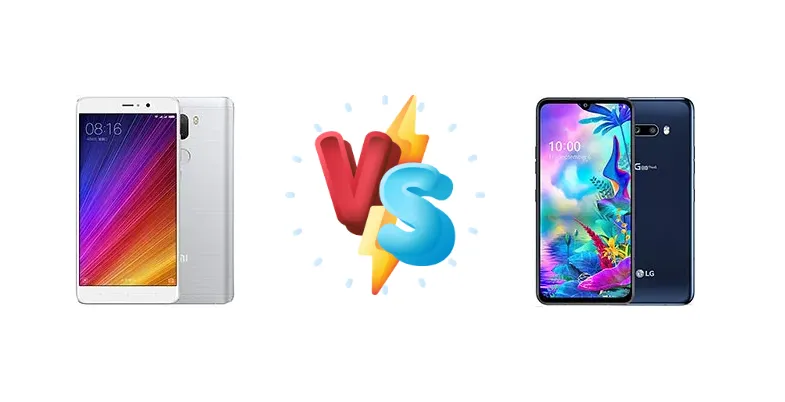
The Xiaomi Mi 5s Plus was a strong contender in its time, boasting a sleek design and impressive specs. However, the LG V50S ThinQ 5G arrived with 5G connectivity and a more modern chipset. Let's dive into a head-to-head comparison to see which phone holds up best today.
🏆 Quick Verdict
The LG V50S ThinQ 5G is the clear winner. Its Snapdragon 855 chipset offers significantly better performance and 5G capabilities, while the improved camera and charging speeds provide a more modern experience. The Mi 5s Plus remains a decent option for budget-conscious users, but it's showing its age.
| Network |
|---|
| 2G bands | GSM 850 / 900 / 1800 / 1900 - SIM 1 & SIM 2 | GSM 850 / 900 / 1800 / 1900 |
| 3G bands | HSDPA 850 / 900 / 1900 / 2100 | HSDPA 850 / 900 / 1700(AWS) / 1900 / 2100 |
| 4G bands | 1, 3, 5, 7, 38, 39, 40, 41 | 1, 2, 3, 4, 5, 7, 8, 12, 13, 17, 20, 25, 26, 28, 40, 41 |
| 5G bands | - | 41 NSA |
| Speed | HSPA, LTE | HSPA 42.2/5.76 Mbps, LTE Cat19 1600/75 Mbps, 5G (2+ Gbps DL) |
| Technology | GSM / CDMA / HSPA / EVDO / LTE | GSM / CDMA / HSPA / EVDO / LTE / 5G |
| | CDMA2000 1xEV-DO | CDMA2000 1xEV-DO |
| Launch |
|---|
| Announced | 2016, September. Released 2016, October | 2019, October. Released 2019, October |
| Status | Discontinued | Discontinued |
| Body |
|---|
| Build | Glass front, aluminum back, aluminum frame | Glass front (Gorilla Glass 5), glass back (Gorilla Glass 6), aluminum frame |
| Dimensions | 154.6 x 77.7 x 8 mm (6.09 x 3.06 x 0.31 in) | 159.3 x 75.8 x 8.4 mm (6.27 x 2.98 x 0.33 in) |
| SIM | Nano-SIM + Nano-SIM | · Nano-SIM· Nano-SIM + Nano-SIM |
| Weight | 168 g (5.93 oz) | 192 g (6.77 oz) |
| | - | IP68 dust/water resistant (up to 1.5m for 30 min)
MIL-STD-810G compliant*
*does not guarantee ruggedness or use in extreme conditions |
| Display |
|---|
| Protection | - | Corning Gorilla Glass 5 |
| Resolution | 1080 x 1920 pixels, 16:9 ratio (~386 ppi density) | 1080 x 2340 pixels, 19.5:9 ratio (~403 ppi density) |
| Size | 5.7 inches, 89.6 cm2 (~74.6% screen-to-body ratio) | 6.4 inches, 100.5 cm2 (~83.3% screen-to-body ratio) |
| Type | IPS LCD | OLED, HDR10 |
| | - | Always-on display |
| Platform |
|---|
| CPU | Quad-core (2x2.35 GHz Kryo & 2x2.2 GHz Kryo) | Octa-core (1x2.84 GHz Kryo 485 & 3x2.42 GHz Kryo 485 & 4x1.78 GHz Kryo 485) |
| Chipset | Qualcomm MSM8996 Snapdragon 821 (14 nm) | Qualcomm SM8150 Snapdragon 855 (7 nm) |
| GPU | Adreno 530 | Adreno 640 |
| OS | Android 6.0 (Marshmallow), upgradable to 8.0 (Oreo), MIUI | Android 9.0 (Pie), upgradable to Android 12 |
| Memory |
|---|
| Card slot | No | microSDXC (uses shared SIM slot) - dual-SIM model |
| Internal | 64GB 4GB RAM, 128GB 6GB RAM | 256GB 8GB RAM |
| | - | UFS 2.1 |
| Main Camera |
|---|
| Dual | 13 MP, f/2.0, 1/3.1", 1.12µm, PDAF
13 MP B/W, f/2.0, 1/3.1", 1.12µm | 12 MP, f/1.8, 27mm (standard), 1/2.55", 1.4µm, dual pixel PDAF, OIS
13 MP, f/2.4, 9mm (ultrawide), 1/3.4", 1.0µm |
| Features | Dual-LED dual-tone flash, HDR, panorama | Dual-LED dual-tone flash, HDR, panorama |
| Video | 4K@30fps, 1080p@30fps | 4K@30/60fps, 1080p@30/60/240fps, 24-bit/192kHz stereo sound rec., gyro-EIS |
| Selfie camera |
|---|
| Features | - | HDR |
| Single | 4 MP, f/2.0, 1/3", 2µm | 32 MP, f/1.9, 26mm (wide), 1/2.8", 0.8µm |
| Video | 1080p@30fps | 4K@30fps, gyro-EIS |
| Sound |
|---|
| 3.5mm jack | Yes | Yes |
| 35mm jack | Yes | Yes |
| Loudspeaker | Yes | Yes, with stereo speakers |
| | - | 32-bit/192kHz audio
24-bit/192kHz audio recording
Tuned by Meridian Audio |
| Comms |
|---|
| Bluetooth | 4.2, A2DP, LE | 5.0, A2DP, LE, aptX HD |
| Infrared port | Yes | - |
| NFC | Yes | Yes |
| Positioning | GPS, GLONASS, BDS | GPS, GLONASS, GALILEO, BDS |
| Radio | No | FM radio |
| USB | USB Type-C | USB Type-C 3.1, OTG |
| WLAN | Wi-Fi 802.11 a/b/g/n/ac, dual-band, Wi-Fi Direct, DLNA | Wi-Fi 802.11 a/b/g/n/ac, dual-band, Wi-Fi Direct, DLNA |
| Features |
|---|
| Sensors | Fingerprint (rear-mounted), accelerometer, gyro, proximity, compass, barometer | Fingerprint (under display, optical), accelerometer, gyro, proximity, compass, barometer |
| Battery |
|---|
| Charging | 18W wired, QC3 | 21W wired, PD, QC3
9W wireless |
| Type | Li-Ion 3800 mAh, non-removable | Li-Po 4000 mAh, non-removable |
| Misc |
|---|
| Colors | Silver, Gray, Gold, Rose Gold | Aurora Black |
| Models | 2016070 | LM-V510N |
| Price | About 310 EUR | About 1100 EUR |
| SAR | 1.16 W/kg (head) 1.47 W/kg (body) | - |
| Tests |
|---|
| Audio quality |
Noise -83.9dB / Crosstalk -84.9dB | - |
| Battery life |
Endurance rating 104h
| - |
| Camera |
Photo / Video | - |
| Display |
Contrast ratio: 1448:1 (nominal), 2.884 (sunlight) | - |
| Loudspeaker |
Voice 65dB / Noise 68dB / Ring 70dB
| - |
| Performance |
Basemark OS II 2.0: 2434Basemark X: 36062 | - |
Xiaomi Mi 5s Plus
- Compact design
- Good value for money (if found used)
- Decent performance for basic tasks
- Impressive contrast ratio on display
- Outdated chipset
- No 5G connectivity
- Camera lacks advanced features
- Battery life, while high in rating, is limited by older tech
LG V50S ThinQ 5G
- 5G connectivity
- Powerful Snapdragon 855 chipset
- Excellent OLED display
- Fast charging (wired and wireless)
- Versatile camera system
- Older model, software support may be limited
- Design may not appeal to everyone
- Availability may be limited
Display Comparison
The LG V50S ThinQ 5G features a 6.2-inch OLED display, offering vibrant colors and deep blacks. The Mi 5s Plus has a 5.7-inch IPS LCD display. While the Mi 5s Plus's contrast ratio is impressive (1448:1), the V50S's OLED technology provides a superior viewing experience with better color accuracy and wider viewing angles. Sunlight readability is also excellent on both devices, with the V50S boasting a reported 2.884 rating.
Camera Comparison
The LG V50S ThinQ 5G generally offers a more versatile and higher-quality camera system. While both phones have capable cameras, the V50S's features like OIS (Optical Image Stabilization) and improved image processing algorithms result in better photos and videos, especially in low-light conditions. The Mi 5s Plus camera is still usable, but lacks the advanced features of the V50S.
Performance
The Snapdragon 855 in the LG V50S ThinQ 5G is a significant upgrade over the Snapdragon 821 in the Mi 5s Plus. The 855's octa-core architecture and 7nm process provide substantially faster processing speeds and improved power efficiency. Expect smoother multitasking, faster app loading times, and better gaming performance on the V50S.
Battery Life
The Xiaomi Mi 5s Plus boasts an endurance rating of 104 hours, which is impressive. However, the LG V50S ThinQ 5G, despite potentially higher power consumption due to its more powerful chipset and 5G capabilities, benefits from faster 21W wired charging and 9W wireless charging, allowing for quicker top-ups.
Buying Guide
The Xiaomi Mi 5s Plus is a good choice for users on a very tight budget who prioritize a compact design and decent performance for basic tasks. The LG V50S ThinQ 5G is ideal for users who want a modern smartphone with 5G connectivity, a better camera, and faster performance for demanding applications and gaming.
Frequently Asked Questions
❓ Is the Xiaomi Mi 5s Plus still worth buying?
Only if you're on a very tight budget and need a basic smartphone for simple tasks. Be aware of its limitations compared to modern devices.
❓ Does the LG V50S ThinQ 5G still receive software updates?
Software support for the LG V50S ThinQ 5G is limited, as LG has exited the smartphone business. However, it may still receive occasional security updates.