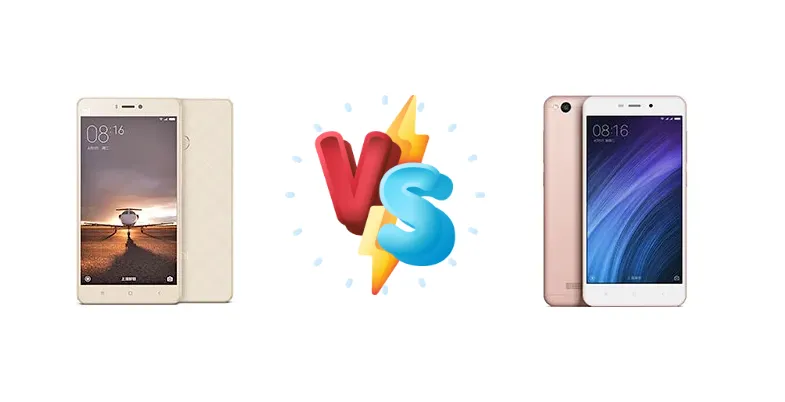
Choosing a new smartphone can be overwhelming, especially with so many options available. Today, we're pitting two Xiaomi devices against each other: the Mi 4s, a slightly older but more powerful phone, and the Redmi 4A, a budget-friendly option. Let's dive into a detailed comparison to help you decide which one suits your needs best.
🏆 Quick Verdict
The Xiaomi Mi 4s offers significantly better performance and a superior display thanks to its Snapdragon 808 chipset and impressive contrast ratio. However, the Redmi 4A excels in affordability and offers a decent experience for basic users. For power users, the Mi 4s is the clear winner, while budget-conscious buyers might prefer the Redmi 4A.
| Network |
|---|
| 2G bands | GSM 850 / 900 / 1800 / 1900 - SIM 1 & SIM 2 | GSM 850 / 900 / 1800 / 1900 - SIM 1 & SIM 2 |
| 3G bands | HSDPA 850 / 1900 / 2100 | HSDPA 850 / 900 / 1900 / 2100 |
| 4G bands | 1, 3, 7, 38, 39, 40, 41 | 1, 3, 4, 5, 7, 20, 38, 40 |
| Speed | HSPA, LTE Cat4 150/50 Mbps | HSPA, LTE |
| Technology | GSM / CDMA / HSPA / LTE | GSM / HSPA / LTE |
| | TD-SCDMA | - |
| Launch |
|---|
| Announced | 2016, February. Released 2016, March | 2016, November. Released 2016, November |
| Status | Discontinued | Discontinued |
| Body |
|---|
| Build | - | Glass front, plastic back, plastic frame |
| Dimensions | 139.3 x 70.8 x 7.8 mm (5.48 x 2.79 x 0.31 in) | 139.9 x 70.4 x 8.5 mm (5.51 x 2.77 x 0.33 in) |
| SIM | Nano-SIM + Micro-SIM | Nano-SIM + Micro-SIM |
| Weight | 133 g (4.69 oz) | 131.5 g (4.66 oz) |
| Display |
|---|
| Resolution | 1080 x 1920 pixels, 16:9 ratio (~441 ppi density) | 720 x 1280 pixels, 16:9 ratio (~296 ppi density) |
| Size | 5.0 inches, 68.9 cm2 (~69.9% screen-to-body ratio) | 5.0 inches, 68.0 cm2 (~69.0% screen-to-body ratio) |
| Type | IPS LCD | IPS LCD |
| Platform |
|---|
| CPU | Hexa-core (4x1.4 GHz Cortex-A53 & 2x1.8 GHz Cortex-A57) | Quad-core 1.4 GHz Cortex-A53 |
| Chipset | Qualcomm MSM8992 Snapdragon 808 (20 nm) | Qualcomm MSM8917 Snapdragon 425 (28 nm) |
| GPU | Adreno 418 | Adreno 308 |
| OS | Android 5.1 (Lollipop), upgradable to 7.0 (Nougat), MIUI 10 | Android 6.0.1 (Marshmallow), MIUI 10 |
| Memory |
|---|
| Card slot | microSDXC (uses shared SIM slot) | microSDXC (uses shared SIM slot) |
| Internal | 64GB 3GB RAM | 16GB 2GB RAM, 32GB 2GB RAM, 32GB 3GB RAM |
| | eMMC 5.0 | eMMC 5.1 |
| Main Camera |
|---|
| Features | Dual-LED dual-tone flash, panorama, HDR | LED flash, HDR, panorama |
| Single | 13 MP, f/2.0, PDAF | 13 MP, f/2.2, AF |
| Video | 1080p@30fps, 720p@120fps | 1080p@30fps |
| Selfie camera |
|---|
| Single | 5 MP, f/2.0 | 5 MP, f/2.2 |
| Video | 1080p@30fps | - |
| Sound |
|---|
| 3.5mm jack | Yes | Yes |
| 35mm jack | Yes | Yes |
| Loudspeaker | Yes | Yes |
| Comms |
|---|
| Bluetooth | 4.1, A2DP | 4.1, A2DP, LE |
| Infrared port | Yes | Yes |
| NFC | No | No |
| Positioning | GPS, GLONASS, BDS | GPS, GLONASS, BDS |
| Radio | No | FM radio |
| USB | USB Type-C | microUSB 2.0 |
| WLAN | Wi-Fi 802.11 a/b/g/n/ac, dual-band, Wi-Fi Direct, hotspot | Wi-Fi 802.11 b/g/n, Wi-Fi Direct |
| Features |
|---|
| Sensors | Fingerprint (rear-mounted), accelerometer, gyro, proximity, compass | Accelerometer, gyro, proximity |
| Battery |
|---|
| Charging | 18W wired, QC2, 40% in 60 min | - |
| Type | Li-Ion 3260 mAh, non-removable | Li-Ion 3120 mAh, non-removable |
| Misc |
|---|
| Colors | Black, White, Gold, Pink | Gold, Rose Gold, Dark Gray |
| Models | - | 2016117 |
| Price | About 220 EUR | About 110 EUR |
| SAR | - | 0.53 W/kg (head) 1.18 W/kg (body) |
| Tests |
|---|
| Audio quality |
Noise -94.9dB / Crosstalk -82.6dB | - |
| Battery life |
Endurance rating 75h
| - |
| Camera |
Photo / Video |
Photo / Video |
| Display |
Contrast ratio: 975:1 (nominal), 2.095 (sunlight) | - |
| Loudspeaker |
Voice 73dB / Noise 68dB / Ring 82dB
| - |
| Performance |
Basemark OS II 2.0: 1545Basemark X: 12990 |
GeekBench: 1781 (v4.4) |
Xiaomi Mi 4s
- Superior Performance
- Excellent Display
- Good Battery Life
- Fast Charging
- Premium Build Quality (likely)
- Older Model
- Potentially Limited Software Updates
- May be harder to find new
Xiaomi Redmi 4A
- Affordable Price
- Decent Battery Life
- Lightweight and Compact
- Easy to Use
- Lower Performance
- Basic Camera
- Less Vibrant Display
- Older Chipset
Display Comparison
The Mi 4s boasts a significantly better display with a contrast ratio of 975:1 (nominal) and an impressive 2.095 in sunlight, making it easily viewable outdoors. The Redmi 4A's display is adequate but lacks the same level of brightness and contrast. Colors are less vibrant, and outdoor visibility is noticeably poorer.
Camera Comparison
While both phones offer 'Photo / Video' capabilities, the Mi 4s generally has a better camera sensor and image processing, resulting in sharper and more detailed photos, especially in good lighting conditions. Low-light performance is also likely to be better on the Mi 4s. The Redmi 4A's camera is adequate for casual snapshots.
Performance
The Mi 4s's Snapdragon 808 chipset with a hexa-core processor provides a substantial performance advantage over the Redmi 4A's Snapdragon 425 and quad-core processor. Apps launch faster, multitasking is smoother, and gaming is more enjoyable on the Mi 4s. The Redmi 4A can handle basic tasks, but struggles with more demanding applications.
Battery Life
The Mi 4s has an endurance rating of 75h, suggesting excellent battery life. The Redmi 4A, while not explicitly stated, typically offers a solid day of battery life with moderate usage due to its smaller screen and less power-hungry processor. The Mi 4s's 18W fast charging is also a significant advantage.
Buying Guide
The Xiaomi Mi 4s is ideal for users who prioritize performance, a good display, and a slightly more premium feel. It's suitable for moderate gaming and multitasking. The Xiaomi Redmi 4A is perfect for first-time smartphone users, those on a tight budget, and individuals who primarily use their phone for calls, texts, and basic apps.
Frequently Asked Questions
❓ Is the Mi 4s still worth buying?
If you need a phone with good performance and a decent display and can find one in good condition, the Mi 4s can still be a worthwhile purchase. However, consider the age and potential lack of software updates.
❓ What is the Redmi 4A best for?
The Redmi 4A is best suited for basic users who need a reliable and affordable phone for calls, texts, and light app usage.