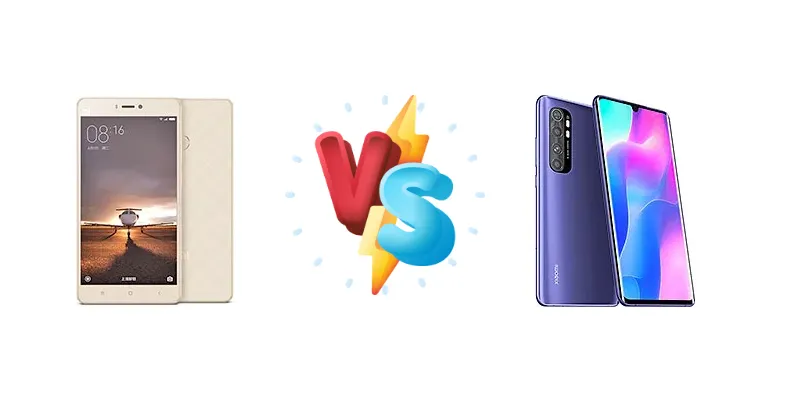
Xiaomi has consistently delivered impressive smartphones at competitive prices. Today, we're pitting two of their devices against each other: the older, but still capable, Mi 4s and the more modern Mi Note 10 Lite. This comparison will help you decide which phone best suits your needs and budget.
🏆 Quick Verdict
The Xiaomi Mi Note 10 Lite is the clear winner. While the Mi 4s boasts a surprisingly good endurance rating for its age, the Note 10 Lite’s superior chipset, brighter display, faster charging, and more modern features make it the better overall choice for most users.
| Network |
|---|
| 2G bands | GSM 850 / 900 / 1800 / 1900 - SIM 1 & SIM 2 | GSM 850 / 900 / 1800 / 1900 |
| 3G bands | HSDPA 850 / 1900 / 2100 | HSDPA 800 / 850 / 900 / 1700(AWS) / 1900 / 2100 |
| 4G bands | 1, 3, 7, 38, 39, 40, 41 | 1, 2, 3, 4, 5, 7, 8, 18, 19, 20, 26, 28, 38, 40, 41 |
| Speed | HSPA, LTE Cat4 150/50 Mbps | HSPA, LTE |
| Technology | GSM / CDMA / HSPA / LTE | GSM / HSPA / LTE |
| | TD-SCDMA | - |
| Launch |
|---|
| Announced | 2016, February. Released 2016, March | 2020, April 30. Released 2020, May 09 |
| Status | Discontinued | Discontinued |
| Body |
|---|
| Build | - | Glass front (Gorilla Glass 5), glass back (Gorilla Glass 5), aluminum frame |
| Dimensions | 139.3 x 70.8 x 7.8 mm (5.48 x 2.79 x 0.31 in) | 157.8 x 74.2 x 9.7 mm (6.21 x 2.92 x 0.38 in) |
| SIM | Nano-SIM + Micro-SIM | Nano-SIM + Nano-SIM |
| Weight | 133 g (4.69 oz) | 204 g (7.20 oz) |
| Display |
|---|
| Protection | - | Corning Gorilla Glass 5 |
| Resolution | 1080 x 1920 pixels, 16:9 ratio (~441 ppi density) | 1080 x 2340 pixels, 19.5:9 ratio (~398 ppi density) |
| Size | 5.0 inches, 68.9 cm2 (~69.9% screen-to-body ratio) | 6.47 inches, 102.8 cm2 (~87.8% screen-to-body ratio) |
| Type | IPS LCD | AMOLED, HDR10, 430 nits (typ) |
| Platform |
|---|
| CPU | Hexa-core (4x1.4 GHz Cortex-A53 & 2x1.8 GHz Cortex-A57) | Octa-core (2x2.2 GHz Kryo 470 Gold & 6x1.8 GHz Kryo 470 Silver) |
| Chipset | Qualcomm MSM8992 Snapdragon 808 (20 nm) | Qualcomm SDM730 Snapdragon 730G (8 nm) |
| GPU | Adreno 418 | Adreno 618 |
| OS | Android 5.1 (Lollipop), upgradable to 7.0 (Nougat), MIUI 10 | Android 10, upgradable to Android 11, MIUI 12.5 E |
| Memory |
|---|
| Card slot | microSDXC (uses shared SIM slot) | No |
| Internal | 64GB 3GB RAM | 64GB 6GB RAM, 128GB 6GB RAM, 128GB 8GB RAM |
| | eMMC 5.0 | UFS 2.1 |
| Main Camera |
|---|
| Features | Dual-LED dual-tone flash, panorama, HDR | Laser AF, Quad-LED flash, HDR, panorama |
| Quad | - | 64 MP, f/1.9, 26mm (wide), 1/1.72", 0.8µm, PDAF
8 MP, f/2.2, (ultrawide), 1/4.0", 1.12µm
2 MP (macro)
Auxiliary lens |
| Single | 13 MP, f/2.0, PDAF | - |
| Video | 1080p@30fps, 720p@120fps | 4K@30fps, 1080p@30/60/120fps, 720p@960fps |
| Selfie camera |
|---|
| Features | - | HDR, panorama |
| Single | 5 MP, f/2.0 | 16 MP, f/2.5, (wide), 1/3.06" 1.0µm |
| Video | 1080p@30fps | 1080p@30fps |
| Sound |
|---|
| 3.5mm jack | Yes | Yes |
| 35mm jack | Yes | Yes |
| Loudspeaker | Yes | Yes |
| | - | 24-bit/192kHz audio |
| Comms |
|---|
| Bluetooth | 4.1, A2DP | 5.0, A2DP, LE, aptX HD, aptX Adaptive |
| Infrared port | Yes | Yes |
| NFC | No | Yes |
| Positioning | GPS, GLONASS, BDS | GPS, GLONASS, GALILEO, BDS |
| Radio | No | FM radio, recording |
| USB | USB Type-C | USB Type-C 2.0 |
| WLAN | Wi-Fi 802.11 a/b/g/n/ac, dual-band, Wi-Fi Direct, hotspot | Wi-Fi 802.11 a/b/g/n/ac, dual-band, Wi-Fi Direct |
| Features |
|---|
| Sensors | Fingerprint (rear-mounted), accelerometer, gyro, proximity, compass | Fingerprint (under display, optical), accelerometer, gyro, compass |
| Battery |
|---|
| Charging | 18W wired, QC2, 40% in 60 min | 30W wired |
| Type | Li-Ion 3260 mAh, non-removable | Li-Po 5260 mAh |
| Misc |
|---|
| Colors | Black, White, Gold, Pink | Midnight Black, Glacier White, Nebula Purple |
| Models | - | M2002F4LG, M1910F4G |
| Price | About 220 EUR | About 110 EUR |
| SAR | - | 1.17 W/kg (head) 0.86 W/kg (body) |
| SAR EU | - | 1.01 W/kg (head) 1.39 W/kg (body) |
| Pricing |
|---|
| 128GB 6GB RAM | - | € 367.55 |
| 64GB 6GB RAM | - | $ 249.99 |
| RENEWED | - | € 229.00 |
| Tests |
|---|
| Audio quality |
Noise -94.9dB / Crosstalk -82.6dB | - |
| Battery life |
Endurance rating 75h
|
Endurance rating 117h
|
| Camera |
Photo / Video |
Photo / Video |
| Display |
Contrast ratio: 975:1 (nominal), 2.095 (sunlight) |
Contrast ratio: Infinite (nominal) |
| Loudspeaker |
Voice 73dB / Noise 68dB / Ring 82dB
|
-29.2 LUFS (Average)
|
| Performance |
Basemark OS II 2.0: 1545Basemark X: 12990 |
AnTuTu: 253271 (v8)
GeekBench: 1694 (v5.1)
GFXBench: 15fps (ES 3.1 onscreen) |
Xiaomi Mi 4s
- Excellent battery life (75h endurance)
- Compact size
- Good value for money (if found used)
- Outdated chipset
- Lower screen brightness
- Slower charging
- Older camera technology
Xiaomi Mi Note 10 Lite
- Modern chipset (Snapdragon 730G)
- Brighter display
- Faster charging (30W)
- Improved camera system
- Longer battery life (117h endurance)
- Can be slightly more expensive than used Mi 4s
- May lack some premium features
Display Comparison
The Mi Note 10 Lite takes the display crown. Its measured 596 nits max brightness is significantly higher than what we'd expect from the Mi 4s, offering better visibility in sunlight. While the Mi 4s has a respectable contrast ratio of 975:1, the Note 10 Lite's 'infinite' contrast ratio (likely a marketing term, but indicative of excellent contrast) further enhances its visual appeal. The Note 10 Lite also likely has a more modern panel technology.
Camera Comparison
While both phones offer 'Photo / Video' capabilities, the Mi Note 10 Lite is expected to have a superior camera system. Modern sensors and image processing algorithms give it an edge in image quality, dynamic range, and low-light performance. The Mi 4s camera is adequate but lacks the features and quality of its successor.
Performance
The Mi Note 10 Lite's Snapdragon 730G chipset is a substantial upgrade over the Mi 4s' Snapdragon 808. The 8nm process offers improved efficiency, and the Octa-core CPU provides noticeably faster performance for everyday tasks and gaming. The Mi 4s, while still capable, will show its age when handling demanding applications.
Battery Life
The Mi Note 10 Lite edges out the Mi 4s in battery endurance with a rating of 117h versus 75h. While the Mi 4s' endurance is impressive for its age, the Note 10 Lite's larger battery capacity and more efficient chipset contribute to its longer battery life. The Note 10 Lite also features 30W fast charging, significantly faster than the Mi 4s' 18W charging.
Buying Guide
The Xiaomi Mi 4s is a good option for users on a very tight budget who prioritize battery life above all else and don't need the latest features. The Xiaomi Mi Note 10 Lite is ideal for those seeking a well-rounded smartphone with a good camera, decent performance, and a vibrant display, all at a reasonable price.
Frequently Asked Questions
❓ Is the Xiaomi Mi 4s still worth buying in 2024?
Only if you're on an extremely tight budget and prioritize battery life above all else. Otherwise, the Mi Note 10 Lite offers a much better experience.
❓ What is the main difference between the Mi 4s and Mi Note 10 Lite?
The Mi Note 10 Lite has a significantly more powerful processor, a brighter display, a better camera, and faster charging capabilities compared to the older Mi 4s.