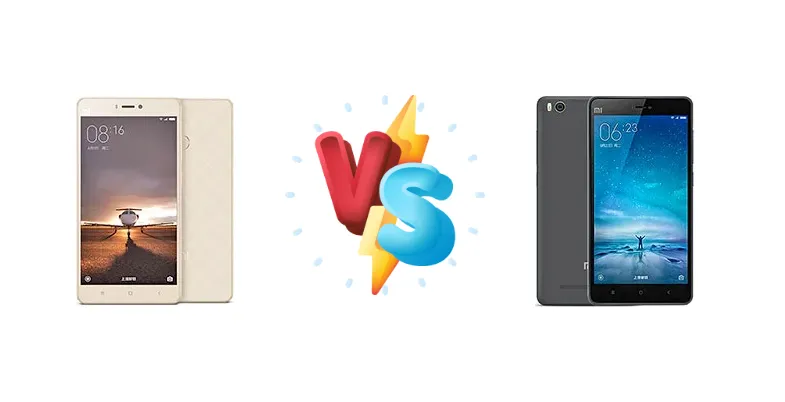
The Xiaomi Mi 4s and Mi 4c were popular mid-range smartphones offering impressive specs for their time. But with both devices now several years old, which one holds up better? This comprehensive comparison dives deep into their features to help you decide which phone is right for you (or if it's time to upgrade!).
🏆 Quick Verdict
The Xiaomi Mi 4s edges out the Mi 4c thanks to its significantly better battery life and superior sunlight display performance. While both share the same Snapdragon 808 chipset, the Mi 4s's endurance makes it the more practical choice for everyday use, despite their age.
| Network |
|---|
| 2G bands | GSM 850 / 900 / 1800 / 1900 - SIM 1 & SIM 2 | GSM 850 / 900 / 1800 / 1900 - SIM 1 & SIM 2 |
| 3G bands | HSDPA 850 / 1900 / 2100 | HSDPA 850 / 900 / 1900 / 2100 |
| 4G bands | 1, 3, 7, 38, 39, 40, 41 | 1, 3, 7, 38, 39, 40, 41 |
| Speed | HSPA, LTE Cat4 150/50 Mbps | HSPA, LTE Cat4 150/50 Mbps |
| Technology | GSM / CDMA / HSPA / LTE | GSM / HSPA / LTE |
| | TD-SCDMA | TD-SCDMA |
| Launch |
|---|
| Announced | 2016, February. Released 2016, March | 2015, September. Released 2015, September |
| Status | Discontinued | Discontinued |
| Body |
|---|
| Build | - | Glass front, plastic back, plastic frame |
| Dimensions | 139.3 x 70.8 x 7.8 mm (5.48 x 2.79 x 0.31 in) | 138.1 x 69.6 x 7.8 mm (5.44 x 2.74 x 0.31 in) |
| SIM | Nano-SIM + Micro-SIM | Dual SIM |
| Weight | 133 g (4.69 oz) | 132 g (4.66 oz) |
| Display |
|---|
| Resolution | 1080 x 1920 pixels, 16:9 ratio (~441 ppi density) | 1080 x 1920 pixels, 16:9 ratio (~441 ppi density) |
| Size | 5.0 inches, 68.9 cm2 (~69.9% screen-to-body ratio) | 5.0 inches, 68.9 cm2 (~71.7% screen-to-body ratio) |
| Type | IPS LCD | IPS LCD |
| Platform |
|---|
| CPU | Hexa-core (4x1.4 GHz Cortex-A53 & 2x1.8 GHz Cortex-A57) | Hexa-core (4x1.4 GHz Cortex-A53 & 2x1.8 GHz Cortex-A57) |
| Chipset | Qualcomm MSM8992 Snapdragon 808 (20 nm) | Qualcomm MSM8992 Snapdragon 808 (20 nm) |
| GPU | Adreno 418 | Adreno 418 |
| OS | Android 5.1 (Lollipop), upgradable to 7.0 (Nougat), MIUI 10 | Android 5.1.1 (Lollipop), upgradable to 7.0 (Nougat), MIUI 10 |
| Memory |
|---|
| Card slot | microSDXC (uses shared SIM slot) | No |
| Internal | 64GB 3GB RAM | 16GB 2GB RAM, 32GB 3GB RAM |
| | eMMC 5.0 | eMMC 5.0 |
| Main Camera |
|---|
| Features | Dual-LED dual-tone flash, panorama, HDR | Dual-LED dual-tone flash, panorama, HDR |
| Single | 13 MP, f/2.0, PDAF | 13 MP, f/2.0, 24mm (wide), 1/3.1", 1.12µm, PDAF |
| Video | 1080p@30fps, 720p@120fps | 1080p@30fps |
| Selfie camera |
|---|
| Single | 5 MP, f/2.0 | 5 MP, f/2.0 |
| Video | 1080p@30fps | 1080p@30fps |
| Sound |
|---|
| 3.5mm jack | Yes | Yes |
| 35mm jack | Yes | Yes |
| Loudspeaker | Yes | Yes |
| Comms |
|---|
| Bluetooth | 4.1, A2DP | 4.1, A2DP |
| Infrared port | Yes | Yes |
| NFC | No | No |
| Positioning | GPS, GLONASS, BDS | GPS, GLONASS, BDS |
| Radio | No | No |
| USB | USB Type-C | USB Type-C |
| WLAN | Wi-Fi 802.11 a/b/g/n/ac, dual-band, Wi-Fi Direct, hotspot | Wi-Fi 802.11 a/b/g/n/ac, dual-band, Wi-Fi Direct, hotspot |
| Features |
|---|
| Sensors | Fingerprint (rear-mounted), accelerometer, gyro, proximity, compass | Accelerometer, gyro, proximity, compass |
| Battery |
|---|
| Charging | 18W wired, QC2, 40% in 60 min | 18W wired, QC2, 40% in 60 min |
| Type | Li-Ion 3260 mAh, non-removable | Li-Ion 3080 mAh, non-removable |
| Misc |
|---|
| Colors | Black, White, Gold, Pink | White, grey, pink, yellow, blue |
| Models | - | Mi-4c |
| Price | About 220 EUR | About 210 EUR |
| Tests |
|---|
| Audio quality |
Noise -94.9dB / Crosstalk -82.6dB |
Noise -94.7dB / Crosstalk -95.3dB |
| Battery life |
Endurance rating 75h
| Endurance rating 52h |
| Camera |
Photo / Video |
Photo / Video |
| Display |
Contrast ratio: 975:1 (nominal), 2.095 (sunlight) |
Contrast ratio: 1609 (nominal), 2.574(sunlight) |
| Loudspeaker |
Voice 73dB / Noise 68dB / Ring 82dB
|
Voice 73dB / Noise 66dB / Ring 77dB |
| Performance |
Basemark OS II 2.0: 1545Basemark X: 12990 |
Basemark OS II 2.0: 1233Basemark X: 12096 |
Xiaomi Mi 4s
- Superior battery life (75h)
- Better sunlight display performance
- Slightly better sustained performance (potentially)
- Older design
- Camera quality is average
- Limited software updates
Xiaomi Mi 4c
- Slightly more compact design
- Higher nominal contrast ratio
- QC2 fast charging
- Significantly shorter battery life (52h)
- Poorer sunlight display performance
- Older design
- Limited software updates
Display Comparison
The Mi 4c boasts a higher nominal contrast ratio (1609:1) compared to the Mi 4s (975:1). However, the Mi 4s shines in direct sunlight with a significantly better contrast ratio of 2.095 versus the Mi 4c's 2.574. This suggests the Mi 4s offers better outdoor readability, a crucial factor for many users.
Camera Comparison
Camera performance on both devices is comparable, relying on a 13MP rear camera and a 5MP front camera. Image quality will be adequate for casual photography, but don't expect flagship-level results. Low-light performance will be a weakness on both.
Performance
Both phones are powered by the same Qualcomm Snapdragon 808 chipset and Hexa-core CPU. Performance will be largely similar in everyday tasks and most apps. However, the Mi 4s might exhibit slightly better sustained performance due to its potentially more efficient thermal management, though this is difficult to confirm definitively without testing.
Battery Life
This is where the Mi 4s truly stands out. It offers a significantly better endurance rating of 75h compared to the Mi 4c's 52h. This translates to considerably longer battery life for the Mi 4s, making it a more practical choice for users who need their phone to last throughout the day.
Buying Guide
Who should buy the Xiaomi Mi 4s? Users prioritizing longer battery life and better outdoor visibility. Who should buy the Xiaomi Mi 4c? Those seeking a slightly more compact device, though the battery performance is a notable drawback. Considering their age, both are best suited for budget-conscious users or those needing a secondary device.
Frequently Asked Questions
❓ Are these phones still receiving software updates?
No, both the Mi 4s and Mi 4c have reached the end of their software update cycle. Security patches are unlikely to be provided.
❓ What is the best use case for these phones today?
They are best suited as secondary devices, for basic tasks like calling, texting, and light web browsing, or for users on a very tight budget.