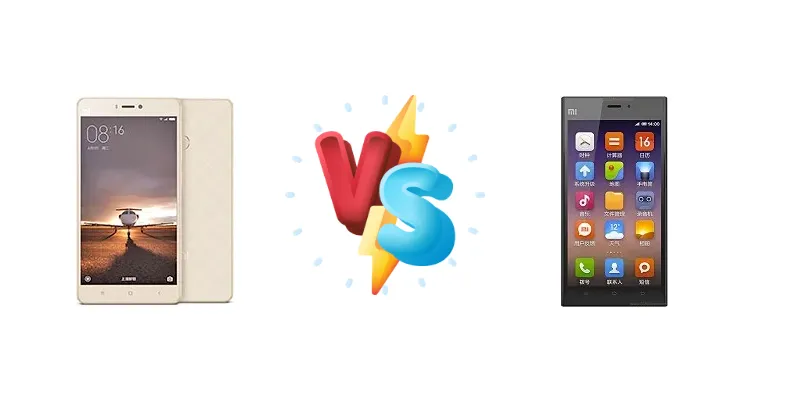
Xiaomi's Mi series has always offered impressive value for money. The Mi 3 and Mi 4s were pivotal devices in establishing this reputation. But which one holds up better today? Let's dive into a detailed comparison to help you decide.
🏆 Quick Verdict
The Xiaomi Mi 4s edges out the Mi 3 thanks to its slightly better battery life, superior sunlight display performance, and more modern chipset. While the Mi 3 boasts a faster CPU clock speed, the Mi 4s's overall package makes it the more compelling choice for most users.
| Network |
|---|
| 2G bands | GSM 850 / 900 / 1800 / 1900 - SIM 1 & SIM 2 | GSM 850 / 900 / 1800 / 1900 |
| 3G bands | HSDPA 850 / 1900 / 2100 | HSDPA 850 / 900 / 1900 / 2100 |
| 4G bands | 1, 3, 7, 38, 39, 40, 41 | - |
| Speed | HSPA, LTE Cat4 150/50 Mbps | HSPA 42.2/5.76 Mbps |
| Technology | GSM / CDMA / HSPA / LTE | GSM / HSPA |
| | TD-SCDMA | - |
| Launch |
|---|
| Announced | 2016, February. Released 2016, March | 2013, September. Released 2013, December |
| Status | Discontinued | Discontinued |
| Body |
|---|
| Build | - | Glass front (Gorilla Glass 3), plastic back, plastic frame |
| Dimensions | 139.3 x 70.8 x 7.8 mm (5.48 x 2.79 x 0.31 in) | 144 x 73.6 x 8.1 mm (5.67 x 2.90 x 0.32 in) |
| SIM | Nano-SIM + Micro-SIM | Mini-SIM |
| Weight | 133 g (4.69 oz) | 145 g (5.11 oz) |
| Display |
|---|
| Protection | - | Corning Gorilla Glass 3 |
| Resolution | 1080 x 1920 pixels, 16:9 ratio (~441 ppi density) | 1080 x 1920 pixels, 16:9 ratio (~441 ppi density) |
| Size | 5.0 inches, 68.9 cm2 (~69.9% screen-to-body ratio) | 5.0 inches, 68.9 cm2 (~65.0% screen-to-body ratio) |
| Type | IPS LCD | IPS LCD |
| Platform |
|---|
| CPU | Hexa-core (4x1.4 GHz Cortex-A53 & 2x1.8 GHz Cortex-A57) | Quad-core 2.3 GHz Krait 400 |
| Chipset | Qualcomm MSM8992 Snapdragon 808 (20 nm) | Qualcomm MSM8274AB Snapdragon 800 (28 nm) |
| GPU | Adreno 418 | Adreno 330 |
| OS | Android 5.1 (Lollipop), upgradable to 7.0 (Nougat), MIUI 10 | Android 4.3 (Jelly Bean), upgradable to 6.0 (Marshmallow), MIUI 5 |
| Memory |
|---|
| Card slot | microSDXC (uses shared SIM slot) | No |
| Internal | 64GB 3GB RAM | 16GB 2GB RAM, 64GB 2GB RAM |
| | eMMC 5.0 | eMMC 4.5 |
| Main Camera |
|---|
| Features | Dual-LED dual-tone flash, panorama, HDR | Dual-LED flash, HDR |
| Single | 13 MP, f/2.0, PDAF | 13 MP, f/2.2, 28mm (wide), AF |
| Video | 1080p@30fps, 720p@120fps | 1080p@30fps, HDR |
| Selfie camera |
|---|
| Single | 5 MP, f/2.0 | 2 MP, f/2.2 |
| Video | 1080p@30fps | 1080p@30fps |
| Sound |
|---|
| 3.5mm jack | Yes | Yes |
| 35mm jack | Yes | Yes |
| Loudspeaker | Yes | Yes |
| Comms |
|---|
| Bluetooth | 4.1, A2DP | 4.0, A2DP |
| Infrared port | Yes | - |
| NFC | No | Yes |
| Positioning | GPS, GLONASS, BDS | GPS, GLONASS |
| Radio | No | FM radio |
| USB | USB Type-C | microUSB 2.0, OTG |
| WLAN | Wi-Fi 802.11 a/b/g/n/ac, dual-band, Wi-Fi Direct, hotspot | Wi-Fi 802.11 a/b/g/n, dual-band, Wi-Fi Direct, hotspot |
| Features |
|---|
| Sensors | Fingerprint (rear-mounted), accelerometer, gyro, proximity, compass | Accelerometer, gyro, proximity, compass, barometer |
| Battery |
|---|
| Charging | 18W wired, QC2, 40% in 60 min | 18W wired, QC2 |
| Music play | - | Up to 50 h |
| Stand-by | - | Up to 500 h |
| Talk time | - | Up to 25 h |
| Type | Li-Ion 3260 mAh, non-removable | Li-Ion 3050 mAh, non-removable |
| Misc |
|---|
| Colors | Black, White, Gold, Pink | White, Gray, Black, Yellow, Pink, Blue, Gold, Green |
| Price | About 220 EUR | About 200 EUR |
| Tests |
|---|
| Audio quality |
Noise -94.9dB / Crosstalk -82.6dB |
Noise -91.5dB / Crosstalk -44.2dB |
| Battery life |
Endurance rating 75h
| Endurance rating 66h |
| Camera |
Photo / Video |
Photo / Video |
| Display |
Contrast ratio: 975:1 (nominal), 2.095 (sunlight) |
Contrast ratio: 907 (nominal), 2.001 (sunlight) |
| Loudspeaker |
Voice 73dB / Noise 68dB / Ring 82dB
|
Voice 69dB / Noise 66dB / Ring 75dB |
| Performance |
Basemark OS II 2.0: 1545Basemark X: 12990 | - |
Xiaomi Mi 4s
- Better Battery Life
- Superior Sunlight Display
- More Modern Chipset
- Faster Charging (QC2)
- Potentially slightly slower single-core performance than Mi 3
Xiaomi Mi 3
- Slightly Faster CPU Clock Speed
- Compact Design
- Shorter Battery Life
- Less Sunlight Readable Display
- Older Chipset
Display Comparison
Both phones feature a 5-inch display, but the Mi 4s takes a slight lead. Its contrast ratio is marginally better at 975:1 compared to the Mi 3's 907:1. More significantly, the Mi 4s boasts a significantly better sunlight readability score of 2.095 versus the Mi 3's 2.001, making it easier to view outdoors.
Camera Comparison
While both phones offer 'Photo / Video' capabilities, detailed camera comparisons are difficult without specific sensor and lens information. Generally, the Mi 4s's newer chipset likely provides better image processing capabilities, resulting in slightly improved photo and video quality. However, both cameras are considered adequate for their time.
Performance
The Mi 3 has a quad-core 2.3 GHz Krait 400 CPU, which initially felt faster. However, the Mi 4s's hexa-core Snapdragon 808 (4x1.4 GHz Cortex-A53 & 2x1.8 GHz Cortex-A57) offers a more balanced and efficient performance profile, especially in multitasking and modern apps. The 20nm process on the 808 is also more efficient than the Mi 3's 28nm Snapdragon 800.
Battery Life
The Mi 4s secures a clear win in battery life, boasting an endurance rating of 75h compared to the Mi 3's 66h. This translates to noticeably longer usage between charges, a significant advantage for daily use.
Buying Guide
The Xiaomi Mi 4s is ideal for users seeking a balance of performance, battery life, and display quality on a budget. The Mi 3 might appeal to those prioritizing raw CPU speed and a slightly more compact design, but its age shows in other areas.
Frequently Asked Questions
❓ Is the Xiaomi Mi 4s still worth buying in [current year]?
While both phones are aging, the Mi 4s's better battery life and display make it a slightly more viable option if you're on a very tight budget and can find one in good condition. However, consider newer budget smartphones for a better overall experience.
❓ Which phone is more likely to receive software updates?
Neither phone is likely to receive significant software updates at this point. Both are end-of-life devices. Security updates are unlikely.