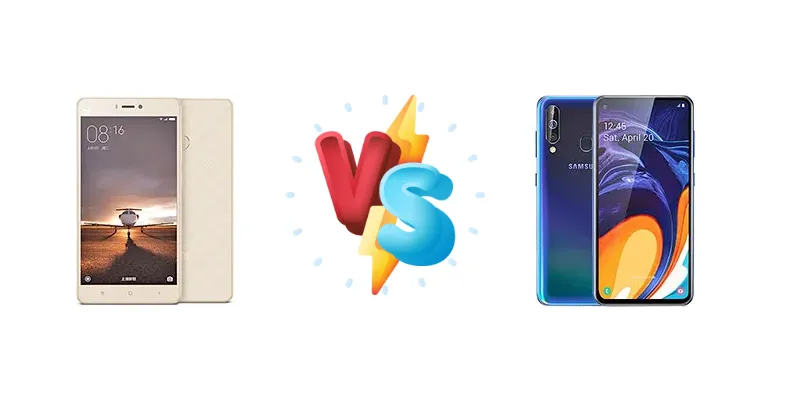
Choosing a new smartphone can be overwhelming, especially with so many options available. Today, we're pitting two contenders against each other: the Xiaomi Mi 4s, a well-regarded older model, and the Samsung Galaxy A60, a more modern mid-range device. Let's dive into a detailed comparison to help you decide which one is right for you.
🏆 Quick Verdict
The Samsung Galaxy A60 edges out the Mi 4s thanks to its newer chipset, brighter display, and slightly better battery life. While the Mi 4s offers a surprisingly good performance for its age, the A60's modern features and overall refinement make it the more compelling choice for most users.
| Network |
|---|
| 2G bands | GSM 850 / 900 / 1800 / 1900 - SIM 1 & SIM 2 | GSM 850 / 900 / 1800 / 1900 |
| 3G bands | HSDPA 850 / 1900 / 2100 | HSDPA 850 / 900 / 1900 / 2100 |
| 4G bands | 1, 3, 7, 38, 39, 40, 41 | 1, 3, 5, 7, 8, 34, 38, 39, 40, 41 |
| Speed | HSPA, LTE Cat4 150/50 Mbps | HSPA 42.2/5.76 Mbps, LTE (2CA) Cat6 400/50 Mbps |
| Technology | GSM / CDMA / HSPA / LTE | GSM / CDMA / HSPA / LTE |
| | TD-SCDMA | 1, 3, 5, 7, 8, 28, 34, 38, 39, 40, 41 - SM-A606Y/DS |
| Launch |
|---|
| Announced | 2016, February. Released 2016, March | 2019, April. Released 2019, June |
| Status | Discontinued | Discontinued |
| Body |
|---|
| Build | - | Glass front (Gorilla Glass 3), plastic back, plastic frame |
| Dimensions | 139.3 x 70.8 x 7.8 mm (5.48 x 2.79 x 0.31 in) | 155.3 x 73.9 x 7.9 mm (6.11 x 2.91 x 0.31 in) |
| SIM | Nano-SIM + Micro-SIM | · Nano-SIM· Nano-SIM + Nano-SIM |
| Weight | 133 g (4.69 oz) | 168 g (5.93 oz) |
| Display |
|---|
| Protection | - | Corning Gorilla Glass 3 |
| Resolution | 1080 x 1920 pixels, 16:9 ratio (~441 ppi density) | 1080 x 2340 pixels, 19.5:9 ratio (~409 ppi density) |
| Size | 5.0 inches, 68.9 cm2 (~69.9% screen-to-body ratio) | 6.3 inches, 97.4 cm2 (~84.9% screen-to-body ratio) |
| Type | IPS LCD | PLS LCD |
| Platform |
|---|
| CPU | Hexa-core (4x1.4 GHz Cortex-A53 & 2x1.8 GHz Cortex-A57) | Octa-core (2x2.0 GHz Kryo 460 Gold & 6x1.7 GHz Kryo 460 Silver) |
| Chipset | Qualcomm MSM8992 Snapdragon 808 (20 nm) | Qualcomm SDM675 Snapdragon 675 (11 nm) |
| GPU | Adreno 418 | Adreno 612 |
| OS | Android 5.1 (Lollipop), upgradable to 7.0 (Nougat), MIUI 10 | Android 9.0 (Pie), upgradable to Android 11, One UI 3.0 |
| Memory |
|---|
| Card slot | microSDXC (uses shared SIM slot) | microSDXC (uses shared SIM slot) |
| Internal | 64GB 3GB RAM | 64GB 6GB RAM, 128GB 6GB RAM |
| | eMMC 5.0 | eMMC 5.1 |
| Main Camera |
|---|
| Features | Dual-LED dual-tone flash, panorama, HDR | LED flash, panorama, HDR |
| Single | 13 MP, f/2.0, PDAF | - |
| Triple | - | 32 MP, f/1.7, 26mm (wide), 1/2.8", 0.8µm, PDAF
8 MP, f/2.2, 12mm (ultrawide), 1/4.0", 1.12µm
Auxiliary lens |
| Video | 1080p@30fps, 720p@120fps | 4K@30fps, 1080p@30fps |
| Selfie camera |
|---|
| Features | - | HDR |
| Single | 5 MP, f/2.0 | 16 MP, f/2.0, 26mm (wide), 1/3.06", 1.0µm |
| Video | 1080p@30fps | 1080p@30fps |
| Sound |
|---|
| 3.5mm jack | Yes | No |
| 35mm jack | Yes | No |
| Loudspeaker | Yes | Yes |
| Comms |
|---|
| Bluetooth | 4.1, A2DP | 5.0, A2DP, LE |
| Infrared port | Yes | - |
| NFC | No | Yes |
| Positioning | GPS, GLONASS, BDS | GPS, GLONASS, GALILEO, BDS |
| Radio | No | FM radio |
| USB | USB Type-C | USB Type-C 2.0 |
| WLAN | Wi-Fi 802.11 a/b/g/n/ac, dual-band, Wi-Fi Direct, hotspot | Wi-Fi 802.11 a/b/g/n/ac, dual-band, Wi-Fi Direct |
| Features |
|---|
| Sensors | Fingerprint (rear-mounted), accelerometer, gyro, proximity, compass | Fingerprint (rear-mounted), accelerometer, gyro, proximity, compass |
| | - | ANT+
Bixby natural language commands and dictation |
| Battery |
|---|
| Charging | 18W wired, QC2, 40% in 60 min | 15W wired |
| Type | Li-Ion 3260 mAh, non-removable | Li-Po 3500 mAh, non-removable |
| Misc |
|---|
| Colors | Black, White, Gold, Pink | Daybreak Black, Seawater Blue, Cocktail Orange, Peach Mist, Gradient Red |
| Models | - | SM-A606F, SM-A6060, SM-A606Y |
| Price | About 220 EUR | About 290 EUR |
| SAR EU | - | 0.27 W/kg (head) 1.17 W/kg (body) |
| Tests |
|---|
| Audio quality |
Noise -94.9dB / Crosstalk -82.6dB | - |
| Battery life |
Endurance rating 75h
|
Endurance rating 86h
|
| Camera |
Photo / Video |
Photo / Video |
| Display |
Contrast ratio: 975:1 (nominal), 2.095 (sunlight) |
Contrast ratio: 1314:1 |
| Loudspeaker |
Voice 73dB / Noise 68dB / Ring 82dB
|
-33.6 LUFS (Poor)
|
| Performance |
Basemark OS II 2.0: 1545Basemark X: 12990 |
AnTuTu: 170102 (v7), 209933 (v8)
GeekBench: 6582 (v4.4), 1602 (v5.1)
GFXBench: 7.3fps (ES 3.1 onscreen) |
Xiaomi Mi 4s
- Excellent performance for its price
- Good sunlight readability (975:1 contrast)
- Fast charging (18W)
- Compact size
- Older chipset
- Potentially outdated software support
- Lower brightness compared to A60
- Camera quality showing its age
Samsung Galaxy A60
- Brighter and more vibrant display (690 nits, 1314:1 contrast)
- More modern chipset (Snapdragon 675)
- Better overall performance
- Likely better camera quality
- Samsung's software support
- Slower charging (15W)
- Can be slightly more expensive than Mi 4s
Display Comparison
The Samsung Galaxy A60 boasts a significantly brighter display (690 nits vs. unknown for Mi 4s) and a higher contrast ratio (1314:1 vs 975:1). While the Mi 4s's contrast ratio is respectable, the A60's superior brightness makes it much easier to view outdoors. Both likely use AMOLED panels, offering vibrant colors and deep blacks.
Camera Comparison
Both phones feature Photo/Video capabilities, but the Galaxy A60 likely has a more modern camera sensor and image processing algorithms. While specific camera specs are missing, the A60's newer hardware and Samsung's image processing expertise likely result in better image quality, especially in low-light conditions. The Mi 4s camera is still capable, but it shows its age.
Performance
The Galaxy A60's Snapdragon 675 chipset, built on an 11nm process, provides a noticeable performance advantage over the Mi 4s's Snapdragon 808 (20nm). The A60's octa-core CPU also generally outperforms the Mi 4s's hexa-core processor, resulting in smoother multitasking and faster app loading times. The A60's newer architecture also offers better power efficiency.
Battery Life
The Galaxy A60 holds a slight edge in battery life, with an endurance rating of 86h compared to the Mi 4s's 75h. While both offer respectable battery performance, the A60's more efficient chipset contributes to its longer runtime. Both support fast charging, though the A60's 15W charging is slower than the Mi 4s's 18W QC2.
Buying Guide
The Xiaomi Mi 4s is a good option for budget-conscious users who prioritize performance and don't need the latest features. The Samsung Galaxy A60 is ideal for those seeking a reliable, modern smartphone with a vibrant display and a decent camera, without breaking the bank.
Frequently Asked Questions
❓ Is the Xiaomi Mi 4s still worth buying?
The Mi 4s can be a good budget option if you find it at a very low price and don't need the latest features. However, the Galaxy A60 offers a more modern experience and better long-term value.
❓ Which phone has better software support?
Samsung generally provides better and longer software support for its devices compared to Xiaomi, especially for older models like the Mi 4s.