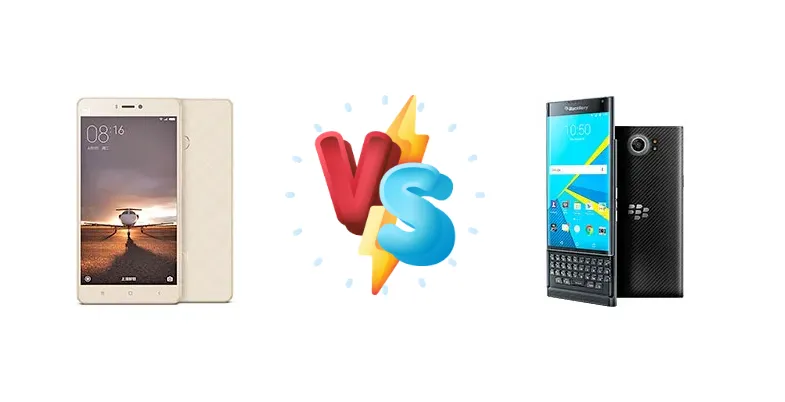
Remember when physical keyboards and sleek, compact designs were the norm? The Xiaomi Mi 4s and BlackBerry Priv represent a bygone era of Android smartphones. Both packed decent specs for their time, but which one holds up better today? Let's dive into a detailed comparison.
🏆 Quick Verdict
The Xiaomi Mi 4s edges out the BlackBerry Priv thanks to its superior battery life and slightly better display visibility in sunlight. While the Priv's keyboard was a unique selling point, the Mi 4s offers a more well-rounded package for modern use, considering its age.
| Network |
|---|
| 2G bands | GSM 850 / 900 / 1800 / 1900 - SIM 1 & SIM 2 | GSM 850 / 900 / 1800 / 1900 |
| 3G bands | HSDPA 850 / 1900 / 2100 | HSDPA 850 / 900 / 1700(AWS) / 1900 / 2100 - USA (STV100-1), Europe (STV100-4) |
| 4G bands | 1, 3, 7, 38, 39, 40, 41 | 1, 2, 3, 4, 5, 7, 12, 17, 20, 29, 30 - USA (STV100-1) |
| Speed | HSPA, LTE Cat4 150/50 Mbps | HSPA 42.2/5.76 Mbps, LTE (3CA) Cat9 450/50 Mbps |
| Technology | GSM / CDMA / HSPA / LTE | GSM / HSPA / LTE |
| | TD-SCDMA | 1, 2, 3, 4, 7, 8, 13, 17, 20, 28 - Europe (STV100-4) |
| Launch |
|---|
| Announced | 2016, February. Released 2016, March | 2015, October. Released 2015, November |
| Status | Discontinued | Discontinued |
| Body |
|---|
| Build | - | Glass front (Gorilla Glass 4), plastic back, plastic frame |
| Dimensions | 139.3 x 70.8 x 7.8 mm (5.48 x 2.79 x 0.31 in) | 147 x 77.2 x 9.4 mm (5.79 x 3.04 x 0.37 in) |
| Keyboard | - | QWERTY |
| SIM | Nano-SIM + Micro-SIM | Nano-SIM |
| Weight | 133 g (4.69 oz) | 192 g (6.77 oz) |
| | - | Capacitive touch 4-row BlackBerry keyboard |
| Display |
|---|
| Protection | - | Corning Gorilla Glass 4 |
| Resolution | 1080 x 1920 pixels, 16:9 ratio (~441 ppi density) | 1440 x 2560 pixels, 16:9 ratio (~540 ppi density) |
| Size | 5.0 inches, 68.9 cm2 (~69.9% screen-to-body ratio) | 5.4 inches, 81.6 cm2 (~71.9% screen-to-body ratio) |
| Type | IPS LCD | AMOLED |
| | - | Curved edge screen |
| Platform |
|---|
| CPU | Hexa-core (4x1.4 GHz Cortex-A53 & 2x1.8 GHz Cortex-A57) | Hexa-core (4x1.4 GHz Cortex-A53 & 2x1.8 GHz Cortex-A57) |
| Chipset | Qualcomm MSM8992 Snapdragon 808 (20 nm) | Qualcomm MSM8992 Snapdragon 808 (20 nm) |
| GPU | Adreno 418 | Adreno 418 |
| OS | Android 5.1 (Lollipop), upgradable to 7.0 (Nougat), MIUI 10 | Android 5.1.1 (Lollipop), upgradable to 6.0.1 (Marshmallow) |
| Memory |
|---|
| Card slot | microSDXC (uses shared SIM slot) | microSDXC (dedicated slot) |
| Internal | 64GB 3GB RAM | 32GB 3GB RAM |
| | eMMC 5.0 | eMMC 5.0 |
| Main Camera |
|---|
| Features | Dual-LED dual-tone flash, panorama, HDR | Schneider-Kreuznach optics, dual-LED dual-tone flash, HDR, panorama |
| Single | 13 MP, f/2.0, PDAF | 18 MP, f/2.2, 27mm (wide), 1/2.4", PDAF, OIS |
| Video | 1080p@30fps, 720p@120fps | 4K@30fps, 1080p@60fps |
| Selfie camera |
|---|
| Single | 5 MP, f/2.0 | 2 MP |
| Video | 1080p@30fps | 720p |
| Sound |
|---|
| 3.5mm jack | Yes | Yes |
| 35mm jack | Yes | Yes |
| Loudspeaker | Yes | Yes |
| Comms |
|---|
| Bluetooth | 4.1, A2DP | 4.1, A2DP, EDR, LE |
| Infrared port | Yes | - |
| NFC | No | Yes |
| Positioning | GPS, GLONASS, BDS | GPS, GLONASS |
| Radio | No | No |
| USB | USB Type-C | microUSB 2.0 (SlimPort 4K) |
| WLAN | Wi-Fi 802.11 a/b/g/n/ac, dual-band, Wi-Fi Direct, hotspot | Wi-Fi 802.11 a/b/g/n/ac, Wi-Fi Direct, hotspot |
| Features |
|---|
| Sensors | Fingerprint (rear-mounted), accelerometer, gyro, proximity, compass | Accelerometer, altimeter, gyro, ToF proximity, compass |
| Battery |
|---|
| Charging | 18W wired, QC2, 40% in 60 min | 18W wired, QC2
Wireless (Qi) (market dependent) |
| Music play | - | Up to 73 h |
| Stand-by | - | Up to 420 h (3G) |
| Talk time | - | Up to 24 h (3G) |
| Type | Li-Ion 3260 mAh, non-removable | Li-Ion 3410 mAh, non-removable |
| Misc |
|---|
| Colors | Black, White, Gold, Pink | Black |
| Models | - | STV100-4, STV100-3, STV100-1, V100, STV100-2 |
| Price | About 220 EUR | About 270 EUR |
| Tests |
|---|
| Audio quality |
Noise -94.9dB / Crosstalk -82.6dB | - |
| Battery life |
Endurance rating 75h
|
Endurance rating 62h
|
| Camera |
Photo / Video |
Photo / Video |
| Display |
Contrast ratio: 975:1 (nominal), 2.095 (sunlight) | - |
| Loudspeaker |
Voice 73dB / Noise 68dB / Ring 82dB
| - |
| Performance |
Basemark OS II 2.0: 1545Basemark X: 12990 | - |
Xiaomi Mi 4s
- Excellent battery life
- Good sunlight display visibility
- Compact design
- Decent performance for its age
- Outdated software
- Camera performance may be lacking
- Limited availability of parts/support
BlackBerry Priv
- Physical keyboard
- Unique design
- Wireless charging (market dependent)
- Decent performance
- Shorter battery life
- Outdated software
- Limited availability of parts/support
- Keyboard can be divisive
Display Comparison
The Xiaomi Mi 4s boasts a contrast ratio of 975:1 (nominal) and an impressive 2.095 in sunlight, indicating excellent outdoor visibility. The BlackBerry Priv's display, while good, doesn't quite match this sunlight performance. Both phones feature 5.5-inch displays, but the Mi 4s's contrast gives it a slight edge.
Camera Comparison
Camera performance is difficult to definitively assess without detailed reviews. Both phones feature 'Photo / Video' capabilities, but image quality will depend on sensor size, software processing, and lens quality. Expect decent results in good lighting conditions, but low-light performance will likely be a weakness for both.
Performance
Both devices share the same Qualcomm Snapdragon 808 chipset and hexa-core CPU, suggesting similar performance. However, software optimization and available RAM (likely 3GB for Mi 4s and 3GB for Priv) could influence real-world speed. Expect adequate performance for everyday tasks, but demanding games might struggle.
Battery Life
This is where the Mi 4s truly shines. With an endurance rating of 75h, it significantly outperforms the BlackBerry Priv's 62h. This translates to noticeably longer battery life for the Mi 4s, a crucial factor for many users.
Buying Guide
Who should buy the Xiaomi Mi 4s? Those seeking a compact, reliable Android phone with good battery life and a decent camera, willing to overlook its age. Who should buy the BlackBerry Priv? Die-hard BlackBerry fans craving a physical keyboard and a unique design, understanding its limitations.
Frequently Asked Questions
❓ Are these phones still receiving software updates?
Highly unlikely. Both phones are several years old and have long since ceased receiving official software updates. Security vulnerabilities are a significant concern.
❓ Where can I find replacement parts for these phones?
Finding replacement parts can be challenging due to their age. Online marketplaces like eBay and AliExpress are your best bet, but availability is limited.
❓ Are these phones worth buying in 2024?
Only if you're a collector or specifically desire the physical keyboard of the Priv or the compact size of the Mi 4s. Modern smartphones offer significantly better performance, features, and security.