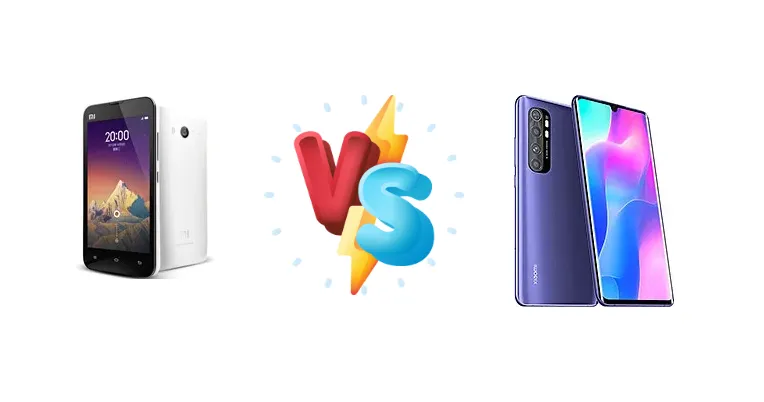
Xiaomi has consistently delivered impressive smartphones at competitive prices. Today, we're pitting two of their devices against each other: the older, but historically significant, Mi 2S and the more modern Mi Note 10 Lite. Let's see how these phones stack up.
🏆 Quick Verdict
The Mi Note 10 Lite is the clear winner. While the Mi 2S holds a place in Xiaomi history, the Note 10 Lite’s superior performance, modern features like 30W charging, and significantly improved camera make it the better choice for most users.
| Network |
|---|
| 2G bands | GSM 850 / 900 / 1800 / 1900 | GSM 850 / 900 / 1800 / 1900 |
| 3G bands | HSDPA 850 / 1900 / 2100 | HSDPA 800 / 850 / 900 / 1700(AWS) / 1900 / 2100 |
| 4G bands | - | 1, 2, 3, 4, 5, 7, 8, 18, 19, 20, 26, 28, 38, 40, 41 |
| Speed | HSPA 42.2/5.76 Mbps | HSPA, LTE |
| Technology | GSM / HSPA | GSM / HSPA / LTE |
| Launch |
|---|
| Announced | 2013, April. Released 2013, April | 2020, April 30. Released 2020, May 09 |
| Status | Discontinued | Discontinued |
| Body |
|---|
| Build | - | Glass front (Gorilla Glass 5), glass back (Gorilla Glass 5), aluminum frame |
| Dimensions | 126 x 62 x 10.2 mm (4.96 x 2.44 x 0.40 in) | 157.8 x 74.2 x 9.7 mm (6.21 x 2.92 x 0.38 in) |
| SIM | Mini-SIM | Nano-SIM + Nano-SIM |
| Weight | 145 g (5.11 oz) | 204 g (7.20 oz) |
| Display |
|---|
| Protection | - | Corning Gorilla Glass 5 |
| Resolution | 720 x 1280 pixels, 16:9 ratio (~342 ppi density) | 1080 x 2340 pixels, 19.5:9 ratio (~398 ppi density) |
| Size | 4.3 inches, 51.0 cm2 (~65.2% screen-to-body ratio) | 6.47 inches, 102.8 cm2 (~87.8% screen-to-body ratio) |
| Type | IPS LCD | AMOLED, HDR10, 430 nits (typ) |
| Platform |
|---|
| CPU | Quad-core 1.7 GHz Krait 300 | Octa-core (2x2.2 GHz Kryo 470 Gold & 6x1.8 GHz Kryo 470 Silver) |
| Chipset | Qualcomm APQ8064 Snapdragon S4 Pro | Qualcomm SDM730 Snapdragon 730G (8 nm) |
| GPU | Adreno 320 | Adreno 618 |
| OS | Android 4.1 (Jelly Bean), upgradable to 4.4.4 (KitKat), MIUI 5 | Android 10, upgradable to Android 11, MIUI 12.5 E |
| Memory |
|---|
| Card slot | No | No |
| Internal | 16GB 2GB RAM, 32GB 2GB RAM | 64GB 6GB RAM, 128GB 6GB RAM, 128GB 8GB RAM |
| | - | UFS 2.1 |
| Main Camera |
|---|
| Features | LED flash, HDR | Laser AF, Quad-LED flash, HDR, panorama |
| Quad | - | 64 MP, f/1.9, 26mm (wide), 1/1.72", 0.8µm, PDAF
8 MP, f/2.2, (ultrawide), 1/4.0", 1.12µm
2 MP (macro)
Auxiliary lens |
| Single | 8 MP, f/2.2 (16 GB version)
13 MP, f/2.2, AF (32 GB version) | - |
| Video | 1080p@30fps, 720p@90fps, HDR | 4K@30fps, 1080p@30/60/120fps, 720p@960fps |
| Selfie camera |
|---|
| Features | - | HDR, panorama |
| Single | 2 MP | 16 MP, f/2.5, (wide), 1/3.06" 1.0µm |
| Video | 1080p@30fps | 1080p@30fps |
| Sound |
|---|
| 3.5mm jack | Yes | Yes |
| 35mm jack | Yes | Yes |
| Loudspeaker | Yes | Yes |
| | - | 24-bit/192kHz audio |
| Comms |
|---|
| Bluetooth | 4.0, A2DP | 5.0, A2DP, LE, aptX HD, aptX Adaptive |
| Infrared port | - | Yes |
| NFC | No | Yes |
| Positioning | GPS, GLONASS | GPS, GLONASS, GALILEO, BDS |
| Radio | FM radio | FM radio, recording |
| USB | microUSB 2.0 (MHL TV-out), OTG | USB Type-C 2.0 |
| WLAN | Wi-Fi 802.11 a/b/g/n, dual-band, Wi-Fi Direct, hotspot | Wi-Fi 802.11 a/b/g/n/ac, dual-band, Wi-Fi Direct |
| Features |
|---|
| Sensors | Accelerometer, gyro, proximity, compass | Fingerprint (under display, optical), accelerometer, gyro, compass |
| Battery |
|---|
| Charging | - | 30W wired |
| Music play | Up to 45 h | - |
| Stand-by | Up to 450 h (3G) | - |
| Talk time | Up to 15 h (3G) | - |
| Type | Li-Ion 2000 mAh, removable | Li-Po 5260 mAh |
| Misc |
|---|
| Colors | Black/white, black/blue, black/yellow, black/green, black/pink | Midnight Black, Glacier White, Nebula Purple |
| Models | - | M2002F4LG, M1910F4G |
| Price | About 250 EUR | About 110 EUR |
| SAR | - | 1.17 W/kg (head) 0.86 W/kg (body) |
| SAR EU | - | 1.01 W/kg (head) 1.39 W/kg (body) |
| Pricing |
|---|
| 128GB 6GB RAM | - | € 367.55 |
| 64GB 6GB RAM | - | $ 249.99 |
| RENEWED | - | € 229.00 |
| Tests |
|---|
| Battery life | - |
Endurance rating 117h
|
| Camera | - |
Photo / Video |
| Display | - |
Contrast ratio: Infinite (nominal) |
| Loudspeaker | - |
-29.2 LUFS (Average)
|
| Performance | - |
AnTuTu: 253271 (v8)
GeekBench: 1694 (v5.1)
GFXBench: 15fps (ES 3.1 onscreen) |
Xiaomi Mi 2S
- Historically significant Snapdragon S4 Pro
- Compact size (for its time)
- Relatively affordable on the used market
- Outdated chipset
- Low resolution display
- Limited camera capabilities
- No modern features like fast charging
Xiaomi Mi Note 10 Lite
- Modern Snapdragon 730G chipset
- Bright and vibrant display
- Improved camera system
- 30W fast charging
- Long battery life
- May lack flagship features
- Plastic build (depending on variant)
Display Comparison
The Mi Note 10 Lite boasts a brighter display (596 nits vs. estimated 400-450 nits for the Mi 2S) and a theoretically infinite contrast ratio, offering richer colors and deeper blacks. While the Mi 2S had a respectable display for its time, the Note 10 Lite’s panel is noticeably superior.
Camera Comparison
The Mi Note 10 Lite’s camera system is a major advantage. While specific details are missing, the Note 10 Lite likely offers improved image quality, more features, and better low-light performance compared to the Mi 2S. The Mi 2S camera was adequate for its time, but it simply can't compete with modern smartphone cameras.
Performance
The Mi Note 10 Lite’s Snapdragon 730G is a significant upgrade over the Mi 2S’s Snapdragon S4 Pro. The 730G’s octa-core architecture and 8nm process provide considerably faster processing speeds and better power efficiency. Expect smoother multitasking and gaming on the Note 10 Lite.
Battery Life
Both phones boast impressive battery life, with the Mi Note 10 Lite achieving an endurance rating of 117 hours. The Mi 2S likely offered a similar endurance rating for its era, but the Note 10 Lite benefits from more efficient components and a larger battery capacity, and also features 30W fast charging.
Buying Guide
Who should buy the Xiaomi Mi 2S? Primarily enthusiasts or collectors interested in experiencing an early Snapdragon powerhouse. Who should buy the Xiaomi Mi Note 10 Lite? Anyone seeking a well-rounded smartphone with a good camera, decent performance, and long battery life at a reasonable price.
Frequently Asked Questions
❓ Is the Mi 2S still worth buying?
Only for collectors or those interested in experiencing an older flagship device. It's not a practical choice for everyday use.
❓ What is the main difference between the Mi 2S and Mi Note 10 Lite?
The Mi Note 10 Lite offers a significantly more modern chipset, a better display, a superior camera, and faster charging compared to the Mi 2S.