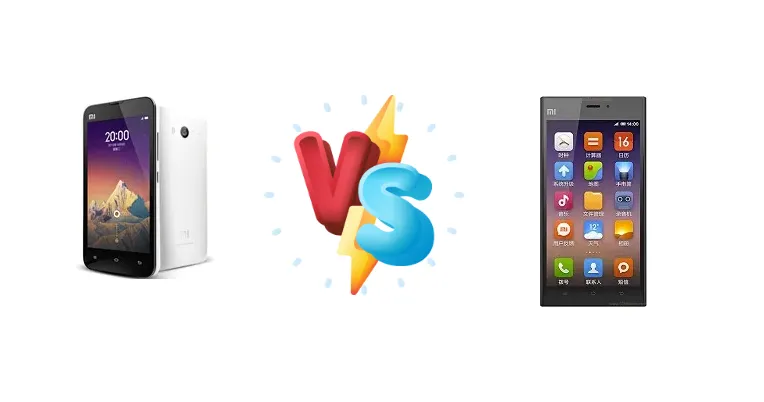
The Xiaomi Mi 2S and Mi 3 represent a pivotal era in Xiaomi's history, offering compelling features for their time. Both phones are now considered vintage, but which one holds up better today? This comparison dives deep into their specs and performance to help you decide.
🏆 Quick Verdict
The Xiaomi Mi 3 emerges as the clear winner thanks to its significantly faster Snapdragon 800 chipset, improved charging capabilities, and generally more modern features. While the Mi 2S was a solid device, the Mi 3's performance boost makes it the preferable choice for enthusiasts.
| Network |
|---|
| 2G bands | GSM 850 / 900 / 1800 / 1900 | GSM 850 / 900 / 1800 / 1900 |
| 3G bands | HSDPA 850 / 1900 / 2100 | HSDPA 850 / 900 / 1900 / 2100 |
| Speed | HSPA 42.2/5.76 Mbps | HSPA 42.2/5.76 Mbps |
| Technology | GSM / HSPA | GSM / HSPA |
| Launch |
|---|
| Announced | 2013, April. Released 2013, April | 2013, September. Released 2013, December |
| Status | Discontinued | Discontinued |
| Body |
|---|
| Build | - | Glass front (Gorilla Glass 3), plastic back, plastic frame |
| Dimensions | 126 x 62 x 10.2 mm (4.96 x 2.44 x 0.40 in) | 144 x 73.6 x 8.1 mm (5.67 x 2.90 x 0.32 in) |
| SIM | Mini-SIM | Mini-SIM |
| Weight | 145 g (5.11 oz) | 145 g (5.11 oz) |
| Display |
|---|
| Protection | - | Corning Gorilla Glass 3 |
| Resolution | 720 x 1280 pixels, 16:9 ratio (~342 ppi density) | 1080 x 1920 pixels, 16:9 ratio (~441 ppi density) |
| Size | 4.3 inches, 51.0 cm2 (~65.2% screen-to-body ratio) | 5.0 inches, 68.9 cm2 (~65.0% screen-to-body ratio) |
| Type | IPS LCD | IPS LCD |
| Platform |
|---|
| CPU | Quad-core 1.7 GHz Krait 300 | Quad-core 2.3 GHz Krait 400 |
| Chipset | Qualcomm APQ8064 Snapdragon S4 Pro | Qualcomm MSM8274AB Snapdragon 800 (28 nm) |
| GPU | Adreno 320 | Adreno 330 |
| OS | Android 4.1 (Jelly Bean), upgradable to 4.4.4 (KitKat), MIUI 5 | Android 4.3 (Jelly Bean), upgradable to 6.0 (Marshmallow), MIUI 5 |
| Memory |
|---|
| Card slot | No | No |
| Internal | 16GB 2GB RAM, 32GB 2GB RAM | 16GB 2GB RAM, 64GB 2GB RAM |
| | - | eMMC 4.5 |
| Main Camera |
|---|
| Features | LED flash, HDR | Dual-LED flash, HDR |
| Single | 8 MP, f/2.2 (16 GB version)
13 MP, f/2.2, AF (32 GB version) | 13 MP, f/2.2, 28mm (wide), AF |
| Video | 1080p@30fps, 720p@90fps, HDR | 1080p@30fps, HDR |
| Selfie camera |
|---|
| Single | 2 MP | 2 MP, f/2.2 |
| Video | 1080p@30fps | 1080p@30fps |
| Sound |
|---|
| 3.5mm jack | Yes | Yes |
| 35mm jack | Yes | Yes |
| Loudspeaker | Yes | Yes |
| Comms |
|---|
| Bluetooth | 4.0, A2DP | 4.0, A2DP |
| NFC | No | Yes |
| Positioning | GPS, GLONASS | GPS, GLONASS |
| Radio | FM radio | FM radio |
| USB | microUSB 2.0 (MHL TV-out), OTG | microUSB 2.0, OTG |
| WLAN | Wi-Fi 802.11 a/b/g/n, dual-band, Wi-Fi Direct, hotspot | Wi-Fi 802.11 a/b/g/n, dual-band, Wi-Fi Direct, hotspot |
| Features |
|---|
| Sensors | Accelerometer, gyro, proximity, compass | Accelerometer, gyro, proximity, compass, barometer |
| Battery |
|---|
| Charging | - | 18W wired, QC2 |
| Music play | Up to 45 h | Up to 50 h |
| Stand-by | Up to 450 h (3G) | Up to 500 h |
| Talk time | Up to 15 h (3G) | Up to 25 h |
| Type | Li-Ion 2000 mAh, removable | Li-Ion 3050 mAh, non-removable |
| Misc |
|---|
| Colors | Black/white, black/blue, black/yellow, black/green, black/pink | White, Gray, Black, Yellow, Pink, Blue, Gold, Green |
| Price | About 250 EUR | About 200 EUR |
| Tests |
|---|
| Audio quality | - |
Noise -91.5dB / Crosstalk -44.2dB |
| Battery life | - | Endurance rating 66h |
| Camera | - |
Photo / Video |
| Display | - |
Contrast ratio: 907 (nominal), 2.001 (sunlight) |
| Loudspeaker | - |
Voice 69dB / Noise 66dB / Ring 75dB |
Xiaomi Mi 2S
- Compact size
- Decent performance for its time
- Relatively affordable
- Outdated chipset
- Shorter battery life
- Slower charging
Xiaomi Mi 3
- Faster Snapdragon 800 chipset
- Longer battery life
- Faster charging (QC2)
- Larger display
- Still an older device
- Limited software support
- May be harder to find in good condition
Display Comparison
Both the Mi 2S and Mi 3 boast impressive contrast ratios of 907 (nominal) and 2.001 (sunlight) for their time. The Mi 3 has a slightly larger display (5.0 inches vs 4.3 inches on the Mi 2S), offering a more immersive viewing experience. However, both displays are LCD and lack the vibrancy of modern OLED panels.
Camera Comparison
Camera quality on both phones is adequate for their era. Both feature Photo/Video capabilities, but detailed specifications are lacking. The Mi 3 likely has a slight edge due to its newer chipset and potentially improved image processing, but don't expect flagship-level results from either device.
Performance
This is where the Mi 3 truly shines. Its Snapdragon 800 chipset (28nm) and 2.3 GHz Krait 400 CPU significantly outperform the Mi 2S's Snapdragon S4 Pro (45nm) and 1.7 GHz Krait 300 CPU. Expect smoother multitasking, faster app loading, and better gaming performance on the Mi 3.
Battery Life
The Mi 3 boasts an endurance rating of 66 hours, which is notably better than the Mi 2S. While the Mi 2S's battery life was respectable, the Mi 3's larger capacity and more efficient chipset contribute to its superior longevity. The Mi 3 also features 18W wired charging with QC2, a significant upgrade over the Mi 2S's charging capabilities.
Buying Guide
The Xiaomi Mi 2S is a good option for collectors or those seeking a nostalgic Android experience on a budget. The Mi 3 is better suited for users who want a slightly more capable vintage phone with better performance and faster charging, even with its age.
Frequently Asked Questions
❓ Are these phones still usable in 2024?
Yes, but with limitations. Expect limited software updates and compatibility with modern apps. They are best suited for basic tasks and nostalgia.
❓ Where can I find these phones?
You'll likely need to search online marketplaces like eBay or specialized vintage phone retailers. Condition and price will vary significantly.