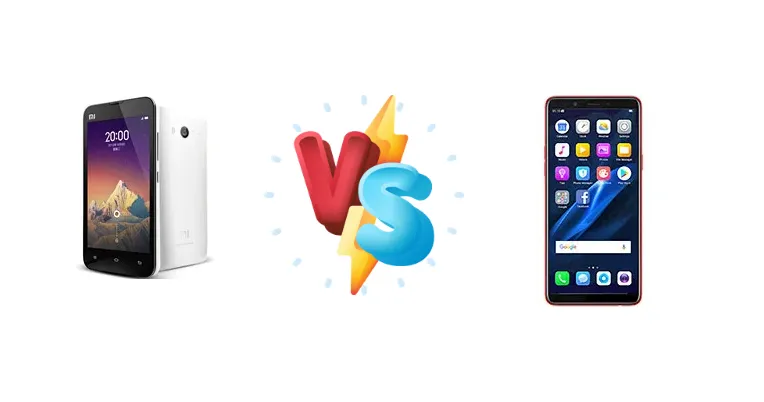
The Xiaomi Mi 2S, a classic from 2013, holds a special place in many Android enthusiasts' hearts. Now, let's pit it against the Oppo F7 Youth, a more modern budget offering. Can the older phone still compete, or does the newer technology of the F7 Youth reign supreme?
🏆 Quick Verdict
The Oppo F7 Youth wins overall due to its significantly more powerful processor, modern features like a larger display and improved camera capabilities. While the Mi 2S has a certain nostalgic charm, the F7 Youth offers a better user experience and future-proofing.
| Network |
|---|
| 2G bands | GSM 850 / 900 / 1800 / 1900 | GSM 850 / 900 / 1800 / 1900 |
| 3G bands | HSDPA 850 / 1900 / 2100 | HSDPA 800 / 850 / 900 / 1700(AWS) / 1900 / 2100 - Taiwan |
| 4G bands | - | 1, 2, 3, 4, 5, 7, 8, 18, 19, 20, 26, 28, 38, 39, 40, 41 - Taiwan |
| Speed | HSPA 42.2/5.76 Mbps | HSPA 42.2/5.76 Mbps, LTE (2CA) Cat13 600/100 Mbps |
| Technology | GSM / HSPA | GSM / HSPA / LTE |
| | - | 1, 3, 5, 7, 8, 38, 40, 41 - Asia Pacific |
| Launch |
|---|
| Announced | 2013, April. Released 2013, April | 2018, May. Released 2018, June |
| Status | Discontinued | Discontinued |
| Body |
|---|
| Dimensions | 126 x 62 x 10.2 mm (4.96 x 2.44 x 0.40 in) | 156.5 x 75.2 x 7.8 mm (6.16 x 2.96 x 0.31 in) |
| SIM | Mini-SIM | Nano-SIM + Nano-SIM |
| Weight | 145 g (5.11 oz) | 155 g (5.47 oz) |
| Display |
|---|
| Resolution | 720 x 1280 pixels, 16:9 ratio (~342 ppi density) | 1080 x 2160 pixels, 18:9 ratio (~402 ppi density) |
| Size | 4.3 inches, 51.0 cm2 (~65.2% screen-to-body ratio) | 6.0 inches, 92.9 cm2 (~78.9% screen-to-body ratio) |
| Type | IPS LCD | IPS LCD |
| Platform |
|---|
| CPU | Quad-core 1.7 GHz Krait 300 | Octa-core (4x2.0 GHz Cortex-A73 & 4x2.0 GHz Cortex-A53) |
| Chipset | Qualcomm APQ8064 Snapdragon S4 Pro | Mediatek MT6771 Helio P60 (12 nm) |
| GPU | Adreno 320 | Mali-G72 MP3 |
| OS | Android 4.1 (Jelly Bean), upgradable to 4.4.4 (KitKat), MIUI 5 | Android 8.1 (Oreo), ColorOS 5.2 |
| Memory |
|---|
| Card slot | No | microSDXC (dedicated slot) |
| Internal | 16GB 2GB RAM, 32GB 2GB RAM | 64GB 4GB RAM |
| | - | eMMC 5.1 |
| Main Camera |
|---|
| Features | LED flash, HDR | LED flash, HDR, panorama |
| Single | 8 MP, f/2.2 (16 GB version)
13 MP, f/2.2, AF (32 GB version) | 13 MP, f/2.2, PDAF |
| Video | 1080p@30fps, 720p@90fps, HDR | 1080p@30fps |
| Selfie camera |
|---|
| Single | 2 MP | 8 MP, f/2.2 |
| Video | 1080p@30fps | - |
| Sound |
|---|
| 3.5mm jack | Yes | Yes |
| 35mm jack | Yes | Yes |
| Loudspeaker | Yes | Yes |
| Comms |
|---|
| Bluetooth | 4.0, A2DP | 4.2, A2DP, LE |
| NFC | No | No |
| Positioning | GPS, GLONASS | GPS |
| Radio | FM radio | FM radio |
| USB | microUSB 2.0 (MHL TV-out), OTG | microUSB 2.0, OTG |
| WLAN | Wi-Fi 802.11 a/b/g/n, dual-band, Wi-Fi Direct, hotspot | Wi-Fi 802.11 b/g/n, Wi-Fi Direct |
| Features |
|---|
| Sensors | Accelerometer, gyro, proximity, compass | Accelerometer, proximity, compass |
| Battery |
|---|
| Music play | Up to 45 h | - |
| Stand-by | Up to 450 h (3G) | - |
| Talk time | Up to 15 h (3G) | - |
| Type | Li-Ion 2000 mAh, removable | Li-Ion 3410 mAh, non-removable |
| Misc |
|---|
| Colors | Black/white, black/blue, black/yellow, black/green, black/pink | Solar Red, Diamond Black |
| Price | About 250 EUR | About 250 EUR |
Xiaomi Mi 2S
- Compact size
- Classic Android experience
- Nostalgic appeal
- Good build quality for its time
- Outdated processor
- Small display
- Limited camera capabilities
- Poor battery life by today's standards
- Lack of modern features
Oppo F7 Youth
- Powerful processor
- Large display
- Improved camera
- Longer battery life
- Modern features
- Larger size may not be ideal for one-handed use
- Oppo's ColorOS can be divisive
Display Comparison
The Oppo F7 Youth boasts a 6.2-inch IPS LCD display, offering a larger and more immersive viewing experience compared to the Mi 2S's 4.3-inch display. Resolution is also higher on the F7 Youth, resulting in sharper visuals. While the Mi 2S's smaller size can be appealing for one-handed use, the F7 Youth's screen is generally more enjoyable for media consumption.
Camera Comparison
The Oppo F7 Youth features a 16MP rear camera and a 16MP front camera, offering better image quality and more features than the Mi 2S's 8MP rear camera. The F7 Youth likely includes features like HDR and portrait mode, which were not available on the Mi 2S. Low-light performance will also be significantly better on the F7 Youth.
Performance
Here's where the F7 Youth truly shines. Its Octa-core Helio P60 chipset with Cortex-A73 cores provides a substantial performance boost over the Mi 2S's Quad-core Snapdragon S4 Pro. Expect smoother multitasking, faster app loading times, and better gaming performance on the F7 Youth. The Mi 2S, while capable for its time, will struggle with modern apps and demanding tasks.
Battery Life
The Oppo F7 Youth has a 3200mAh battery, providing longer battery life than the Mi 2S's 2000mAh battery. While battery optimization has improved over the years, the F7 Youth's larger capacity gives it a clear advantage.
Buying Guide
The Xiaomi Mi 2S is for Android purists and those seeking a compact, classic Android experience. The Oppo F7 Youth is ideal for users prioritizing performance, a larger screen, and a more modern camera system within a budget.
Frequently Asked Questions
❓ Is the Xiaomi Mi 2S still usable in 2024?
Yes, but with limitations. It can handle basic tasks, but modern apps and games may struggle. It's best suited for nostalgia or as a secondary device.
❓ Which phone has better software support?
The Oppo F7 Youth, despite being older, is likely to have received more updates than the Mi 2S, which is no longer actively supported.