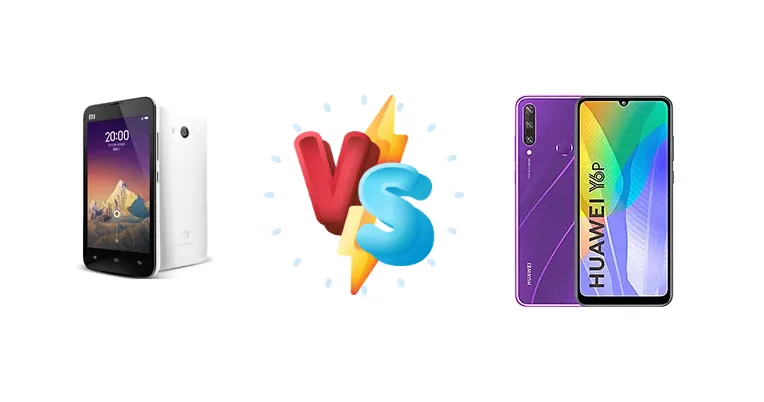
The smartphone market is overflowing with options, especially in the budget segment. Today, we're pitting two contenders against each other: the Xiaomi Mi 2S, a phone from a bygone era, and the Huawei Y6p, a more modern offering. Let's see how they stack up.
🏆 Quick Verdict
The Huawei Y6p wins overall due to its newer chipset, better power efficiency, and modern software. While the Mi 2S boasts a slightly faster CPU, the Y6p's octa-core processor and 12nm process offer a smoother, more reliable experience for everyday tasks.
| Network |
|---|
| 2G bands | GSM 850 / 900 / 1800 / 1900 | GSM 850 / 900 / 1800 / 1900 |
| 3G bands | HSDPA 850 / 1900 / 2100 | HSDPA 850 / 900 / 1700(AWS) / 1900 / 2100 |
| 4G bands | - | 1, 2, 3, 4, 5, 7, 8, 20, 28, 34, 38, 39, 40, 41 |
| Speed | HSPA 42.2/5.76 Mbps | HSPA 42.2/5.76 Mbps, LTE Cat4 150/50 Mbps |
| Technology | GSM / HSPA | GSM / HSPA / LTE |
| Launch |
|---|
| Announced | 2013, April. Released 2013, April | 2020, May 05. Released 2020, May 06 |
| Status | Discontinued | Discontinued |
| Body |
|---|
| Build | - | Glass front, plastic back, plastic frame |
| Dimensions | 126 x 62 x 10.2 mm (4.96 x 2.44 x 0.40 in) | 159.1 x 74.1 x 9 mm (6.26 x 2.92 x 0.35 in) |
| SIM | Mini-SIM | · Nano-SIM· Nano-SIM + Nano-SIM |
| Weight | 145 g (5.11 oz) | 185 g (6.53 oz) |
| Display |
|---|
| Resolution | 720 x 1280 pixels, 16:9 ratio (~342 ppi density) | 720 x 1600 pixels, 20:9 ratio (~278 ppi density) |
| Size | 4.3 inches, 51.0 cm2 (~65.2% screen-to-body ratio) | 6.3 inches, 95.8 cm2 (~81.3% screen-to-body ratio) |
| Type | IPS LCD | IPS LCD |
| Platform |
|---|
| CPU | Quad-core 1.7 GHz Krait 300 | Octa-core (4x2.0 GHz Cortex-A53 & 4x1.5 GHz Cortex-A53) |
| Chipset | Qualcomm APQ8064 Snapdragon S4 Pro | Mediatek MT6762R Helio P22 (12 nm) |
| GPU | Adreno 320 | PowerVR GE8320 |
| OS | Android 4.1 (Jelly Bean), upgradable to 4.4.4 (KitKat), MIUI 5 | Android 10, EMUI 10.1, no Google Play Services |
| Memory |
|---|
| Card slot | No | microSDXC (dedicated slot) |
| Internal | 16GB 2GB RAM, 32GB 2GB RAM | 32GB 3GB RAM, 64GB 3GB RAM, 64GB 4GB RAM |
| | - | eMMC 5.1 |
| Main Camera |
|---|
| Features | LED flash, HDR | LED flash, HDR, panorama |
| Single | 8 MP, f/2.2 (16 GB version)
13 MP, f/2.2, AF (32 GB version) | - |
| Triple | - | 13 MP, f/1.8, (wide), PDAF
5 MP, f/2.2, 120˚ (ultrawide)
Auxiliary lens |
| Video | 1080p@30fps, 720p@90fps, HDR | 1080p@30fps |
| Selfie camera |
|---|
| Features | - | HDR |
| Single | 2 MP | 8 MP, f/2.0, (wide) |
| Video | 1080p@30fps | 1080p@30fps |
| Sound |
|---|
| 3.5mm jack | Yes | Yes |
| 35mm jack | Yes | Yes |
| Loudspeaker | Yes | Yes |
| Comms |
|---|
| Bluetooth | 4.0, A2DP | 5.0, A2DP, LE |
| NFC | No | Yes (market/region dependent)MED-LX9N (Yes); MED-LX9 (No) |
| Positioning | GPS, GLONASS | GPS, GLONASS, BDS |
| Radio | FM radio | FM radio; built-in antenna |
| USB | microUSB 2.0 (MHL TV-out), OTG | microUSB 2.0, OTG |
| WLAN | Wi-Fi 802.11 a/b/g/n, dual-band, Wi-Fi Direct, hotspot | Wi-Fi 802.11 b/g/n, Wi-Fi Direct |
| Features |
|---|
| Sensors | Accelerometer, gyro, proximity, compass | Fingerprint (rear-mounted), accelerometer, proximity |
| Battery |
|---|
| Charging | - | 10W wired
Reverse wired |
| Music play | Up to 45 h | - |
| Stand-by | Up to 450 h (3G) | - |
| Talk time | Up to 15 h (3G) | - |
| Type | Li-Ion 2000 mAh, removable | Li-Po 5000 mAh |
| Misc |
|---|
| Colors | Black/white, black/blue, black/yellow, black/green, black/pink | Phantom Purple, Emerald Green, Midnight Black |
| Models | - | MED-LX9, MED-LX9N |
| Price | About 250 EUR | About 160 EUR |
Xiaomi Mi 2S
- Compact size
- Nostalgic appeal
- Decent performance for basic tasks (when new)
- Outdated chipset
- Poor battery life
- Low-resolution display
- Limited app compatibility
Huawei Y6p
- Larger display
- Better battery life
- More modern chipset
- Improved camera
- Reverse wired charging
- Performance not ideal for demanding games
- Huawei's software ecosystem (potential limitations)
- 10W charging is slow
Display Comparison
The Mi 2S features a 4.3-inch IPS display, while the Y6p has a larger 6.3-inch IPS display. The Y6p's larger screen is better for media consumption and easier to navigate. Both offer decent color accuracy for their price points, but the Y6p's size advantage is significant.
Camera Comparison
The Mi 2S has an 8MP rear camera, while the Y6p boasts a 13MP rear camera. While megapixels aren't everything, the Y6p generally produces better images with more detail and dynamic range. The Y6p also benefits from Huawei's image processing algorithms. Both lack impressive low-light performance.
Performance
The Mi 2S's Snapdragon S4 Pro with a 1.7 GHz Krait 300 quad-core CPU was impressive in its time, but it struggles with modern apps. The Y6p's Helio P22 octa-core processor, though not a powerhouse, handles everyday tasks and light gaming much more effectively. The Y6p's 12nm process also contributes to better power efficiency.
Battery Life
The Mi 2S has a 2000mAh battery, which is inadequate by today's standards. The Y6p features a 3020mAh battery, offering significantly longer battery life. The Y6p's more efficient chipset further extends its usage time.
Buying Guide
The Xiaomi Mi 2S is for those seeking a nostalgic experience or a very basic phone for minimal tasks. The Huawei Y6p is ideal for users needing a reliable, affordable smartphone for social media, browsing, and light gaming.
Frequently Asked Questions
❓ Is the Xiaomi Mi 2S still usable in 2024?
It can be used for very basic tasks like calls and messaging, but its outdated hardware limits its functionality and app compatibility.
❓ Does the Huawei Y6p have Google Play Services?
Due to US sanctions, the Huawei Y6p may not have Google Play Services pre-installed. Users may need to sideload them or use Huawei's AppGallery.