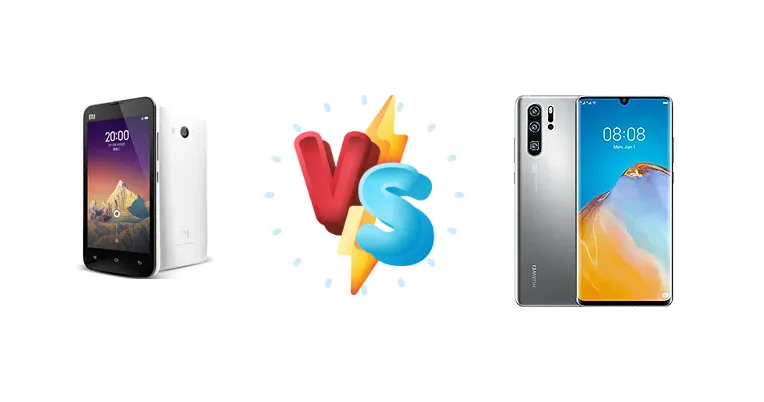
The Xiaomi Mi 2S, a flagship from 2013, holds a nostalgic place in many Android fans' hearts. Now, let's pit it against the Huawei P30 Pro New Edition, a significantly more modern device. Can the Mi 2S's legacy stand up to the P30 Pro's advanced features?
🏆 Quick Verdict
The Huawei P30 Pro New Edition is the clear winner. While the Mi 2S was impressive for its time, the P30 Pro's superior chipset, camera, battery, and modern features make it a vastly better choice for today's users. It's a generational leap in technology.
| Network |
|---|
| 2G bands | GSM 850 / 900 / 1800 / 1900 | GSM 850 / 900 / 1800 / 1900 |
| 3G bands | HSDPA 850 / 1900 / 2100 | HSDPA 800 / 850 / 900 / 1700(AWS) / 1900 / 2100 |
| 4G bands | - | LTE |
| Speed | HSPA 42.2/5.76 Mbps | HSPA 42.2/5.76 Mbps, LTE Cat21 1400/200 Mbps |
| Technology | GSM / HSPA | GSM / HSPA / LTE |
| Launch |
|---|
| Announced | 2013, April. Released 2013, April | 2020, May 12. Released 2020, June 01 |
| Status | Discontinued | Discontinued |
| Body |
|---|
| Build | - | Glass front (Aluminosilicate glass), glass back (Aluminosilicate glass), aluminum frame |
| Dimensions | 126 x 62 x 10.2 mm (4.96 x 2.44 x 0.40 in) | 158 x 73.4 x 8.4 mm (6.22 x 2.89 x 0.33 in) |
| SIM | Mini-SIM | · Nano-SIM· Nano-SIM + Nano-SIM |
| Weight | 145 g (5.11 oz) | 192 g (6.77 oz) |
| | - | IP68 dust/water resistant (up to 2m for 30 mins)
|
| Display |
|---|
| Resolution | 720 x 1280 pixels, 16:9 ratio (~342 ppi density) | 1080 x 2340 pixels, 19.5:9 ratio (~398 ppi density) |
| Size | 4.3 inches, 51.0 cm2 (~65.2% screen-to-body ratio) | 6.47 inches, 102.8 cm2 (~88.6% screen-to-body ratio) |
| Type | IPS LCD | OLED, HDR10 |
| Platform |
|---|
| CPU | Quad-core 1.7 GHz Krait 300 | Octa-core (2x2.6 GHz Cortex-A76 & 2x1.92 GHz Cortex-A76 & 4x1.8 GHz Cortex-A55) |
| Chipset | Qualcomm APQ8064 Snapdragon S4 Pro | Kirin 980 (7 nm) |
| GPU | Adreno 320 | Mali-G76 MP10 |
| OS | Android 4.1 (Jelly Bean), upgradable to 4.4.4 (KitKat), MIUI 5 | Android 10, EMUI 10.1, Google Play Services |
| Memory |
|---|
| Card slot | No | Nano Memory (uses shared SIM slot) |
| Internal | 16GB 2GB RAM, 32GB 2GB RAM | 128GB 6GB RAM, 256GB 8GB RAM |
| | - | UFS 3.0 |
| Main Camera |
|---|
| Features | LED flash, HDR | Leica optics, color spectrum sensor, dual-LED dual-tone flash, panorama, HDR |
| Single | 8 MP, f/2.2 (16 GB version)
13 MP, f/2.2, AF (32 GB version) | - |
| Triple | - | 40 MP, f/1.6, 27mm (wide), 1/1.7", PDAF, OIS
8 MP, f/3.4, 125mm (periscope telephoto), 1/4.0", PDAF, OIS, 5x optical zoom, 10x hybrid zoom
20 MP, f/2.2, 16mm (ultrawide), 1/2.7", PDAF
TOF 3D, (depth) |
| Video | 1080p@30fps, 720p@90fps, HDR | 4K@30fps, 1080p@60fps, 1080p@30fps (gyro-EIS), 720p@960fps |
| Selfie camera |
|---|
| Features | - | HDR |
| Single | 2 MP | 32 MP, f/2.0, 26mm (wide), 1/2.8", 0.8µm |
| Video | 1080p@30fps | 1080p@30fps |
| Sound |
|---|
| 3.5mm jack | Yes | No |
| 35mm jack | Yes | No |
| Loudspeaker | Yes | Yes |
| | - | 32-bit/384kHz audio |
| Comms |
|---|
| Bluetooth | 4.0, A2DP | 5.0, A2DP, aptX HD, LE |
| Infrared port | - | Yes |
| NFC | No | Yes |
| Positioning | GPS, GLONASS | GPS (L1+L5), GLONASS (L1), BDS (B1), GALILEO (E1+E5a), QZSS (L1+L5) |
| Radio | FM radio | No |
| USB | microUSB 2.0 (MHL TV-out), OTG | USB Type-C 3.1 |
| WLAN | Wi-Fi 802.11 a/b/g/n, dual-band, Wi-Fi Direct, hotspot | Wi-Fi 802.11 a/b/g/n/ac, dual-band, Wi-Fi Direct |
| Features |
|---|
| Sensors | Accelerometer, gyro, proximity, compass | Fingerprint (under display, optical), accelerometer, gyro, proximity, compass |
| Battery |
|---|
| Charging | - | 40W wired, 70% in 30 min
15W wireless
Reverse wireless |
| Music play | Up to 45 h | - |
| Stand-by | Up to 450 h (3G) | - |
| Talk time | Up to 15 h (3G) | - |
| Type | Li-Ion 2000 mAh, removable | Li-Po 4200 mAh |
| Misc |
|---|
| Colors | Black/white, black/blue, black/yellow, black/green, black/pink | Aurora, Black, Silver Frost |
| Price | About 250 EUR | About 820 EUR |
Xiaomi Mi 2S
- Compact size
- Nostalgic Android experience
- Relatively affordable (used)
- Outdated performance
- Low-resolution display
- Poor camera
- Short battery life
- Limited software support
Huawei P30 Pro New Edition
- Excellent camera system
- Long battery life
- Fast charging (wired & wireless)
- Powerful performance
- Modern design
- Reverse wireless charging
- Can be expensive (new)
- Huawei ecosystem limitations (potential Google services restrictions)
Display Comparison
The Mi 2S features a 4.3-inch 768 x 1280 display. The P30 Pro New Edition boasts a 6.4-inch OLED display with a 1080 x 2340 resolution. The P30 Pro's larger, higher-resolution OLED screen offers significantly better color accuracy, contrast, and viewing angles.
Camera Comparison
The Mi 2S has an 8MP rear camera. The P30 Pro New Edition features a 40MP main camera, a 20MP monochrome sensor, and a 16MP ultra-wide lens. The P30 Pro's camera system offers vastly superior image quality, zoom capabilities, and low-light performance.
Performance
The Mi 2S's Qualcomm Snapdragon S4 Pro chipset with a quad-core 1.7 GHz Krait 300 CPU is showing its age. The P30 Pro New Edition's Kirin 980 chipset with its octa-core architecture (2x2.6 GHz Cortex-A76 & 2x1.92 GHz Cortex-A76 & 4x1.8 GHz Cortex-A55) provides a massive performance advantage in every area, from app loading to gaming.
Battery Life
The Mi 2S has a 2000 mAh battery. The P30 Pro New Edition has a 4000 mAh battery with 40W wired charging and 15W wireless charging. The P30 Pro offers significantly longer battery life and much faster charging speeds.
Buying Guide
The Xiaomi Mi 2S is for collectors or those seeking a retro Android experience. The Huawei P30 Pro New Edition is for users prioritizing a powerful camera, long battery life, and modern performance.
Frequently Asked Questions
❓ Is the Xiaomi Mi 2S still usable in 2024?
Yes, but with significant limitations. It's usable for basic tasks, but performance will be sluggish compared to modern phones. Software support is non-existent.
❓ Does the Huawei P30 Pro New Edition have Google Play Services?
The availability of Google Play Services can vary depending on the region and specific model. It may require workarounds to install.