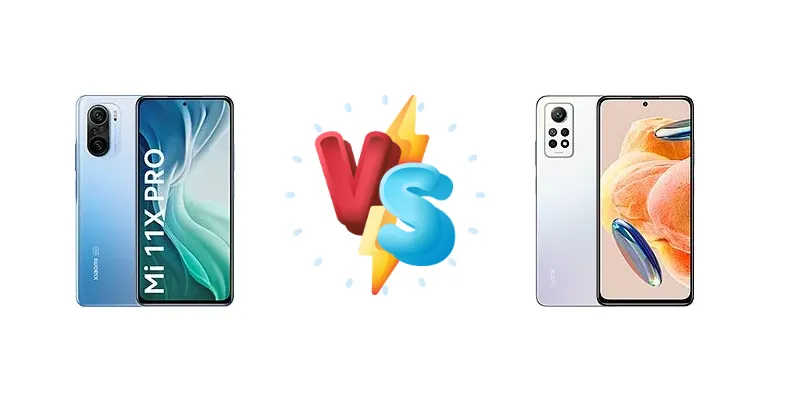
Choosing a new smartphone can be overwhelming, especially with so many options from Xiaomi. The Mi 11X Pro and Redmi Note 12 Pro 4G both offer compelling features, but cater to different needs. This comprehensive comparison will help you decide which phone is right for you.
🏆 Quick Verdict
The Mi 11X Pro delivers flagship-level performance thanks to its Snapdragon 888, making it ideal for gamers and power users. The Redmi Note 12 Pro 4G offers faster charging and a more budget-friendly price, appealing to those prioritizing value and everyday use.
| Network |
|---|
| 2G bands | GSM 850 / 900 / 1800 / 1900 | GSM 850 / 900 / 1800 / 1900 |
| 3G bands | HSDPA 850 / 900 / 1900 / 2100 | HSDPA 850 / 900 / 1700(AWS) / 1900 / 2100 |
| 4G bands | 1, 3, 5, 7, 8, 38, 40, 41 | 1, 2, 3, 4, 5, 7, 8, 20, 28, 38, 40, 41, 66 |
| 5G bands | 77, 78 Sub6 | - |
| Speed | HSPA, LTE, 5G | HSPA, LTE |
| Technology | GSM / HSPA / LTE / 5G | GSM / HSPA / LTE |
| Launch |
|---|
| Announced | 2021, April 23 | 2023, March 03 |
| Status | Available. Released 2021, May 05 | Available. Released 2023, April 11 |
| Body |
|---|
| Build | Glass front (Gorilla Glass 5), glass back (Gorilla Glass 5) | - |
| Dimensions | 163.7 x 76.4 x 7.8 mm (6.44 x 3.01 x 0.31 in) | 164.2 x 76.1 x 8.1 mm (6.46 x 3.00 x 0.32 in) |
| SIM | Nano-SIM + Nano-SIM | Nano-SIM + Nano-SIM |
| Weight | 196 g (6.91 oz) | 201.8 g (7.13 oz) |
| Display |
|---|
| Protection | Corning Gorilla Glass 5 | - |
| Resolution | 1080 x 2400 pixels, 20:9 ratio (~395 ppi density) | 1080 x 2400 pixels, 20:9 ratio (~395 ppi density) |
| Size | 6.67 inches, 107.4 cm2 (~85.9% screen-to-body ratio) | 6.67 inches, 107.4 cm2 (~86.0% screen-to-body ratio) |
| Type | Super AMOLED, 120Hz, HDR10+, 900 nits (HBM), 1300 nits (peak) | AMOLED, 120Hz, Dolby Vision, 700 nits (HBM), 1100 nits (peak) |
| Platform |
|---|
| CPU | Octa-core (1x2.84 GHz Cortex-X1 & 3x2.42 GHz Cortex-A78 & 4x1.80 GHz Cortex-A55) | Octa-core (2x2.2 GHz Kryo 470 Gold & 6x1.8 GHz Kryo 470 Silver) |
| Chipset | Qualcomm SM8350 Snapdragon 888 5G (5 nm) | Qualcomm SM7150 Snapdragon 732G (8 nm) |
| GPU | Adreno 660 | Adreno 618 |
| OS | Android 11, MIUI 12 | Android 11, MIUI 13 |
| Memory |
|---|
| Card slot | No | microSDXC (uses shared SIM slot) |
| Internal | 128GB 8GB RAM, 256GB 8GB RAM | 128GB 6GB RAM, 128GB 8GB RAM, 256GB 8GB RAM |
| | UFS 3.1 | UFS 2.2 |
| Main Camera |
|---|
| Features | Color spectrum sensor, LED flash, HDR, panorama | LED flash, HDR, panorama |
| Quad | - | 108 MP, f/1.9, (wide), 1/1.52", 0.7µm, PDAF
8 MP, 120˚, (ultrawide)
2 MP (macro)
Auxiliary lens |
| Single | 20 MP, f/2.5, (wide), 1/3.4", 0.8µm | - |
| Triple | 108 MP, f/1.8, 26mm (wide), 1/1.52", 0.7µm, PDAF
8 MP, f/2.2, 119˚ (ultrawide)
5 MP, f/2.4, 50mm (telephoto macro), 1/5.0", 1.12µm, AF | - |
| Video | 8K@30fps, 4K@30/60fps, 1080p@30/60/120/240/960fps, gyro-EIS, HDR10+ | 4K@30fps, 1080p@30/60fps |
| Selfie camera |
|---|
| Features | HDR | - |
| Single | 20 MP, f/2.5, (wide), 1/3.4", 0.8µm | 16 MP, f/2.4, (wide) |
| Video | 1080p@30fps, 720p@120fps | 1080p@30fps |
| Sound |
|---|
| 3.5mm jack | No | Yes |
| 35mm jack | No | Yes |
| Loudspeaker | Yes, with stereo speakers | Yes, with stereo speakers |
| | 24-bit/192kHz audio | - |
| Comms |
|---|
| Bluetooth | 5.2, A2DP, LE | 5.0, A2DP, LE |
| Infrared port | Yes | Yes |
| NFC | No | Yes (market/region dependent) |
| Positioning | GPS (L1+L5), GLONASS, BDS, NavIC | GPS, GLONASS, GALILEO, BDS |
| Radio | No | Unspecified |
| USB | USB Type-C 2.0, OTG | USB Type-C 2.0, OTG |
| WLAN | Wi-Fi 802.11 a/b/g/n/ac/6, dual-band, Wi-Fi Direct | Wi-Fi 802.11 a/b/g/n/ac, dual-band |
| Features |
|---|
| Sensors | Fingerprint (side-mounted), accelerometer, gyro, proximity, compass, barometer | Fingerprint (side-mounted), accelerometer, gyro, compass |
| Battery |
|---|
| Charging | 33W wired, PD3.0, QC3, 100% in 52 min | 67W wired |
| Type | Li-Po 4520 mAh | Li-Po 5000 mAh |
| Misc |
|---|
| Colors | Celestial Silver, Lunar White, Cosmic Black | Star Blue, Graphite Gray, Polar White, Ice blue |
| Models | M2012K11I | 2209116AG, 2209116AG |
| Price | About 440 EUR | About 150 EUR |
| SAR | 0.85 W/kg (head) 0.60 W/kg (body) | - |
Xiaomi Mi 11X Pro
- Flagship Performance (Snapdragon 888)
- Excellent Display (AMOLED, 120Hz)
- High-Resolution Camera (108MP)
- Smooth Scrolling
- Slower Charging (33W)
- Higher Price
- Potentially Larger Size
Xiaomi Redmi Note 12 Pro 4G
- Fast Charging (67W)
- More Affordable
- Good Camera (108MP)
- Reliable Performance for Everyday Tasks
- Lower Performance (Snapdragon 732G)
- Less Refined Image Processing
- May Struggle with Demanding Games
Display Comparison
The Mi 11X Pro typically features a 6.81-inch AMOLED display with a 120Hz refresh rate, offering vibrant colors and smooth scrolling. The Redmi Note 12 Pro 4G usually has a 6.67-inch AMOLED display, also with a 120Hz refresh rate, but potentially with slightly lower peak brightness. Both offer excellent viewing experiences, but the Mi 11X Pro's larger size and potentially higher brightness give it a slight edge.
Camera Comparison
The Mi 11X Pro generally boasts a triple-camera system with a 108MP main sensor, offering excellent detail and dynamic range. The Redmi Note 12 Pro 4G also features a 108MP main sensor, but its image processing might not be as refined. Both phones capture good photos in well-lit conditions, but the Mi 11X Pro often produces more consistent results across different scenarios.
Performance
Here's where the Mi 11X Pro truly shines. Its Snapdragon 888 chipset is significantly more powerful than the Redmi Note 12 Pro 4G's Snapdragon 732G. Expect noticeably faster app loading, smoother multitasking, and superior gaming performance on the Mi 11X Pro. The Redmi Note 12 Pro 4G is still capable for everyday tasks, but struggles with demanding games.
Battery Life
The Redmi Note 12 Pro 4G takes the lead in charging speed with its 67W wired charging, allowing for a full charge in around 40 minutes. The Mi 11X Pro's 33W charging is still respectable, but takes longer to reach 100%. Battery capacity is generally similar between the two, offering all-day battery life for moderate usage.
Buying Guide
The Xiaomi Mi 11X Pro is perfect for users who demand top-tier performance, enjoy mobile gaming, and don't mind a slightly higher price. The Xiaomi Redmi Note 12 Pro 4G is a great choice for budget-conscious buyers who want a reliable phone with fast charging and a good camera, prioritizing value over raw power.
Frequently Asked Questions
❓ Is the Mi 11X Pro worth the extra money?
If you prioritize performance and a premium experience, the Mi 11X Pro is worth the investment. However, if you're on a budget and don't need top-tier power, the Redmi Note 12 Pro 4G offers excellent value.
❓ Does the Redmi Note 12 Pro 4G support 5G?
No, the Redmi Note 12 Pro 4G is a 4G-only device. The Mi 11X Pro supports 5G connectivity.