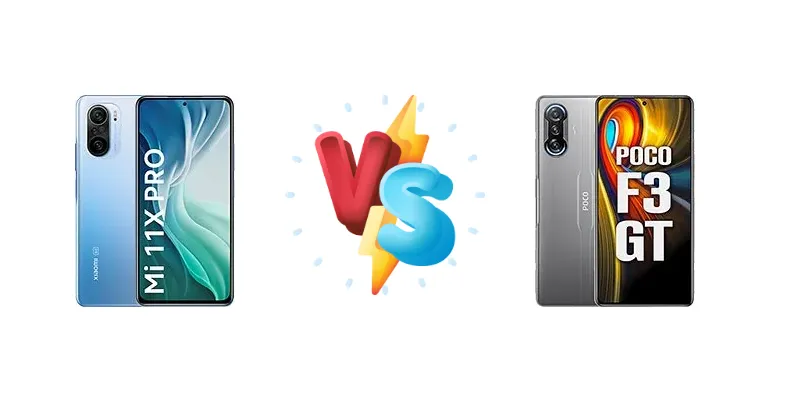
Xiaomi consistently delivers impressive smartphones at competitive prices. The Mi 11X Pro and Poco F3 GT are two such contenders, both offering flagship-level features. But which one truly comes out on top? Let's dive into a comprehensive comparison to help you decide.
🏆 Quick Verdict
The Poco F3 GT takes the crown thanks to its significantly faster charging and competitive performance at a lower price point. While the Mi 11X Pro boasts the Snapdragon 888, the F3 GT's Dimensity 1200 and 67W charging offer a compelling overall package.
| Network |
|---|
| 2G bands | GSM 850 / 900 / 1800 / 1900 | GSM 850 / 900 / 1800 / 1900 |
| 3G bands | HSDPA 850 / 900 / 1900 / 2100 | HSDPA 850 / 900 / 1900 / 2100 |
| 4G bands | 1, 3, 5, 7, 8, 38, 40, 41 | 1, 3, 5, 8, 40, 41 |
| 5G bands | 77, 78 Sub6 | 77, 78 SA/NSA |
| Speed | HSPA, LTE, 5G | HSPA, LTE, 5G |
| Technology | GSM / HSPA / LTE / 5G | GSM / HSPA / LTE / 5G |
| Launch |
|---|
| Announced | 2021, April 23 | 2021, July 23 |
| Status | Available. Released 2021, May 05 | Available. Released 2021, July 26 |
| Body |
|---|
| Build | Glass front (Gorilla Glass 5), glass back (Gorilla Glass 5) | Glass front (Gorilla Glass 5), glass back (Gorilla Glass 5) |
| Dimensions | 163.7 x 76.4 x 7.8 mm (6.44 x 3.01 x 0.31 in) | 161.9 x 76.9 x 8.3 mm (6.37 x 3.03 x 0.33 in) |
| SIM | Nano-SIM + Nano-SIM | Nano-SIM + Nano-SIM |
| Weight | 196 g (6.91 oz) | 205 g (7.23 oz) |
| | - | Physical pop-up gaming triggers
IP53, dust and splash resistant |
| Display |
|---|
| Protection | Corning Gorilla Glass 5 | Corning Gorilla Glass 5 |
| Resolution | 1080 x 2400 pixels, 20:9 ratio (~395 ppi density) | 1080 x 2400 pixels, 20:9 ratio (~395 ppi density) |
| Size | 6.67 inches, 107.4 cm2 (~85.9% screen-to-body ratio) | 6.67 inches, 107.4 cm2 (~86.3% screen-to-body ratio) |
| Type | Super AMOLED, 120Hz, HDR10+, 900 nits (HBM), 1300 nits (peak) | AMOLED, 1B colors, 120Hz, HDR10+, 500 nits (typ) |
| Platform |
|---|
| CPU | Octa-core (1x2.84 GHz Cortex-X1 & 3x2.42 GHz Cortex-A78 & 4x1.80 GHz Cortex-A55) | Octa-core (1x3.0 GHz Cortex-A78 & 3x2.6 GHz Cortex-A78 & 4x2.0 GHz Cortex-A55) |
| Chipset | Qualcomm SM8350 Snapdragon 888 5G (5 nm) | Mediatek Dimensity 1200 (6 nm) |
| GPU | Adreno 660 | Mali-G77 MC9 |
| OS | Android 11, MIUI 12 | Android 11, upgradable to Android 12, MIUI 13 for POCO |
| Memory |
|---|
| Card slot | No | No |
| Internal | 128GB 8GB RAM, 256GB 8GB RAM | 128GB 6GB RAM, 128GB 8GB RAM, 256GB 8GB RAM |
| | UFS 3.1 | UFS 3.1 |
| Main Camera |
|---|
| Features | Color spectrum sensor, LED flash, HDR, panorama | Dual-LED flash, HDR, panorama |
| Single | 20 MP, f/2.5, (wide), 1/3.4", 0.8µm | 16 MP, f/2.5, (wide), 1/3.06" 1.0µm |
| Triple | 108 MP, f/1.8, 26mm (wide), 1/1.52", 0.7µm, PDAF
8 MP, f/2.2, 119˚ (ultrawide)
5 MP, f/2.4, 50mm (telephoto macro), 1/5.0", 1.12µm, AF | 64 MP, f/1.7, 26mm (wide), 1/2.0", 0.7µm, PDAF
8 MP, f/2.2, 120˚ (ultrawide)
2 MP (macro) |
| Video | 8K@30fps, 4K@30/60fps, 1080p@30/60/120/240/960fps, gyro-EIS, HDR10+ | 4K@30fps, 1080p@30/60/120fps, 720p@960fps, HDR |
| Selfie camera |
|---|
| Features | HDR | HDR, panorama |
| Single | 20 MP, f/2.5, (wide), 1/3.4", 0.8µm | 16 MP, f/2.5, (wide), 1/3.06" 1.0µm |
| Video | 1080p@30fps, 720p@120fps | 1080p@30fps, HDR |
| Sound |
|---|
| 3.5mm jack | No | No |
| 35mm jack | No | No |
| Loudspeaker | Yes, with stereo speakers | Yes, with stereo speakers |
| | 24-bit/192kHz audio | 24-bit/192kHz audio
Tuned by JBL |
| Comms |
|---|
| Bluetooth | 5.2, A2DP, LE | 5.1, A2DP, LE |
| Infrared port | Yes | Yes |
| NFC | No | Yes (market/region dependent) |
| Positioning | GPS (L1+L5), GLONASS, BDS, NavIC | GPS, GLONASS, GALILEO, BDS |
| Radio | No | No |
| USB | USB Type-C 2.0, OTG | USB Type-C 2.0, OTG |
| WLAN | Wi-Fi 802.11 a/b/g/n/ac/6, dual-band, Wi-Fi Direct | Wi-Fi 802.11 a/b/g/n/ac/6, dual-band, Wi-Fi Direct |
| Features |
|---|
| Sensors | Fingerprint (side-mounted), accelerometer, gyro, proximity, compass, barometer | Fingerprint (side-mounted), accelerometer, gyro, proximity, compass |
| Battery |
|---|
| Charging | 33W wired, PD3.0, QC3, 100% in 52 min | 67W wired, PD3.0, QC3, 100% in 42 min |
| Type | Li-Po 4520 mAh | Li-Po 5065 mAh |
| Misc |
|---|
| Colors | Celestial Silver, Lunar White, Cosmic Black | Predator Black, Gunmetal Silver |
| Models | M2012K11I | MZB09C6IN, M2104K10I |
| Price | About 440 EUR | About 300 EUR |
| SAR | 0.85 W/kg (head) 0.60 W/kg (body) | 0.81 W/kg (head) 0.48 W/kg (body) |
Xiaomi Mi 11X Pro
- Powerful Snapdragon 888 chipset
- Slightly better camera quality
- Refined software experience
- Good display
- Slower charging speed
- Higher price
- Can get warm under load
Xiaomi Poco F3 GT
- Blazing-fast 67W charging
- Excellent gaming performance
- Competitive price
- Good display
- Effective cooling system
- Slightly less powerful chipset than Mi 11X Pro
- Camera slightly behind Mi 11X Pro
- Poco UI can be polarizing
Display Comparison
Both phones feature a 6.67-inch AMOLED display with a 120Hz refresh rate, offering vibrant colors and smooth scrolling. The Mi 11X Pro might have slightly better color accuracy, but the difference is minimal. Resolution is generally FHD+ on both.
Camera Comparison
The Mi 11X Pro generally has a slight edge in camera quality, particularly in low-light conditions, thanks to its likely better image processing. Both phones feature a triple-camera setup, typically including a main sensor, ultrawide, and macro lens. Expect versatile photography from both devices.
Performance
The Mi 11X Pro's Snapdragon 888 is a powerhouse, excelling in demanding tasks and gaming. However, the Poco F3 GT's Dimensity 1200 holds its own remarkably well, offering excellent gaming performance and efficient power consumption. The F3 GT's cooling system is also noteworthy, preventing throttling during extended gaming sessions.
Battery Life
The Poco F3 GT's 67W charging is a game-changer, allowing for incredibly fast top-ups. The Mi 11X Pro's 33W charging is respectable but noticeably slower. Battery capacity is similar on both, around 5000mAh, so real-world battery life is comparable.
Buying Guide
The Xiaomi Mi 11X Pro is ideal for users prioritizing raw processing power and a slightly more refined software experience. The Poco F3 GT is the better choice for those seeking blazing-fast charging, excellent gaming performance, and a more budget-friendly price tag.
Frequently Asked Questions
❓ Is the Poco F3 GT good for gaming?
Yes, the Poco F3 GT is excellent for gaming thanks to its powerful Dimensity 1200 chipset and efficient cooling system. It can handle most games at high settings without significant throttling.
❓ Which phone has better battery life?
While both have similar battery capacities, the Poco F3 GT's faster charging makes it feel like it has better battery life overall due to the quick top-ups. Real-world usage is comparable.