
Xiaomi Mi 11X Pro vs Mi 11i: A Head-to-Head Showdown
| Phones Images | |||||
|---|---|---|---|---|---|
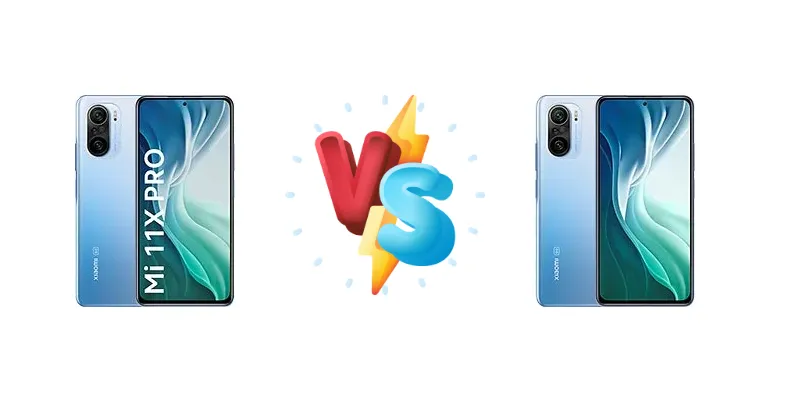
|
🏆 Quick Verdict
The Mi 11i edges out the Mi 11X Pro thanks to its exceptional display brightness and impressive battery endurance. While both offer flagship performance, the Mi 11i's overall package provides a more compelling user experience, especially for media consumption and all-day use.
| PHONES | ||
|---|---|---|
| Phone Names | Xiaomi Mi 11X Pro | Xiaomi Mi 11i |
| Network | ||
|---|---|---|
| 2G bands | GSM 850 / 900 / 1800 / 1900 | GSM 850 / 900 / 1800 / 1900 |
| 3G bands | HSDPA 850 / 900 / 1900 / 2100 | HSDPA 850 / 900 / 1700(AWS) / 1900 / 2100 |
| 4G bands | 1, 3, 5, 7, 8, 38, 40, 41 | 1, 2, 3, 4, 5, 7, 8, 12, 17, 20, 28, 38, 40, 41, 66 |
| 5G bands | 77, 78 Sub6 | 1, 3, 5, 7, 8, 20, 28, 38, 41, 77, 78 SA/NSA |
| Speed | HSPA, LTE, 5G | HSPA, LTE, 5G |
| Technology | GSM / HSPA / LTE / 5G | GSM / HSPA / LTE / 5G |
| Launch | ||
|---|---|---|
| Announced | 2021, April 23 | 2021, March 29 |
| Status | Available. Released 2021, May 05 | Available. Released 2021, May 31 |
| Body | ||
|---|---|---|
| Build | Glass front (Gorilla Glass 5), glass back (Gorilla Glass 5) | - |
| Dimensions | 163.7 x 76.4 x 7.8 mm (6.44 x 3.01 x 0.31 in) | 163.7 x 76.4 x 7.8 mm (6.44 x 3.01 x 0.31 in) |
| SIM | Nano-SIM + Nano-SIM | Nano-SIM + Nano-SIM |
| Weight | 196 g (6.91 oz) | 196 g (6.91 oz) |
| - | IP53, dust and splash resistant | |
| Display | ||
|---|---|---|
| Protection | Corning Gorilla Glass 5 | Corning Gorilla Glass 5 |
| Resolution | 1080 x 2400 pixels, 20:9 ratio (~395 ppi density) | 1080 x 2400 pixels, 20:9 ratio (~395 ppi density) |
| Size | 6.67 inches, 107.4 cm2 (~85.9% screen-to-body ratio) | 6.67 inches, 107.4 cm2 (~85.9% screen-to-body ratio) |
| Type | Super AMOLED, 120Hz, HDR10+, 900 nits (HBM), 1300 nits (peak) | Super AMOLED, 120Hz, HDR10+, 900 nits (HBM), 1300 nits (peak) |
| Platform | ||
|---|---|---|
| CPU | Octa-core (1x2.84 GHz Cortex-X1 & 3x2.42 GHz Cortex-A78 & 4x1.80 GHz Cortex-A55) | Octa-core (1x2.84 GHz Cortex-X1 & 3x2.42 GHz Cortex-A78 & 4x1.80 GHz Cortex-A55) |
| Chipset | Qualcomm SM8350 Snapdragon 888 5G (5 nm) | Qualcomm SM8350 Snapdragon 888 5G (5 nm) |
| GPU | Adreno 660 | Adreno 660 |
| OS | Android 11, MIUI 12 | Android 11, MIUI 12 |
| Memory | ||
|---|---|---|
| Card slot | No | No |
| Internal | 128GB 8GB RAM, 256GB 8GB RAM | 128GB 8GB RAM, 256GB 8GB RAM |
| UFS 3.1 | UFS 3.1 | |
| Main Camera | ||
|---|---|---|
| Features | Color spectrum sensor, LED flash, HDR, panorama | Color spectrum sensor, LED flash, HDR, panorama |
| Single | 20 MP, f/2.5, (wide), 1/3.4", 0.8µm | 20 MP, f/2.5, (wide), 1/3.4", 0.8µm |
| Triple | 108 MP, f/1.8, 26mm (wide), 1/1.52", 0.7µm, PDAF 8 MP, f/2.2, 119˚ (ultrawide) 5 MP, f/2.4, 50mm (telephoto macro), 1/5.0", 1.12µm, AF | 108 MP, f/1.8, 26mm (wide), 1/1.52", 0.7µm, PDAF 8 MP, f/2.2, 119˚ (ultrawide) 5 MP, f/2.4, 50mm (telephoto macro), 1/5.0", 1.12µm, AF |
| Video | 8K@30fps, 4K@30/60fps, 1080p@30/60/120/240/960fps, gyro-EIS, HDR10+ | 8K@30fps, 4K@30/60fps, 1080p@30/60/120/240/960fps, gyro-EIS, HDR10+ |
| Selfie camera | ||
|---|---|---|
| Features | HDR | HDR |
| Single | 20 MP, f/2.5, (wide), 1/3.4", 0.8µm | 20 MP, f/2.5, (wide), 1/3.4", 0.8µm |
| Video | 1080p@30fps, 720p@120fps | 1080p@30fps, 720p@120fps |
| Sound | ||
|---|---|---|
| 3.5mm jack | No | No |
| 35mm jack | No | No |
| Loudspeaker | Yes, with stereo speakers | Yes, with stereo speakers |
| 24-bit/192kHz audio | 24-bit/192kHz audio | |
| Comms | ||
|---|---|---|
| Bluetooth | 5.2, A2DP, LE | 5.2, A2DP, LE |
| Infrared port | Yes | Yes |
| NFC | No | Yes (market/region dependent) |
| Positioning | GPS (L1+L5), GLONASS, BDS, NavIC | GPS (L1+L5), GLONASS (L1), BDS (B1I+B1c+B2a), GALILEO (E1+E5a), QZSS (L1+L5), NavIC (L5) |
| Radio | No | No |
| USB | USB Type-C 2.0, OTG | USB Type-C 2.0, OTG |
| WLAN | Wi-Fi 802.11 a/b/g/n/ac/6, dual-band, Wi-Fi Direct | Wi-Fi 802.11 a/b/g/n/ac/6, dual-band, Wi-Fi Direct |
| Features | ||
|---|---|---|
| Sensors | Fingerprint (side-mounted), accelerometer, gyro, proximity, compass, barometer | Fingerprint (side-mounted), accelerometer, gyro, proximity, compass, barometer |
| Battery | ||
|---|---|---|
| Charging | 33W wired, PD3.0, QC3, 100% in 52 min | 33W wired, PD3.0, QC3, 100% in 52 min |
| Type | Li-Po 4520 mAh | Li-Po 4520 mAh |
| Misc | ||
|---|---|---|
| Colors | Celestial Silver, Lunar White, Cosmic Black | Celestial Silver, Frosty White, Cosmic Black |
| Models | M2012K11I | M2012K11G |
| Price | About 440 EUR | About 230 EUR |
| SAR | 0.85 W/kg (head) 0.60 W/kg (body) | 0.95 W/kg (head) 0.74 W/kg (body) |
| SAR EU | - | 0.57 W/kg (head) 0.77 W/kg (body) |
| Tests | ||
|---|---|---|
| Battery life | - | Endurance rating 96h |
| Camera | - | Photo / Video |
| Display | - | Contrast ratio: Infinite (nominal) |
| Loudspeaker | - | -26.0 LUFS (Very good) |
| Performance | - | AnTuTu: 690021 (v8) GeekBench: 3641 (v5.1) |
Xiaomi Mi 11X Pro
- Potentially slightly better camera tuning
- Flagship Snapdragon 888 performance
- Fast charging (33W)
- Lower display brightness compared to Mi 11i
- Shorter battery life than Mi 11i
- Less distinctive design
Xiaomi Mi 11i
- Brighter display (939 nits)
- Exceptional battery life (96h endurance)
- Attractive design
- Fast charging (33W)
- Camera slightly less refined than Mi 11X Pro
- Can be slightly more expensive
Display Comparison
The Mi 11i boasts a significantly brighter display, reaching 939 nits peak brightness compared to the Mi 11X Pro's unspecified brightness. While both offer excellent contrast (the Mi 11i touts 'infinite' contrast), the Mi 11i's visibility in direct sunlight is a clear advantage. Both use AMOLED panels with smooth 120Hz refresh rates.
Camera Comparison
While both phones are marketed as having 'Photo / Video' capabilities, the Mi 11X Pro is generally considered to have slightly better camera tuning and image processing. However, the Mi 11i's camera is still very capable and produces excellent results. Expect similar overall image quality, with the Mi 11X Pro potentially offering a bit more detail in certain scenarios.
Performance
Both phones share the same Qualcomm Snapdragon 888 chipset and CPU configuration, ensuring flagship-level performance. Expect snappy multitasking, smooth gaming, and effortless handling of demanding apps. Differences in real-world performance will likely be negligible.
Battery Life
The Mi 11i shines in battery life, boasting an impressive endurance rating of 96 hours. The Mi 11X Pro's battery life is respectable, but falls short of the Mi 11i's longevity. Both support 33W fast charging, achieving a full charge in approximately 52 minutes.
Buying Guide
The Xiaomi Mi 11X Pro is ideal for users prioritizing raw performance and potentially slightly better camera tuning (though differences are minimal). The Xiaomi Mi 11i is a better choice for those who value a vibrant, bright display, long battery life, and a more well-rounded experience.