
Xiaomi Mi 11X Pro vs Samsung Galaxy S21 FE 5G: The Ultimate Showdown
| Phones Images | |||||
|---|---|---|---|---|---|
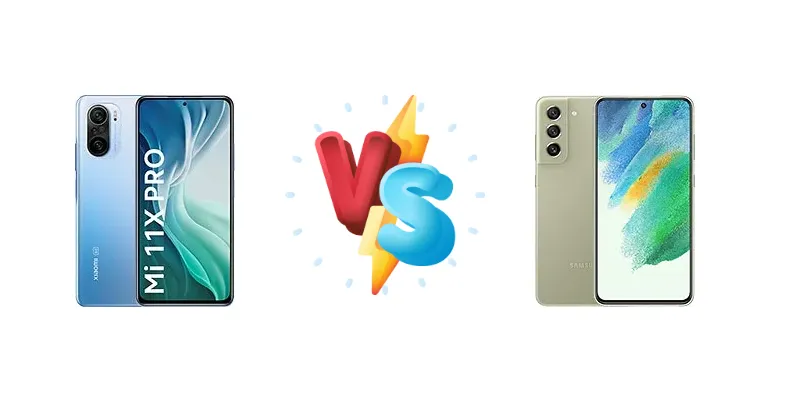
|
🏆 Quick Verdict
The Mi 11X Pro boasts significantly faster charging and a slightly more powerful chipset. However, the S21 FE offers a brighter display, potentially better camera versatility, and the Samsung ecosystem. Ultimately, the choice depends on your priorities: speed and value versus a polished experience and brand recognition.
| PHONES | ||
|---|---|---|
| Phone Names | Xiaomi Mi 11X Pro | Samsung Galaxy S21 FE 5G |
| Network | ||
|---|---|---|
| 2G bands | GSM 850 / 900 / 1800 / 1900 | GSM 850 / 900 / 1800 / 1900 |
| 3G bands | HSDPA 850 / 900 / 1900 / 2100 | HSDPA 850 / 900 / 1700(AWS) / 1900 / 2100 |
| 4G bands | 1, 3, 5, 7, 8, 38, 40, 41 | 1, 2, 3, 4, 5, 7, 8, 12, 17, 20, 26, 28, 32, 38, 40, 41, 66 - International |
| 5G bands | 77, 78 Sub6 | 1, 3, 5, 8, 20, 28, 38, 40, 41, 66, 78 SA/NSA/Sub6 - International |
| Speed | HSPA, LTE, 5G | HSPA 42.2/5.76 Mbps, LTE (5CA) Cat19 1600/200 Mbps, 5G |
| Technology | GSM / HSPA / LTE / 5G | GSM / CDMA / HSPA / EVDO / LTE / 5G |
| - | 41, 66, 71, 260, 261 SA/NSA/Sub6/mmWave - USA | |
| Launch | ||
|---|---|---|
| Announced | 2021, April 23 | 2022, January 04 |
| Status | Available. Released 2021, May 05 | Available. Released 2022, January 07 |
| Body | ||
|---|---|---|
| Build | Glass front (Gorilla Glass 5), glass back (Gorilla Glass 5) | Glass front (Gorilla Glass Victus), plastic back, aluminum frame |
| Dimensions | 163.7 x 76.4 x 7.8 mm (6.44 x 3.01 x 0.31 in) | 155.7 x 74.5 x 7.9 mm (6.13 x 2.93 x 0.31 in) |
| SIM | Nano-SIM + Nano-SIM | · Nano-SIM· Nano-SIM + Nano-SIM |
| Weight | 196 g (6.91 oz) | 177 g (6.24 oz) |
| - | IP68 dust/water resistant (up to 1.5m for 30 min) | |
| Display | ||
|---|---|---|
| Protection | Corning Gorilla Glass 5 | Corning Gorilla Glass Victus |
| Resolution | 1080 x 2400 pixels, 20:9 ratio (~395 ppi density) | 1080 x 2340 pixels, 19.5:9 ratio (~403 ppi density) |
| Size | 6.67 inches, 107.4 cm2 (~85.9% screen-to-body ratio) | 6.4 inches, 100.5 cm2 (~86.7% screen-to-body ratio) |
| Type | Super AMOLED, 120Hz, HDR10+, 900 nits (HBM), 1300 nits (peak) | Dynamic AMOLED 2X, 120Hz, HDR10+ |
| - | Always-on display | |
| Platform | ||
|---|---|---|
| CPU | Octa-core (1x2.84 GHz Cortex-X1 & 3x2.42 GHz Cortex-A78 & 4x1.80 GHz Cortex-A55) | Octa-core (1x2.84 GHz Cortex-X1 & 3x2.42 GHz Cortex-A78 & 4x1.80 GHz Cortex-A55) - Version 1Octa-core (1x2.9 GHz Cortex-X1 & 3x2.80 GHz Cortex-A78 & 4x2.2 GHz Cortex-A55) - Version 2 |
| Chipset | Qualcomm SM8350 Snapdragon 888 5G (5 nm) | Qualcomm SM8350 Snapdragon 888 5G (5 nm) - Version 1Exynos 2100 (5 nm) - Version 2 |
| GPU | Adreno 660 | Adreno 660 - Version 1Mali-G78 MP14 - Version 2 |
| OS | Android 11, MIUI 12 | Android 12, up to 4 major Android upgrades, One UI 8 |
| Memory | ||
|---|---|---|
| Card slot | No | No |
| Internal | 128GB 8GB RAM, 256GB 8GB RAM | 128GB 6GB RAM, 128GB 8GB RAM, 256GB 6GB RAM, 256GB 8GB RAM |
| UFS 3.1 | - | |
| Main Camera | ||
|---|---|---|
| Features | Color spectrum sensor, LED flash, HDR, panorama | LED flash, auto-HDR, panorama |
| Single | 20 MP, f/2.5, (wide), 1/3.4", 0.8µm | 32 MP, f/2.2, 26mm (wide), 1/2.74", 0.8µm |
| Triple | 108 MP, f/1.8, 26mm (wide), 1/1.52", 0.7µm, PDAF 8 MP, f/2.2, 119˚ (ultrawide) 5 MP, f/2.4, 50mm (telephoto macro), 1/5.0", 1.12µm, AF | 12 MP, f/1.8, 26mm (wide), 1/1.76", 1.8µm, dual pixel PDAF, OIS 8 MP, f/2.4, 76mm (telephoto), 1/4.5", 1.0µm, PDAF, OIS, 3x optical zoom 12 MP, f/2.2, 13mm, 123˚ (ultrawide), 1/3.0", 1.12µm |
| Video | 8K@30fps, 4K@30/60fps, 1080p@30/60/120/240/960fps, gyro-EIS, HDR10+ | 4K@30/60fps, 1080p@30/60/120/240fps, HDR10+, gyro-EIS |
| Selfie camera | ||
|---|---|---|
| Features | HDR | HDR |
| Single | 20 MP, f/2.5, (wide), 1/3.4", 0.8µm | 32 MP, f/2.2, 26mm (wide), 1/2.74", 0.8µm |
| Video | 1080p@30fps, 720p@120fps | 4K@30/60fps, 1080p@30/60fps, gyro-EIS |
| Sound | ||
|---|---|---|
| 3.5mm jack | No | No |
| 35mm jack | No | No |
| Loudspeaker | Yes, with stereo speakers | Yes, with stereo speakers |
| 24-bit/192kHz audio | 32-bit/384kHz audio | |
| Comms | ||
|---|---|---|
| Bluetooth | 5.2, A2DP, LE | 5.0, A2DP, LE |
| Infrared port | Yes | - |
| NFC | No | Yes |
| Positioning | GPS (L1+L5), GLONASS, BDS, NavIC | GPS, GLONASS, BDS, GALILEO |
| Radio | No | Unspecified |
| USB | USB Type-C 2.0, OTG | USB Type-C, OTG |
| WLAN | Wi-Fi 802.11 a/b/g/n/ac/6, dual-band, Wi-Fi Direct | Wi-Fi 802.11 a/b/g/n/ac/6, dual-band, Wi-Fi Direct |
| Features | ||
|---|---|---|
| Sensors | Fingerprint (side-mounted), accelerometer, gyro, proximity, compass, barometer | Fingerprint (under display, optical), accelerometer, gyro, proximity, compass |
| - | Bixby natural language commands and dictation Samsung Pay (Visa, MasterCard certified) Samsung DeX (desktop experience support) | |
| Battery | ||
|---|---|---|
| Charging | 33W wired, PD3.0, QC3, 100% in 52 min | 25W wired, PD3.0, 50% in 30 min 15W wireless Reverse wireless |
| Type | Li-Po 4520 mAh | Li-Ion 4500 mAh |
| Misc | ||
|---|---|---|
| Colors | Celestial Silver, Lunar White, Cosmic Black | White, Graphite, Lavender, Olive |
| Models | M2012K11I | SM-G990B, SM-G990B/DS, SM-G990U, SM-G990U1, SM-G990W, SM-G990E, SM-G9900, SM-G990B2, SM-G990U2, SM-G990W2, SM-G990U3 |
| Price | About 440 EUR | € 199.00 / $ 143.95 / £ 154.99 / ₹ 29,990 |
| SAR | 0.85 W/kg (head) 0.60 W/kg (body) | 0.77 W/kg (head) 0.90 W/kg (body) |
| SAR EU | - | 0.95 W/kg (head) 1.48 W/kg (body) |
| Tests | ||
|---|---|---|
| Battery life | - | Endurance rating 92h |
| Camera | - | Photo / Video |
| Display | - | Contrast ratio: Infinite (nominal) |
| Loudspeaker | - | -26.9 LUFS (Good) |
| Performance | - | AnTuTu: 566529 (v8), 719696 (v9) GeekBench: 3049 (v5.1) GFXBench: 56fps (ES 3.1 onscreen) |
Xiaomi Mi 11X Pro
- Faster Charging (33W)
- Potentially better cooling for sustained performance
- Generally more affordable
- Excellent performance with Snapdragon 888
- No wireless charging
- Camera versatility may be limited
- Software updates may be less frequent
Samsung Galaxy S21 FE 5G
- Brighter Display
- Samsung Ecosystem Integration
- Wireless Charging
- Potentially better camera versatility (multiple lenses)
- Longer Battery Life (claimed)
- Slower Charging (25W)
- Potentially higher price
- Exynos version may have slightly lower performance
Display Comparison
The Samsung Galaxy S21 FE takes the lead here with a measured peak brightness of 792 nits, offering better visibility in direct sunlight. While the Mi 11X Pro's display is excellent, the S21 FE's contrast ratio (infinite nominal) and overall brightness provide a more immersive viewing experience. Both utilize AMOLED technology, ensuring vibrant colors and deep blacks.
Camera Comparison
The S21 FE likely offers more camera versatility with its multiple lenses (wide, ultrawide, telephoto – assumed based on typical S21 FE configuration). The Mi 11X Pro is expected to have a strong main camera, but may lack the flexibility of the S21 FE's setup. Image processing is a key differentiator; Samsung's tends to be more saturated, while Xiaomi's aims for more natural colors. Both are capable of recording high-quality video.
Performance
Both phones are powered by the Snapdragon 888, but the S21 FE has two CPU versions. Version 1 uses the same CPU as the Mi 11X Pro. Version 2 has a slightly faster Cortex-X1 and A78 cores. In real-world usage, both offer flagship-level performance, handling demanding games and multitasking with ease. However, the Mi 11X Pro's slightly more aggressive cooling might prevent throttling during extended gaming sessions.
Battery Life
The S21 FE claims an impressive endurance rating of 92 hours, suggesting superior battery optimization. The Mi 11X Pro's 33W charging is significantly faster than the S21 FE's 25W wired charging, allowing for quicker top-ups. Wireless charging is available on the S21 FE, but not on the Mi 11X Pro.
Buying Guide
The Xiaomi Mi 11X Pro is ideal for users prioritizing raw performance, fast charging, and a more budget-friendly price. The Samsung Galaxy S21 FE is a better fit for those who value a vibrant display, Samsung's software and ecosystem, and a more refined overall experience, even if it comes at a slightly higher cost.