
Xiaomi Mi 11 vs Sony Xperia 1 III: Which Flagship Reigns Supreme?
| Phones Images | |||||
|---|---|---|---|---|---|
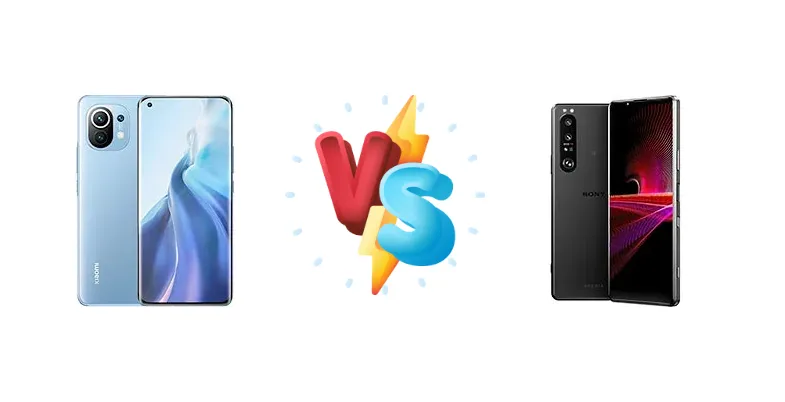
|
🏆 Quick Verdict
For the average user prioritizing value and fast charging, the Xiaomi Mi 11 emerges as the winner. Its 55W wired and 50W wireless charging capabilities, coupled with a comparable Snapdragon 888 chipset, offer a more practical daily experience. However, the Xperia 1 III caters to a specific audience valuing Sony’s camera ecosystem and display technology.
| PHONES | ||
|---|---|---|
| Phone Names | Xiaomi Mi 11 | Sony Xperia 1 III |
| Network | ||
|---|---|---|
| 2G bands | GSM 850 / 900 / 1800 / 1900 | GSM 850 / 900 / 1800 / 1900 |
| 3G bands | HSDPA 850 / 900 / 1700(AWS) / 1900 / 2100 | HSDPA 800 / 850 / 900 / 1700(AWS) / 1900 / 2100 |
| 4G bands | 1, 2, 3, 4, 5, 7, 8, 12, 17, 20, 28, 32, 38, 40, 41, 42, 66 - International | 1, 2, 3, 4, 5, 7, 8, 12, 13, 17, 19, 20, 25, 26, 28, 29, 32, 34, 38, 39, 40, 41, 46, 66 - Europe |
| 5G bands | 1, 3, 5, 7, 8, 20, 28, 38, 41, 77, 78, 79 SA/NSA - International | 1, 3, 5, 7, 8, 20, 28, 38, 40, 41, 77, 78 SA/NSA/Sub6 - Europe |
| Speed | HSPA, LTE, 5G | HSPA, LTE, 5G |
| Technology | GSM / CDMA / HSPA / EVDO / LTE / 5G | GSM / HSPA / LTE / 5G |
| 1, 3, 28, 41, 77, 78, 79 SA/NSA - China | SA/NSA/Sub6/mmWave - USA (specific) | |
| Launch | ||
|---|---|---|
| Announced | 2020, December 28. Released 2021, January 01 | 2021, April 14 |
| Status | Discontinued | Available. Released 2021, August 25 |
| Body | ||
|---|---|---|
| Build | Glass front (Gorilla Glass Victus), glass back (Gorilla Glass 5) or eco leather back, aluminum frame | Glass front (Gorilla Glass Victus), glass back (Gorilla Glass 6), aluminum frame |
| Dimensions | 164.3 x 74.6 x 8.1 mm (Glass) / 8.6 mm (Leather) | 165 x 71 x 8.2 mm (6.50 x 2.80 x 0.32 in) |
| SIM | Nano-SIM + Nano-SIM | Nano-SIM + Nano-SIM |
| Weight | 196 g (Glass) / 194 g (Leather) (6.84 oz) | 186 g / 187.1 g (mmWave) (6.56 oz) |
| - | IP65/IP68 dust/water resistant (up to 1.5m for 30 min) | |
| Display | ||
|---|---|---|
| Protection | Corning Gorilla Glass Victus | Corning Gorilla Glass Victus |
| Resolution | 1440 x 3200 pixels, 20:9 ratio (~515 ppi density) | 1644 x 3840 pixels, 21:9 ratio (~643 ppi density) |
| Size | 6.81 inches, 112.0 cm2 (~91.4% screen-to-body ratio) | 6.5 inches, 98.6 cm2 (~84.2% screen-to-body ratio) |
| Type | AMOLED, 1B colors, 120Hz, HDR10+, 1500 nits (peak) | OLED, 1B colors, 120Hz, HDR BT.2020 |
| - | Runs at 1096 x 2560 pixels except for select use cases | |
| Platform | ||
|---|---|---|
| CPU | Octa-core (1x2.84 GHz Cortex-X1 & 3x2.42 GHz Cortex-A78 & 4x1.80 GHz Cortex-A55 | Octa-core (1x2.84 GHz Cortex-X1 & 3x2.42 GHz Cortex-A78 & 4x1.80 GHz Cortex-A55) |
| Chipset | Qualcomm SM8350 Snapdragon 888 5G (5 nm) | Qualcomm SM8350 Snapdragon 888 5G (5 nm) |
| GPU | Adreno 660 | Adreno 660 |
| OS | Android 11, upgradable to Android 14, HyperOS | Android 11, upgradable to Android 13 |
| Memory | ||
|---|---|---|
| Card slot | No | microSDXC (uses shared SIM slot) |
| Internal | 128GB 6GB RAM, 128GB 8GB RAM, 256GB 8GB RAM, 256GB 12GB RAM | 256GB 12GB RAM, 512GB 12GB RAM |
| UFS 3.1 | UFS 3.X | |
| Main Camera | ||
|---|---|---|
| Features | Dual-LED dual-tone flash, HDR, panorama | Zeiss optics, Zeiss T* lens coating, color spectrum sensor, LED flash, panorama, HDR, eye tracking |
| Single | - | 8 MP, f/2.0, 24mm (wide), 1/4", 1.12µm |
| Triple | 108 MP, f/1.9, 26mm (wide), 1/1.33", 0.8µm, PDAF, OIS 13 MP, f/2.4, 123˚ (ultrawide), 1/3.06", 1.12µm 5 MP (macro) | 12 MP, f/1.7, 24mm (wide), 1/1.7", 1.8µm, dual pixel PDAF, OIS 12 MP, f/2.3, 70mm (telephoto), f/2.8, 105mm (telephoto), 1/2.9", dual pixel PDAF, 3x/4.4x optical zoom, OIS 12 MP, f/2.2, 124˚, 16mm (ultrawide), 1/2.6", dual pixel PDAF 0.3 MP, TOF 3D, (depth) |
| Video | 8K@24/30fps, 4K@30/60fps, 1080p@30/60/120/240fps; gyro-EIS, HDR10+ | 4K@24/25/30/60/120fps HDR, 1080p@30/60/120fps; 5-axis gyro-EIS, OIS |
| Selfie camera | ||
|---|---|---|
| Features | HDR | HDR |
| Single | 20 MP, f/2.2, 27mm (wide), 1/3.4", 0.8µm | 8 MP, f/2.0, 24mm (wide), 1/4.0", 1.12µm |
| Video | 1080p@30/60fps, 720p@120fps | 1080p@30fps, 5-axis gyro-EIS |
| Sound | ||
|---|---|---|
| 3.5mm jack | No | Yes |
| 35mm jack | No | Yes |
| Loudspeaker | Yes, with stereo speakers | Yes, with stereo speakers |
| 24-bit/192kHz audio | 24-bit/192kHz audio Dynamic vibration system | |
| Comms | ||
|---|---|---|
| Bluetooth | 5.2, A2DP, LE, aptX HD, aptX Adaptive | 5.2, A2DP, LE, aptX HD, aptX Adaptive |
| Infrared port | Yes | - |
| NFC | Yes | Yes |
| Positioning | GPS (L1+L5), GLONASS (G1), BDS (B1I+B1c+B2a), GALILEO (E1+E5a), QZSS (L1+L5), NavIC (L5) | GPS, GLONASS, BDS, GALILEO, QZSS |
| Radio | No | No |
| USB | USB Type-C 2.0, OTG | USB Type-C 3.1, OTG, video output |
| WLAN | Wi-Fi 802.11 a/b/g/n/ac/6, dual-band, Wi-Fi Direct | Wi-Fi 802.11 a/b/g/n/ac/6, dual-band, Wi-Fi Direct, DLNA |
| Features | ||
|---|---|---|
| Sensors | Fingerprint (under display, optical), accelerometer, gyro, compass | Fingerprint (side-mounted), accelerometer, gyro, proximity, barometer, compass |
| Virtual proximity sensing | Native Sony Alpha camera support | |
| Battery | ||
|---|---|---|
| Charging | 55W wired, PD3.0, QC4, 100% in 45 min 50W wireless, 100% in 53 min 10W reverse wireless | 30W wired, PD, 50% in 30 min Wireless Reverse wireless |
| Type | Li-Po 4600 mAh | Li-Po 4500 mAh |
| Misc | ||
|---|---|---|
| Colors | Horizon Blue, Cloud White, Midnight Gray, Special Edition Blue, Gold, Violet | Frosted Black, Frosted Gray, Frosted Purple |
| Models | M2011K2C, M2011K2G | XQBC62/V, XQBC52V.UKCX, SO-51B, SOG03, A101SO, XQ-BC62, XQ-BC72, XQ-BC52, XQ-BC01, XQ-BC11, XQ-BC21, XQ-BC72 |
| Price | About 330 EUR | € 505.26 / $ 903.43 |
| SAR | 0.95 W/kg (head) 0.65 W/kg (body) | - |
| SAR EU | 0.56 W/kg (head) 0.98 W/kg (body) | - |
| Tests | ||
|---|---|---|
| Battery life | Endurance rating 89h | Endurance rating 82h |
| Camera | Photo / Video | Photo / Video |
| Display | Contrast ratio: Infinite (nominal) | Contrast ratio: Infinite (nominal) |
| Loudspeaker | -24.2 LUFS (Very good) | -26.5 LUFS (Good) |
| Performance | AnTuTu: 668722 (v8) GeekBench: 3489 (v5.1) GFXBench: 33fps (ES 3.1 onscreen) | AnTuTu: 607423 (v8) GeekBench: 3515 (v5.1) GFXBench: 54fps (ES 3.1 onscreen) |
Xiaomi Mi 11
- Significantly faster wired and wireless charging
- Higher battery endurance rating
- More affordable price point
- Less emphasis on professional camera features
- Potentially less refined display calibration
Sony Xperia 1 III
- Superior display brightness for outdoor visibility
- Sony’s professional camera features and image processing
- Focus on content creation and manual controls
- Slower charging speeds
- Lower battery endurance rating
- Higher price
Display Comparison
Both the Xiaomi Mi 11 and Sony Xperia 1 III boast displays with an 'Infinite' (nominal) contrast ratio, suggesting excellent black levels. However, the Xperia 1 III distinguishes itself with a measured peak brightness of 620 nits, offering superior visibility in direct sunlight compared to the Mi 11, which lacks a specified peak brightness. While both likely utilize AMOLED technology, Sony’s emphasis on color accuracy and professional video editing workflows suggests a more calibrated display experience, potentially appealing to content creators. The Mi 11's display, while excellent, is geared towards general consumption.
Camera Comparison
Both phones feature capable camera systems, but Sony’s approach with the Xperia 1 III is markedly different. While both are listed as having Photo/Video capabilities, Sony’s heritage in imaging technology and professional cameras is a key differentiator. The Xperia 1 III likely emphasizes manual controls, advanced video recording features (like 4K 120fps), and Sony’s image processing algorithms. The Mi 11, while capable, likely prioritizes computational photography and ease of use. Without sensor size or aperture details, a direct comparison is difficult, but Sony’s focus on a dedicated camera experience gives it an edge for photography enthusiasts.
Performance
Both devices are powered by the Qualcomm SM8350 Snapdragon 888 5G (5 nm) chipset, featuring an Octa-core CPU configuration (1x2.84 GHz Cortex-X1, 3x2.42 GHz Cortex-A78, and 4x1.80 GHz Cortex-A55). This means raw processing power is largely equivalent. However, thermal management and sustained performance could differ. The Mi 11’s larger physical size *potentially* allows for a more robust cooling solution, but this isn’t confirmed by the provided data. Both devices benefit from 5G connectivity, but real-world speeds will depend on network availability. The lack of RAM specification prevents a deeper analysis of multitasking capabilities.
Battery Life
The Xiaomi Mi 11 boasts an endurance rating of 89 hours, slightly exceeding the Sony Xperia 1 III’s 82-hour rating. However, charging speeds are where the Mi 11 truly shines. Its 55W wired charging (100% in 45 minutes) and 50W wireless charging (100% in 53 minutes) are significantly faster than the Xperia 1 III’s 30W wired charging (50% in 30 minutes). The inclusion of 10W reverse wireless charging on the Mi 11 is another convenience feature absent from the Xperia 1 III. While the Mi 11’s battery life is marginally better, the superior charging speeds make it more practical for users who frequently need to top up their device.
Buying Guide
Buy the Xiaomi Mi 11 if you need a powerful all-rounder with incredibly fast charging and a vibrant display at a more accessible price point. It’s ideal for users who want flagship performance without breaking the bank. Buy the Sony Xperia 1 III if you prioritize a professional-grade camera experience, manual controls, and a focus on content creation, and are willing to pay a premium for Sony’s unique feature set and display calibration.