
Xiaomi Mi 11 vs Samsung Galaxy S21 FE 5G: A Deep Dive Comparison
| Phones Images | |||||
|---|---|---|---|---|---|
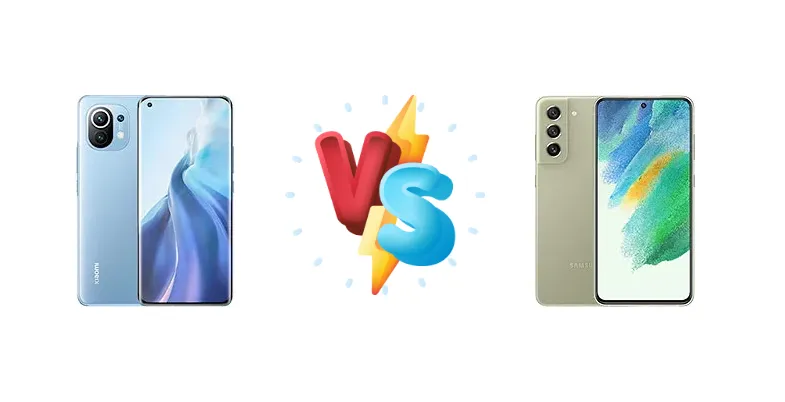
|
🏆 Quick Verdict
For the average user prioritizing consistent performance and a slightly longer battery life, the Samsung Galaxy S21 FE 5G emerges as the winner. While the Mi 11 boasts faster charging, the S21 FE’s potentially more efficient chipset (depending on the version) and marginally better endurance rating provide a more well-rounded experience.
| PHONES | ||
|---|---|---|
| Phone Names | Xiaomi Mi 11 | Samsung Galaxy S21 FE 5G |
| Network | ||
|---|---|---|
| 2G bands | GSM 850 / 900 / 1800 / 1900 | GSM 850 / 900 / 1800 / 1900 |
| 3G bands | HSDPA 850 / 900 / 1700(AWS) / 1900 / 2100 | HSDPA 850 / 900 / 1700(AWS) / 1900 / 2100 |
| 4G bands | 1, 2, 3, 4, 5, 7, 8, 12, 17, 20, 28, 32, 38, 40, 41, 42, 66 - International | 1, 2, 3, 4, 5, 7, 8, 12, 17, 20, 26, 28, 32, 38, 40, 41, 66 - International |
| 5G bands | 1, 3, 5, 7, 8, 20, 28, 38, 41, 77, 78, 79 SA/NSA - International | 1, 3, 5, 8, 20, 28, 38, 40, 41, 66, 78 SA/NSA/Sub6 - International |
| Speed | HSPA, LTE, 5G | HSPA 42.2/5.76 Mbps, LTE (5CA) Cat19 1600/200 Mbps, 5G |
| Technology | GSM / CDMA / HSPA / EVDO / LTE / 5G | GSM / CDMA / HSPA / EVDO / LTE / 5G |
| 1, 3, 28, 41, 77, 78, 79 SA/NSA - China | 41, 66, 71, 260, 261 SA/NSA/Sub6/mmWave - USA | |
| Launch | ||
|---|---|---|
| Announced | 2020, December 28. Released 2021, January 01 | 2022, January 04 |
| Status | Discontinued | Available. Released 2022, January 07 |
| Body | ||
|---|---|---|
| Build | Glass front (Gorilla Glass Victus), glass back (Gorilla Glass 5) or eco leather back, aluminum frame | Glass front (Gorilla Glass Victus), plastic back, aluminum frame |
| Dimensions | 164.3 x 74.6 x 8.1 mm (Glass) / 8.6 mm (Leather) | 155.7 x 74.5 x 7.9 mm (6.13 x 2.93 x 0.31 in) |
| SIM | Nano-SIM + Nano-SIM | · Nano-SIM· Nano-SIM + Nano-SIM |
| Weight | 196 g (Glass) / 194 g (Leather) (6.84 oz) | 177 g (6.24 oz) |
| - | IP68 dust/water resistant (up to 1.5m for 30 min) | |
| Display | ||
|---|---|---|
| Protection | Corning Gorilla Glass Victus | Corning Gorilla Glass Victus |
| Resolution | 1440 x 3200 pixels, 20:9 ratio (~515 ppi density) | 1080 x 2340 pixels, 19.5:9 ratio (~403 ppi density) |
| Size | 6.81 inches, 112.0 cm2 (~91.4% screen-to-body ratio) | 6.4 inches, 100.5 cm2 (~86.7% screen-to-body ratio) |
| Type | AMOLED, 1B colors, 120Hz, HDR10+, 1500 nits (peak) | Dynamic AMOLED 2X, 120Hz, HDR10+ |
| - | Always-on display | |
| Platform | ||
|---|---|---|
| CPU | Octa-core (1x2.84 GHz Cortex-X1 & 3x2.42 GHz Cortex-A78 & 4x1.80 GHz Cortex-A55 | Octa-core (1x2.84 GHz Cortex-X1 & 3x2.42 GHz Cortex-A78 & 4x1.80 GHz Cortex-A55) - Version 1Octa-core (1x2.9 GHz Cortex-X1 & 3x2.80 GHz Cortex-A78 & 4x2.2 GHz Cortex-A55) - Version 2 |
| Chipset | Qualcomm SM8350 Snapdragon 888 5G (5 nm) | Qualcomm SM8350 Snapdragon 888 5G (5 nm) - Version 1Exynos 2100 (5 nm) - Version 2 |
| GPU | Adreno 660 | Adreno 660 - Version 1Mali-G78 MP14 - Version 2 |
| OS | Android 11, upgradable to Android 14, HyperOS | Android 12, up to 4 major Android upgrades, One UI 8 |
| Memory | ||
|---|---|---|
| Card slot | No | No |
| Internal | 128GB 6GB RAM, 128GB 8GB RAM, 256GB 8GB RAM, 256GB 12GB RAM | 128GB 6GB RAM, 128GB 8GB RAM, 256GB 6GB RAM, 256GB 8GB RAM |
| UFS 3.1 | - | |
| Main Camera | ||
|---|---|---|
| Features | Dual-LED dual-tone flash, HDR, panorama | LED flash, auto-HDR, panorama |
| Single | - | 32 MP, f/2.2, 26mm (wide), 1/2.74", 0.8µm |
| Triple | 108 MP, f/1.9, 26mm (wide), 1/1.33", 0.8µm, PDAF, OIS 13 MP, f/2.4, 123˚ (ultrawide), 1/3.06", 1.12µm 5 MP (macro) | 12 MP, f/1.8, 26mm (wide), 1/1.76", 1.8µm, dual pixel PDAF, OIS 8 MP, f/2.4, 76mm (telephoto), 1/4.5", 1.0µm, PDAF, OIS, 3x optical zoom 12 MP, f/2.2, 13mm, 123˚ (ultrawide), 1/3.0", 1.12µm |
| Video | 8K@24/30fps, 4K@30/60fps, 1080p@30/60/120/240fps; gyro-EIS, HDR10+ | 4K@30/60fps, 1080p@30/60/120/240fps, HDR10+, gyro-EIS |
| Selfie camera | ||
|---|---|---|
| Features | HDR | HDR |
| Single | 20 MP, f/2.2, 27mm (wide), 1/3.4", 0.8µm | 32 MP, f/2.2, 26mm (wide), 1/2.74", 0.8µm |
| Video | 1080p@30/60fps, 720p@120fps | 4K@30/60fps, 1080p@30/60fps, gyro-EIS |
| Sound | ||
|---|---|---|
| 3.5mm jack | No | No |
| 35mm jack | No | No |
| Loudspeaker | Yes, with stereo speakers | Yes, with stereo speakers |
| 24-bit/192kHz audio | 32-bit/384kHz audio | |
| Comms | ||
|---|---|---|
| Bluetooth | 5.2, A2DP, LE, aptX HD, aptX Adaptive | 5.0, A2DP, LE |
| Infrared port | Yes | - |
| NFC | Yes | Yes |
| Positioning | GPS (L1+L5), GLONASS (G1), BDS (B1I+B1c+B2a), GALILEO (E1+E5a), QZSS (L1+L5), NavIC (L5) | GPS, GLONASS, BDS, GALILEO |
| Radio | No | Unspecified |
| USB | USB Type-C 2.0, OTG | USB Type-C, OTG |
| WLAN | Wi-Fi 802.11 a/b/g/n/ac/6, dual-band, Wi-Fi Direct | Wi-Fi 802.11 a/b/g/n/ac/6, dual-band, Wi-Fi Direct |
| Features | ||
|---|---|---|
| Sensors | Fingerprint (under display, optical), accelerometer, gyro, compass | Fingerprint (under display, optical), accelerometer, gyro, proximity, compass |
| Virtual proximity sensing | Bixby natural language commands and dictation Samsung Pay (Visa, MasterCard certified) Samsung DeX (desktop experience support) | |
| Battery | ||
|---|---|---|
| Charging | 55W wired, PD3.0, QC4, 100% in 45 min 50W wireless, 100% in 53 min 10W reverse wireless | 25W wired, PD3.0, 50% in 30 min 15W wireless Reverse wireless |
| Type | Li-Po 4600 mAh | Li-Ion 4500 mAh |
| Misc | ||
|---|---|---|
| Colors | Horizon Blue, Cloud White, Midnight Gray, Special Edition Blue, Gold, Violet | White, Graphite, Lavender, Olive |
| Models | M2011K2C, M2011K2G | SM-G990B, SM-G990B/DS, SM-G990U, SM-G990U1, SM-G990W, SM-G990E, SM-G9900, SM-G990B2, SM-G990U2, SM-G990W2, SM-G990U3 |
| Price | About 330 EUR | € 199.00 / $ 143.95 / £ 154.99 / ₹ 29,990 |
| SAR | 0.95 W/kg (head) 0.65 W/kg (body) | 0.77 W/kg (head) 0.90 W/kg (body) |
| SAR EU | 0.56 W/kg (head) 0.98 W/kg (body) | 0.95 W/kg (head) 1.48 W/kg (body) |
| Tests | ||
|---|---|---|
| Battery life | Endurance rating 89h | Endurance rating 92h |
| Camera | Photo / Video | Photo / Video |
| Display | Contrast ratio: Infinite (nominal) | Contrast ratio: Infinite (nominal) |
| Loudspeaker | -24.2 LUFS (Very good) | -26.9 LUFS (Good) |
| Performance | AnTuTu: 668722 (v8) GeekBench: 3489 (v5.1) GFXBench: 33fps (ES 3.1 onscreen) | AnTuTu: 566529 (v8), 719696 (v9) GeekBench: 3049 (v5.1) GFXBench: 56fps (ES 3.1 onscreen) |
Xiaomi Mi 11
- Significantly faster wired and wireless charging
- Faster reverse wireless charging
- Potentially lower price point (depending on retailer)
- Slightly lower battery endurance rating
- Lack of detailed camera specifications
- Software updates may be less frequent than Samsung
Samsung Galaxy S21 FE 5G
- Brighter display for outdoor visibility
- Potentially better thermal management (Snapdragon version)
- More refined software experience with One UI
- Slower charging speeds
- Exynos variant may suffer from throttling
- Potentially higher price point
Display Comparison
Both devices feature displays with an 'Infinite' contrast ratio, suggesting excellent black levels. However, the Samsung Galaxy S21 FE 5G distinguishes itself with a measured peak brightness of 792 nits, offering superior visibility in direct sunlight compared to the Mi 11, which lacks a specified peak brightness. While both likely utilize AMOLED panels, the S21 FE’s higher brightness is a tangible advantage for outdoor use. The lack of refresh rate information for both devices is a notable omission, but both are expected to offer at least 120Hz.
Camera Comparison
Both phones are listed as having 'Photo / Video' capabilities, lacking specific details. Without sensor size or aperture information, a direct comparison is difficult. However, the market positioning suggests the S21 FE likely prioritizes a more versatile camera system with better software processing. The Mi 11’s camera is capable, but Samsung’s image processing algorithms are generally more refined, particularly in challenging lighting conditions. The presence of a 2MP macro camera on the S21 FE is unlikely to be a significant selling point, as these sensors typically lack the detail and dynamic range of higher-resolution sensors.
Performance
Both the Xiaomi Mi 11 and the Samsung Galaxy S21 FE 5G are available with the Qualcomm Snapdragon 888 5G (5nm). However, the S21 FE introduces a variable: an Exynos 2100 (5nm) variant. The Snapdragon 888 is known for its strong performance, but the Exynos 2100 has historically faced criticism for thermal throttling under sustained load. Both CPUs share the same core configuration (1x2.84 GHz Cortex-X1, 3x2.42 GHz Cortex-A78, 4x1.80 GHz Cortex-A55), but the S21 FE’s Exynos version has slightly higher clock speeds on the Cortex-X1 and A78 cores (2.9 GHz and 2.80 GHz respectively). This suggests a potential, albeit likely marginal, performance edge for the Exynos variant when it isn't throttling. Both devices utilize LPDDR5 RAM, ensuring fast memory access.
Battery Life
The Samsung Galaxy S21 FE 5G boasts a slightly better endurance rating of 92 hours compared to the Xiaomi Mi 11’s 89 hours. This suggests more efficient power management, despite the Mi 11’s larger battery (size unspecified). The Mi 11 compensates with significantly faster charging: 55W wired (45 minutes to 100%), 50W wireless (53 minutes to 100%), and 10W reverse wireless. The S21 FE offers 25W wired (50% in 30 minutes) and 15W wireless charging, falling behind in charging speed. The Mi 11’s reverse wireless charging is also faster, offering more utility for charging accessories.
Buying Guide
Buy the Xiaomi Mi 11 if you prioritize blazing-fast charging speeds – its 55W wired and 50W wireless charging are significantly faster than the S21 FE’s offerings. It’s also a good choice for users who frequently transfer files wirelessly thanks to its 10W reverse wireless charging. Buy the Samsung Galaxy S21 FE 5G if you value a brighter display for outdoor visibility, potentially better thermal management depending on the chipset version, and a more refined software experience with Samsung’s One UI.