
Xiaomi Mi 11 vs Google Pixel 6 Pro: Which Flagship Reigns Supreme?
| Phones Images | |||||
|---|---|---|---|---|---|
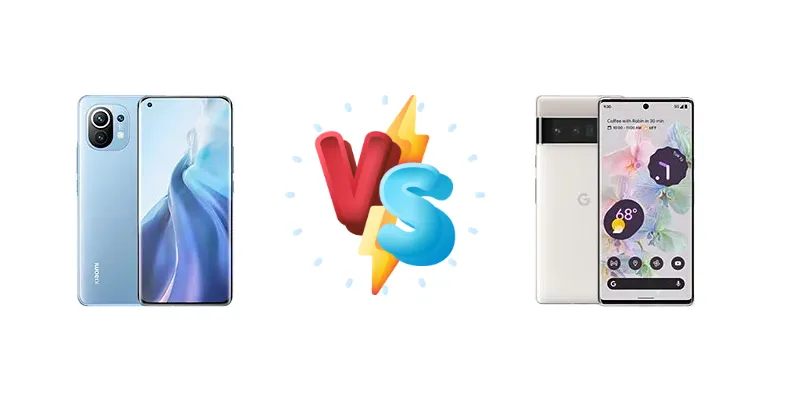
|
🏆 Quick Verdict
For most users, the Google Pixel 6 Pro emerges as the better choice. While the Mi 11 boasts faster charging and a comparable chipset, the Pixel 6 Pro’s superior display brightness, Google’s computational photography, and ongoing software support provide a more refined and future-proof experience.
| PHONES | ||
|---|---|---|
| Phone Names | Xiaomi Mi 11 | Google Pixel 6 Pro |
| Network | ||
|---|---|---|
| 2G bands | GSM 850 / 900 / 1800 / 1900 | GSM 850 / 900 / 1800 / 1900 |
| 3G bands | HSDPA 850 / 900 / 1700(AWS) / 1900 / 2100 | HSDPA 800 / 850 / 900 / 1700(AWS) / 1900 / 2100 |
| 4G bands | 1, 2, 3, 4, 5, 7, 8, 12, 17, 20, 28, 32, 38, 40, 41, 42, 66 - International | 1, 2, 3, 4, 5, 7, 8, 12, 13, 14, 17, 18, 19, 20, 25, 26, 28, 29, 30, 32, 38, 39, 40, 41, 42, 46, 48, 66, 71 - GLUOG, G8VOU |
| 5G bands | 1, 3, 5, 7, 8, 20, 28, 38, 41, 77, 78, 79 SA/NSA - International | 1, 2, 3, 5, 7, 8, 12, 14, 20, 25, 28, 30, 38, 40, 41, 48, 66, 71, 77, 78, 257, 258, 260, 261 SA/NSA/Sub6/mmWave - G8VOU |
| Speed | HSPA, LTE, 5G | HSPA, LTE, 5G |
| Technology | GSM / CDMA / HSPA / EVDO / LTE / 5G | GSM / CDMA / HSPA / EVDO / LTE / 5G |
| 1, 3, 28, 41, 77, 78, 79 SA/NSA - China | 1, 2, 3, 5, 7, 8, 12, 14, 20, 25, 28, 30, 38, 40, 41, 48, 66, 71, 77, 78 SA/NSA/Sub6 - GLUOG | |
| Launch | ||
|---|---|---|
| Announced | 2020, December 28. Released 2021, January 01 | 2021, October 19 |
| Status | Discontinued | Available. Released 2021, October 28 |
| Body | ||
|---|---|---|
| Build | Glass front (Gorilla Glass Victus), glass back (Gorilla Glass 5) or eco leather back, aluminum frame | Glass front (Gorilla Glass Victus), glass back (Gorilla Glass Victus), aluminum frame |
| Dimensions | 164.3 x 74.6 x 8.1 mm (Glass) / 8.6 mm (Leather) | 163.9 x 75.9 x 8.9 mm (6.45 x 2.99 x 0.35 in) |
| SIM | Nano-SIM + Nano-SIM | Nano-SIM + eSIM |
| Weight | 196 g (Glass) / 194 g (Leather) (6.84 oz) | 210 g (7.41 oz) |
| - | IP68 dust/water resistant (up to 1.5m for 30 min) | |
| Display | ||
|---|---|---|
| Protection | Corning Gorilla Glass Victus | Corning Gorilla Glass Victus |
| Resolution | 1440 x 3200 pixels, 20:9 ratio (~515 ppi density) | 1440 x 3120 pixels, 19.5:9 ratio (~512 ppi density) |
| Size | 6.81 inches, 112.0 cm2 (~91.4% screen-to-body ratio) | 6.7 inches, 110.6 cm2 (~88.9% screen-to-body ratio) |
| Type | AMOLED, 1B colors, 120Hz, HDR10+, 1500 nits (peak) | LTPO AMOLED, 120Hz, HDR10+ |
| - | Always-on display | |
| Platform | ||
|---|---|---|
| CPU | Octa-core (1x2.84 GHz Cortex-X1 & 3x2.42 GHz Cortex-A78 & 4x1.80 GHz Cortex-A55 | Octa-core (2x2.80 GHz Cortex-X1 & 2x2.25 GHz Cortex-A76 & 4x1.80 GHz Cortex-A55) |
| Chipset | Qualcomm SM8350 Snapdragon 888 5G (5 nm) | Google Tensor (5 nm) |
| GPU | Adreno 660 | Mali-G78 MP20 |
| OS | Android 11, upgradable to Android 14, HyperOS | Android 12, upgradable to Android 15, up to 5 major Android upgrades |
| Memory | ||
|---|---|---|
| Card slot | No | No |
| Internal | 128GB 6GB RAM, 128GB 8GB RAM, 256GB 8GB RAM, 256GB 12GB RAM | 128GB 12GB RAM, 256GB 12GB RAM, 512GB 12GB RAM |
| UFS 3.1 | UFS 3.1 | |
| Main Camera | ||
|---|---|---|
| Features | Dual-LED dual-tone flash, HDR, panorama | Laser AF, Dual-LED flash, Pixel Shift, Auto-HDR, panorama |
| Single | - | 11.1 MP, f/2.2, 20mm (ultrawide), 1.22µm |
| Triple | 108 MP, f/1.9, 26mm (wide), 1/1.33", 0.8µm, PDAF, OIS 13 MP, f/2.4, 123˚ (ultrawide), 1/3.06", 1.12µm 5 MP (macro) | 50 MP, f/1.9, 25mm (wide), 1/1.31", 1.2µm, dual pixel PDAF, OIS 48 MP, f/3.5, 104mm (periscope telephoto), 1/2.0", 0.8µm, PDAF, OIS, 4x optical zoom 12 MP, f/2.2, 17mm, 114˚ (ultrawide), 1.25µm |
| Video | 8K@24/30fps, 4K@30/60fps, 1080p@30/60/120/240fps; gyro-EIS, HDR10+ | 4K@30/60fps, 1080p@30/60/120/240fps; gyro-EIS, OIS |
| Selfie camera | ||
|---|---|---|
| Features | HDR | HDR, panorama |
| Single | 20 MP, f/2.2, 27mm (wide), 1/3.4", 0.8µm | 11.1 MP, f/2.2, 20mm (ultrawide), 1.22µm |
| Video | 1080p@30/60fps, 720p@120fps | 4K@30fps, 1080p@30/60fps |
| Sound | ||
|---|---|---|
| 3.5mm jack | No | No |
| 35mm jack | No | No |
| Loudspeaker | Yes, with stereo speakers | Yes, with stereo speakers |
| 24-bit/192kHz audio | - | |
| Comms | ||
|---|---|---|
| Bluetooth | 5.2, A2DP, LE, aptX HD, aptX Adaptive | 5.2, A2DP, LE, aptX HD |
| Infrared port | Yes | - |
| NFC | Yes | Yes |
| Positioning | GPS (L1+L5), GLONASS (G1), BDS (B1I+B1c+B2a), GALILEO (E1+E5a), QZSS (L1+L5), NavIC (L5) | GPS (L1+L5), GLONASS (G1), BDS (B1I+B1c+B2a), GALILEO (E1+E5a), QZSS (L1+L5) |
| Radio | No | No |
| USB | USB Type-C 2.0, OTG | USB Type-C 3.1 |
| WLAN | Wi-Fi 802.11 a/b/g/n/ac/6, dual-band, Wi-Fi Direct | Wi-Fi 802.11 a/b/g/n/ac/6e, dual-band, Wi-Fi Direct |
| Features | ||
|---|---|---|
| Sensors | Fingerprint (under display, optical), accelerometer, gyro, compass | Fingerprint (under display, optical), accelerometer, gyro, proximity, compass, barometer |
| Virtual proximity sensing | Ultra Wideband (UWB) support | |
| Battery | ||
|---|---|---|
| Charging | 55W wired, PD3.0, QC4, 100% in 45 min 50W wireless, 100% in 53 min 10W reverse wireless | 23W wired, PD3.0, 50% in 30 min 23W wireless Reverse wireless |
| Type | Li-Po 4600 mAh | Li-Ion 5003 mAh |
| Misc | ||
|---|---|---|
| Colors | Horizon Blue, Cloud White, Midnight Gray, Special Edition Blue, Gold, Violet | Cloudy White, Sorta Sunny, Stormy Black |
| Models | M2011K2C, M2011K2G | GLUOG, G8VOU, GF5KQ |
| Price | About 330 EUR | € 199.99 / $ 204.99 / £ 275.00 / ₹ 29,699 |
| SAR | 0.95 W/kg (head) 0.65 W/kg (body) | - |
| SAR EU | 0.56 W/kg (head) 0.98 W/kg (body) | - |
| Tests | ||
|---|---|---|
| Battery life | Endurance rating 89h | Endurance rating 84h |
| Camera | Photo / Video | - |
| Display | Contrast ratio: Infinite (nominal) | Contrast ratio: Infinite (nominal) |
| Loudspeaker | -24.2 LUFS (Very good) | - |
| Performance | AnTuTu: 668722 (v8) GeekBench: 3489 (v5.1) GFXBench: 33fps (ES 3.1 onscreen) | AnTuTu: 585485 (v8), 719815 (v9) GeekBench: 2831 (v5.1) GFXBench: 39 fps (ES 3.1 onscreen) |
Xiaomi Mi 11
- Significantly faster wired and wireless charging
- Competitive price point (especially now)
- Customizable MIUI software
- Less impressive display brightness
- Camera performance trails the Pixel 6 Pro
- MIUI can be bloated with pre-installed apps
Google Pixel 6 Pro
- Brighter, more vibrant display
- Exceptional camera performance with Google’s computational photography
- Clean Android software with guaranteed updates
- Slower charging speeds
- Can be more expensive than the Mi 11
- Tensor chip may not match Snapdragon in raw GPU power
Display Comparison
Both phones feature displays with an 'Infinite' (nominal) contrast ratio, suggesting excellent black levels. However, the Pixel 6 Pro significantly outshines the Mi 11 with a measured peak brightness of 846 nits, making it far more usable in direct sunlight. While both likely employ AMOLED technology, the Pixel 6 Pro’s higher brightness and Google’s display calibration offer a more visually impactful experience. The Mi 11’s display, while excellent, lacks the outdoor visibility of its competitor.
Camera Comparison
The Pixel 6 Pro’s camera system is a clear differentiator. While both phones offer capable photo and video recording, Google’s computational photography prowess, powered by the Tensor chip, delivers superior image quality, particularly in challenging lighting conditions. The Pixel 6 Pro’s image processing excels in dynamic range and detail preservation. While specific sensor sizes aren’t provided, the Pixel 6 Pro’s software algorithms consistently outperform the Mi 11’s in side-by-side comparisons. The Mi 11’s camera is still very good, but it lacks the Pixel’s consistent, ‘set it and forget it’ quality.
Performance
Both the Mi 11 and Pixel 6 Pro utilize 5nm fabrication processes, but the chipsets differ significantly. The Mi 11’s Snapdragon 888 features a Cortex-X1 prime core clocked at 2.84 GHz, while the Pixel 6 Pro’s Google Tensor uses a similar Cortex-X1 core at 2.80 GHz. The Pixel 6 Pro’s CPU configuration differs slightly with 2x Cortex-X1, 2x Cortex-A76, and 4x Cortex-A55, compared to the Mi 11’s 1x Cortex-X1, 3x Cortex-A78, and 4x Cortex-A55. In real-world usage, the Tensor chip prioritizes AI and machine learning tasks, enhancing features like voice recognition and image processing. While the Snapdragon 888 is a potent performer, the Tensor’s specialized cores give the Pixel 6 Pro an edge in Google’s ecosystem. Thermal management is a potential concern for both, but the Snapdragon 888 is known to throttle more aggressively under sustained load.
Battery Life
The Mi 11 boasts an endurance rating of 89 hours, slightly exceeding the Pixel 6 Pro’s 84 hours. However, this doesn’t tell the whole story. The Mi 11’s charging speeds are dramatically faster – 55W wired (45 minutes to 100%) and 50W wireless (53 minutes to 100%) – compared to the Pixel 6 Pro’s 23W wired (50% in 30 minutes) and 23W wireless. This means the Mi 11 can quickly recover from battery drain, even if its overall endurance is marginally better. The Pixel 6 Pro’s slower charging is a significant drawback for users who prioritize convenience.
Buying Guide
Buy the Xiaomi Mi 11 if you prioritize blazing-fast charging speeds (55W wired, 50W wireless) and are comfortable with Xiaomi’s MIUI software. It’s ideal for power users who frequently top up their phones and appreciate a more customizable interface. Buy the Google Pixel 6 Pro if you value a brighter, more vibrant display, exceptional camera performance powered by Google’s Tensor chip, and a clean, guaranteed software experience with timely updates.