
Xiaomi Mi 10T 5G vs OnePlus 8T: A Detailed Comparison for Value Seekers
| Phones Images | |||||
|---|---|---|---|---|---|
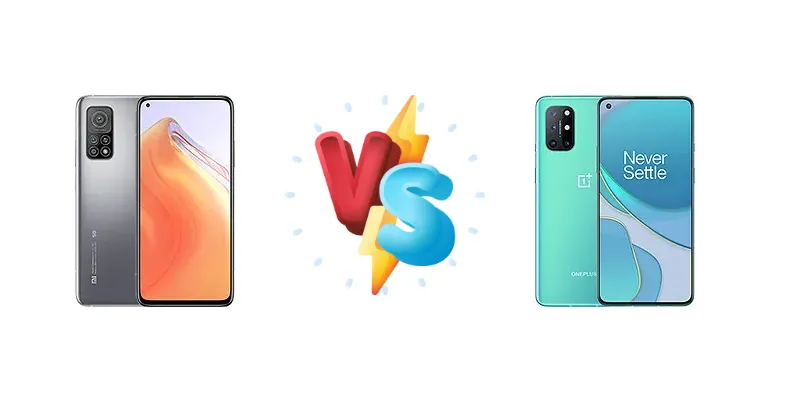
|
🏆 Quick Verdict
For the average user prioritizing rapid charging and a slightly brighter display, the OnePlus 8T emerges as the winner. Its 65W charging capability, reaching 100% in just 39 minutes, is a significant advantage. However, the Mi 10T 5G remains a compelling option for those seeking a similar performance profile at an even lower price point.
| PHONES | ||
|---|---|---|
| Phone Names | Xiaomi Mi 10T 5G | OnePlus 8T |
| Network | ||
|---|---|---|
| 2G bands | GSM 850 / 900 / 1800 / 1900 | GSM 850 / 900 / 1800 / 1900 |
| 3G bands | HSDPA 850 / 900 / 1700(AWS) / 1900 / 2100 | HSDPA 800 / 850 / 900 / 1700(AWS) / 1800 / 1900 / 2100 |
| 4G bands | 1, 2, 3, 4, 5, 7, 8, 20, 28, 32, 38, 40, 41 | 1, 2, 3, 4, 5, 7, 8, 12, 13, 17, 18, 19, 20, 25, 26, 28, 32, 34, 38, 39, 40, 41, 42, 66 - EU |
| 5G bands | 1, 3, 7, 8, 20, 28, 38, 41, 77, 78 NSA | 1, 3, 7, 28, 41, 78 SA/NSA - EU |
| Speed | HSPA, LTE, 5G (2+ Gbps DL) | HSPA 42.2/5.76 Mbps, LTE (5CA) Cat18 1200/200 Mbps, 5G 7.5 Gbps DL |
| Technology | GSM / HSPA / LTE / 5G | GSM / CDMA / HSPA / LTE / 5G |
| - | 41, 78, 79 SA/NSA - CN | |
| Launch | ||
|---|---|---|
| Announced | 2020, September 30. Released 2020, October 13 | 2020, October 14 |
| Status | Discontinued | Available. Released 2020, October 16 |
| Body | ||
|---|---|---|
| Build | Glass front (Gorilla Glass 5), glass back (Gorilla Glass 5), aluminum frame | Glass front (Gorilla Glass 5), glass back (Gorilla Glass 5), aluminum frame |
| Dimensions | 165.1 x 76.4 x 9.3 mm (6.5 x 3.01 x 0.37 in) | 160.7 x 74.1 x 8.4 mm (6.33 x 2.92 x 0.33 in) |
| SIM | Nano-SIM + Nano-SIM | Nano-SIM + Nano-SIM |
| Weight | 216 g (7.62 oz) | 188 g (6.63 oz) |
| Display | ||
|---|---|---|
| Protection | Corning Gorilla Glass 5 | Corning Gorilla Glass 5 |
| Resolution | 1080 x 2400 pixels, 20:9 ratio (~395 ppi density) | 1080 x 2400 pixels, 20:9 ratio (~402 ppi density) |
| Size | 6.67 inches, 107.4 cm2 (~85.2% screen-to-body ratio) | 6.55 inches, 103.6 cm2 (~87.0% screen-to-body ratio) |
| Type | IPS LCD, 144Hz, HDR10+, 500 nits (typ), 650 nits (peak) | Fluid AMOLED, 120Hz, HDR10+ |
| - | Always-on display | |
| Platform | ||
|---|---|---|
| CPU | Octa-core (1x2.84 GHz Cortex-A77 & 3x2.42 GHz Cortex-A77 & 4x1.80 GHz Cortex-A55) | Octa-core (1x2.84 GHz Cortex-A77 & 3x2.42 GHz Cortex-A77 & 4x1.80 GHz Cortex-A55) |
| Chipset | Qualcomm SM8250 Snapdragon 865 5G (7 nm+) | Qualcomm SM8250 Snapdragon 865 5G (7 nm+) |
| GPU | Adreno 650 | Adreno 650 |
| OS | Android 10, upgradable to Android 11, MIUI 12.5 | Android 11, upgradable to Android 14, OxygenOS 14 |
| Memory | ||
|---|---|---|
| Card slot | No | No |
| Internal | 128GB 6GB RAM, 128GB 8GB RAM, 256GB 6GB RAM | 128GB 8GB RAM, 256GB 12GB RAM |
| UFS 3.1 | UFS 3.1 | |
| Main Camera | ||
|---|---|---|
| Features | LED flash, HDR, panorama | Dual-LED flash, HDR, panorama |
| Quad | - | 48 MP, f/1.7, 26mm (wide), 1/2.0", 0.8µm, PDAF, OIS 16 MP, f/2.2, 14mm, 123˚ (ultrawide), 1/3.6", 1.0µm 5 MP (macro) 2 MP, f/2.4, (monochrome) |
| Triple | 64 MP, f/1.9, 26mm (wide), 1/1.73", 0.8µm, PDAF 13 MP, f/2.4, 123˚ (ultrawide), 1/3.06", 1.12µm 5 MP (macro), AF | - |
| Video | 8K@30fps, 4K@30/60fps, 1080p@30/60/120/240/960fps; gyro-EIS | 4K@30/60fps, 1080p@30/60/240fps, Auto HDR, gyro-EIS |
| Selfie camera | ||
|---|---|---|
| Features | HDR | HDR |
| Single | 20 MP, f/2.2, 27mm (wide), 1/3.4", 0.8µm | 16 MP, f/2.4, (wide), 1/3.06", 1.0µm |
| Video | 1080p@30fps, 720p@120fps | 1080p@30fps, gyro-EIS |
| Sound | ||
|---|---|---|
| 3.5mm jack | No | No |
| 35mm jack | No | No |
| Loudspeaker | Yes, with stereo speakers | Yes, with stereo speakers |
| 24-bit/192kHz audio | - | |
| Comms | ||
|---|---|---|
| Bluetooth | 5.1, A2DP, LE, aptX HD, aptX Adaptive | 5.1, A2DP, LE, aptX HD |
| Infrared port | Yes | - |
| NFC | Yes | Yes |
| Positioning | GPS (L1+L5), GLONASS (G1), BDS (B1), GALILEO (E1+E5a) | GPS (L1+L5), GLONASS (G1), BDS (B1), GALILEO (E1+E5a) |
| Radio | No | No |
| USB | USB Type-C 2.0, OTG | USB Type-C 3.1, OTG |
| WLAN | Wi-Fi 802.11 a/b/g/n/ac/6, dual-band, Wi-Fi Direct | Wi-Fi 802.11 a/b/g/n/ac/6, dual-band, Wi-Fi Direct, DLNA |
| Features | ||
|---|---|---|
| Sensors | Fingerprint (side-mounted), accelerometer, gyro, proximity, compass, barometer | Fingerprint (under display, optical), accelerometer, gyro, proximity, compass, barometer (market dependant) |
| Battery | ||
|---|---|---|
| Charging | 33W wired, PD3.0 | 65W wired, 100% in 39 min |
| Type | Li-Po 5000 mAh | Li-Po 4500 mAh |
| Misc | ||
|---|---|---|
| Colors | Cosmic Black, Lunar Silver | Aquamarine Green, Lunar Silver, Cyberpunk 2077 Edition |
| Models | M2007J3SY | KB2001, KB2000, KB2003, KB2005 |
| Price | About 240 EUR | € 130.75 |
| SAR | 0.97 W/kg (head) 0.98 W/kg (body) | - |
| SAR EU | 0.57 W/kg (head) 1.00 W/kg (body) | - |
| Tests | ||
|---|---|---|
| Battery life | - | Endurance rating 104h |
| Camera | - | Photo / Video |
| Display | - | Contrast ratio: Infinite (nominal) |
| Loudspeaker | - | -24.0 LUFS (Very good) |
| Performance | - | AnTuTu: 586000 (v8) GeekBench: 3126 (v5.1) GFXBench: 46fps (ES 3.1 onscreen) |
Xiaomi Mi 10T 5G
- Potentially lower price point for similar performance.
- Snapdragon 865 5G offers flagship-level processing.
- 120Hz display for smooth visuals.
- Slower 33W charging.
- Display brightness likely lower than OnePlus 8T.
OnePlus 8T
- 65W Super Warp Charge – 100% in 39 minutes.
- Brighter 802 nit display for better outdoor visibility.
- Refined OnePlus software experience.
- May be slightly more expensive than the Mi 10T 5G.
- Camera performance details are limited.
Display Comparison
Both the Mi 10T 5G and OnePlus 8T feature displays capable of a 120Hz refresh rate, contributing to smooth scrolling and animations. However, the OnePlus 8T boasts a measured peak brightness of 802 nits, suggesting superior visibility in direct sunlight compared to the Mi 10T 5G (brightness data unavailable). While both have an 'infinite' contrast ratio (nominal), the real-world difference in viewing experience will likely be subtle. The absence of LTPO technology in either device means refresh rate scaling isn't as dynamic as on newer flagships, potentially impacting battery life during mixed usage.
Camera Comparison
Both phones offer photo and video capabilities, but detailed sensor information is lacking. Without specifics on sensor size, aperture, or OIS, a direct comparison is difficult. The absence of information suggests neither phone prioritizes a groundbreaking camera experience. The inclusion of a 2MP macro camera on either device is likely a marketing gimmick, offering limited practical benefit due to the small sensor size and lack of optical image stabilization. Image processing styles will likely differ, with Xiaomi often favoring more saturated colors and OnePlus aiming for a more natural look.
Performance
At the heart of both devices lies the Qualcomm SM8250 Snapdragon 865 5G (7 nm+). The CPU configuration is identical – an octa-core setup with 1x2.84 GHz Cortex-A77, 3x2.42 GHz Cortex-A77, and 4x1.80 GHz Cortex-A55 cores. This means CPU performance will be virtually indistinguishable between the two. The 7nm+ fabrication process offers a balance between performance and efficiency. However, thermal management, which isn't specified, will dictate sustained performance under heavy load. Both devices likely utilize LPDDR5 RAM, but the speed isn't specified, impacting multitasking capabilities. The GPU performance will also be similar, capable of handling demanding games at high settings.
Battery Life
The OnePlus 8T holds an endurance rating of 104 hours, indicating solid battery life. Crucially, it supports 65W wired charging, achieving a full charge in just 39 minutes. The Mi 10T 5G, with 33W wired charging and PD3.0, will take considerably longer to charge. While the Mi 10T 5G’s battery capacity isn’t specified, the faster charging of the OnePlus 8T effectively mitigates any potential capacity disadvantage. The difference in charging speed is a significant real-world benefit, especially for users who frequently need to top up their battery.
Buying Guide
Buy the Xiaomi Mi 10T 5G if you need maximum performance-per-dollar and are willing to trade off charging speed and a marginally less bright display. It’s ideal for gamers and power users who prioritize raw processing power. Buy the OnePlus 8T if you prefer a faster charging experience, a slightly brighter screen for outdoor visibility, and the refined software experience OnePlus is known for. It’s a better all-rounder for everyday use.