
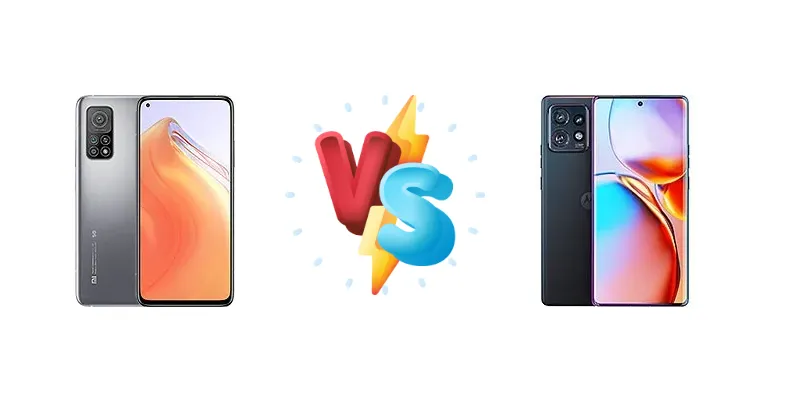
Xiaomi Mi 10T 5G vs Motorola Edge+ (2023): A Generational Leap in Performance and Charging
| Phones Images | |||||
|---|---|---|---|---|---|
|
🏆 Quick Verdict
For most users, the Motorola Edge+ (2023) is the clear winner. The Snapdragon 8 Gen 2 delivers substantially improved performance and efficiency, coupled with significantly faster 68W charging. While the Mi 10T 5G remains a capable device, the Edge+ offers a future-proofed experience.
| PHONES | ||
|---|---|---|
| Phone Names | Xiaomi Mi 10T 5G | Motorola Edge+ (2023) |
| Network | ||
|---|---|---|
| 2G bands | GSM 850 / 900 / 1800 / 1900 | GSM 850 / 900 / 1800 / 1900 |
| 3G bands | HSDPA 850 / 900 / 1700(AWS) / 1900 / 2100 | HSDPA 850 / 900 / 1700(AWS) / 1900 / 2100 |
| 4G bands | 1, 2, 3, 4, 5, 7, 8, 20, 28, 32, 38, 40, 41 | 1, 2, 3, 4, 5, 7, 8, 12, 13, 14, 17, 18, 20, 25, 26, 28, 29, 30, 38, 39, 40, 41, 41, 46, 48, 66, 71 |
| 5G bands | 1, 3, 7, 8, 20, 28, 38, 41, 77, 78 NSA | 1, 2, 3, 5, 7, 12, 14, 20, 25, 26, 28, 29, 30, 38, 41, 41, 48, 66, 70, 71, 77, 78 SA/NSA/Sub6/mmWave |
| Speed | HSPA, LTE, 5G (2+ Gbps DL) | HSPA, LTE, 5G |
| Technology | GSM / HSPA / LTE / 5G | GSM / HSPA / LTE / 5G |
| Launch | ||
|---|---|---|
| Announced | 2020, September 30. Released 2020, October 13 | 2023, May 02 |
| Status | Discontinued | Available. Released 2023, May 19 |
| Body | ||
|---|---|---|
| Build | Glass front (Gorilla Glass 5), glass back (Gorilla Glass 5), aluminum frame | Glass front (Gorilla Glass Victus), glass back (Gorilla Glass Victus), aluminum frame |
| Dimensions | 165.1 x 76.4 x 9.3 mm (6.5 x 3.01 x 0.37 in) | 161.2 x 74 x 8.6 mm (6.35 x 2.91 x 0.34 in) |
| SIM | Nano-SIM + Nano-SIM | Nano-SIM + eSIM |
| Weight | 216 g (7.62 oz) | 203 g (7.16 oz) |
| - | IP68 dust/water resistant (up to 1.5m for 30 min) | |
| Display | ||
|---|---|---|
| Protection | Corning Gorilla Glass 5 | Corning Gorilla Glass Victus |
| Resolution | 1080 x 2400 pixels, 20:9 ratio (~395 ppi density) | 1080 x 2400 pixels, 20:9 ratio (~395 ppi density) |
| Size | 6.67 inches, 107.4 cm2 (~85.2% screen-to-body ratio) | 6.67 inches, 107.4 cm2 (~90.0% screen-to-body ratio) |
| Type | IPS LCD, 144Hz, HDR10+, 500 nits (typ), 650 nits (peak) | OLED, 1B colors, 165Hz, HDR10+, Dolby Vision, 1300 nits (peak) |
| Platform | ||
|---|---|---|
| CPU | Octa-core (1x2.84 GHz Cortex-A77 & 3x2.42 GHz Cortex-A77 & 4x1.80 GHz Cortex-A55) | Octa-core (1x3.2 GHz Cortex-X3 & 2x2.8 GHz Cortex-A715 & 2x2.8 GHz Cortex-A710 & 3x2.0 GHz Cortex-A510) |
| Chipset | Qualcomm SM8250 Snapdragon 865 5G (7 nm+) | Qualcomm SM8550-AB Snapdragon 8 Gen 2 (4 nm) |
| GPU | Adreno 650 | Adreno 740 |
| OS | Android 10, upgradable to Android 11, MIUI 12.5 | Android 13, upgradable to Android 14 |
| Memory | ||
|---|---|---|
| Card slot | No | No |
| Internal | 128GB 6GB RAM, 128GB 8GB RAM, 256GB 6GB RAM | 512GB 8GB RAM |
| UFS 3.1 | UFS 4.0 | |
| Main Camera | ||
|---|---|---|
| Features | LED flash, HDR, panorama | Dual-LED flash, panorama, HDR |
| Triple | 64 MP, f/1.9, 26mm (wide), 1/1.73", 0.8µm, PDAF 13 MP, f/2.4, 123˚ (ultrawide), 1/3.06", 1.12µm 5 MP (macro), AF | 50 MP, f/1.8, (wide), 1/1.55", 1.0µm, multi-directional PDAF, OIS 12 MP, f/1.6, (telephoto), 1/2.93", 1.22µm, PDAF, 2x optical zoom 50 MP, f/2.2, 114˚ (ultrawide), 1/2.76", 0.64µm, AF |
| Video | 8K@30fps, 4K@30/60fps, 1080p@30/60/120/240/960fps; gyro-EIS | 8K@30fps, 4K@30/60fps, 1080p@30/60/120/240/960fps, 10-bit HDR10+, gyro-EIS |
| Selfie camera | ||
|---|---|---|
| Features | HDR | HDR |
| Single | 20 MP, f/2.2, 27mm (wide), 1/3.4", 0.8µm | 60 MP, f/2.2, (wide), 1/2.8", 0.61µm |
| Video | 1080p@30fps, 720p@120fps | 4K@30/60fps, 1080p@30/60/120/240fps |
| Sound | ||
|---|---|---|
| 3.5mm jack | No | No |
| 35mm jack | No | No |
| Loudspeaker | Yes, with stereo speakers | Yes, with stereo speakers |
| 24-bit/192kHz audio | - | |
| Comms | ||
|---|---|---|
| Bluetooth | 5.1, A2DP, LE, aptX HD, aptX Adaptive | 5.3, A2DP, LE, aptX HD, aptX Adaptive |
| Infrared port | Yes | - |
| NFC | Yes | Yes |
| Positioning | GPS (L1+L5), GLONASS (G1), BDS (B1), GALILEO (E1+E5a) | GPS, GLONASS, GALILEO, BDS |
| Radio | No | No |
| USB | USB Type-C 2.0, OTG | USB Type-C 3.2, OTG, DisplayPort 1.4 |
| WLAN | Wi-Fi 802.11 a/b/g/n/ac/6, dual-band, Wi-Fi Direct | Wi-Fi 802.11 a/b/g/n/ac/6e/7, tri-band, Wi-Fi Direct |
| Features | ||
|---|---|---|
| Sensors | Fingerprint (side-mounted), accelerometer, gyro, proximity, compass, barometer | Fingerprint (under display, optical), accelerometer, gyro, proximity, compass, barometer |
| - | Ready For 3.5 support | |
| Battery | ||
|---|---|---|
| Charging | 33W wired, PD3.0 | 68W wired 15W wireless 5W reverse wired 5W reverse wireless |
| Type | Li-Po 5000 mAh | Li-Po 5100 mAh |
| Misc | ||
|---|---|---|
| Colors | Cosmic Black, Lunar Silver | Interstellar Black |
| Models | M2007J3SY | - |
| Price | About 240 EUR | $ 298.99 |
| SAR | 0.97 W/kg (head) 0.98 W/kg (body) | - |
| SAR EU | 0.57 W/kg (head) 1.00 W/kg (body) | - |
Xiaomi Mi 10T 5G
- Significantly lower price point
- Still capable for everyday tasks
- Decent performance for the price
- Older chipset with limited future support
- Slower charging speed
- Potential for thermal throttling
Motorola Edge+ (2023)
- Flagship-level performance with Snapdragon 8 Gen 2
- Ultra-fast 68W wired charging
- Wireless and reverse wireless charging
- Higher price tag
- May be overkill for basic users
- Potentially larger physical size
Display Comparison
While both devices likely feature LCD panels (data not provided), the core difference lies in the processing power driving them. The Snapdragon 8 Gen 2 in the Edge+ (2023) will handle graphically intensive tasks, like high-refresh-rate gaming, with greater ease. The Mi 10T 5G's Snapdragon 865, while capable, will exhibit more noticeable frame drops in demanding scenarios. Without specific display specs, it's difficult to compare brightness or color accuracy, but the newer chipset provides headroom for more advanced display features.
Camera Comparison
Without detailed camera specifications, a direct comparison is limited. However, the processing capabilities of the Snapdragon 8 Gen 2 in the Edge+ (2023) will undoubtedly enhance image processing, resulting in better dynamic range, noise reduction, and overall image quality. The ISP (Image Signal Processor) within the Gen 2 is far more advanced, enabling features like real-time HDR video recording and improved low-light performance. The Mi 10T 5G’s camera will still produce acceptable results, but will lack the sophistication of the Edge+’s image pipeline.
Performance
The Snapdragon 8 Gen 2 (4nm) in the Motorola Edge+ (2023) represents a massive leap over the Snapdragon 865 (7nm+) in the Mi 10T 5G. The Gen 2’s Cortex-X3 prime core, clocked at 3.2 GHz, offers significantly higher single-core performance, crucial for responsive app launches and UI navigation. The architectural improvements in the Cortex-A715/A710 cores, combined with the 4nm process, translate to better multi-core performance and, crucially, improved thermal efficiency. The Mi 10T 5G will likely throttle under sustained load, impacting gaming and video editing, while the Edge+ (2023) will maintain higher clock speeds for longer. The Edge+ also benefits from potentially faster RAM (LPDDR5x is likely, versus LPDDR4x in the Mi 10T 5G).
Battery Life
The Motorola Edge+ (2023) boasts a significant advantage in charging speed with its 68W wired charging, allowing for a full charge in under 40 minutes. The Mi 10T 5G’s 33W charging is considerably slower. While battery capacity isn't specified, the Snapdragon 8 Gen 2’s superior efficiency means the Edge+ (2023) will likely deliver comparable or better battery life despite potentially having a similar or smaller battery capacity. The addition of 15W wireless and reverse wireless charging on the Edge+ (2023) further enhances its convenience.
Buying Guide
Buy the Xiaomi Mi 10T 5G if you prioritize value and are comfortable with a phone that's showing its age. It's a solid choice for everyday tasks and light gaming on a tighter budget. Buy the Motorola Edge+ (2023) if you demand the best possible performance, rapid charging, and a longer software support lifespan, and are willing to pay a premium for it.