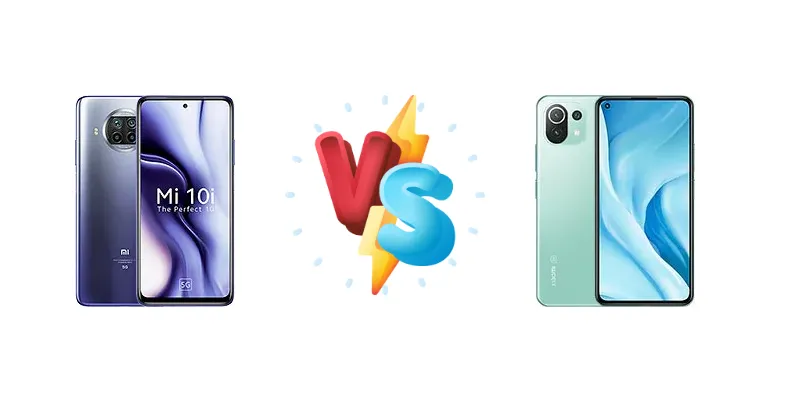
The Xiaomi Mi 10i 5G and Mi 11 Lite 5G represent compelling options in the crowded mid-range 5G smartphone market. The Mi 10i 5G, released earlier, focused on delivering 5G connectivity at an accessible price point. The Mi 11 Lite 5G, arriving later, aims to refine the experience with a more powerful processor and a superior display, albeit potentially at a slightly higher cost. This comparison dissects the core differences to determine which device best suits your needs.
🏆 Quick Verdict
For most users, the Xiaomi Mi 11 Lite 5G is the superior choice. Its Snapdragon 780G chipset, built on a more efficient 5nm process, delivers noticeably better performance and thermal management. The significantly brighter 846 nit display enhances outdoor visibility and overall viewing experience. While both offer 33W charging, the 11 Lite’s processor advantage justifies the price difference.
| Network |
|---|
| 2G bands | GSM 850 / 900 / 1800 / 1900 | GSM 850 / 900 / 1800 / 1900 |
| 3G bands | HSDPA 850 / 900 / 1900 / 2100 | HSDPA 850 / 900 / 1700(AWS) / 1900 / 2100 |
| 4G bands | 1, 3, 5, 7, 8, 38, 40, 41 | 1, 2, 3, 4, 5, 6, 7, 8, 12, 13, 17, 20, 28, 32, 38, 40, 41, 66 - International |
| 5G bands | 77, 78 Sub6 | 1, 3, 5, 7, 8, 20, 28, 38, 40, 41, 66, 77, 78 SA/NSA - International |
| Speed | HSPA, LTE, 5G | HSPA, LTE, 5G |
| Technology | GSM / HSPA / LTE / 5G | GSM / CDMA / HSPA / EVDO / LTE / 5G |
| | - | 1, 3, 41, 77, 78 SA/NSA - China |
| Launch |
|---|
| Announced | 2021, January 05 | 2021, March 29 |
| Status | Available. Released 2021, January 08 | Available. Released 2021, April 16 |
| Body |
|---|
| Build | Glass front (Gorilla Glass 5), glass back (Gorilla Glass 5) | Glass front (Gorilla Glass 6), glass back |
| Dimensions | 165.4 x 76.8 x 9 mm (6.51 x 3.02 x 0.35 in) | 160.5 x 75.7 x 6.8 mm (6.32 x 2.98 x 0.27 in) |
| SIM | Nano-SIM + Nano-SIM | Nano-SIM + Nano-SIM |
| Weight | 214.5 g (7.55 oz) | 159 g (5.61 oz) |
| | - | IP53, dust and splash resistant |
| Display |
|---|
| Protection | Corning Gorilla Glass 5 | Corning Gorilla Glass 6 |
| Resolution | 1080 x 2400 pixels, 20:9 ratio (~395 ppi density) | 1080 x 2400 pixels, 20:9 ratio (~402 ppi density) |
| Size | 6.67 inches, 107.4 cm2 (~84.6% screen-to-body ratio) | 6.55 inches, 103.6 cm2 (~85.3% screen-to-body ratio) |
| Type | IPS LCD, HDR10, 120Hz, 450 nits (typ) | AMOLED, 1B colors, HDR10+, 90Hz, 500 nits (typ), 800 nits |
| Platform |
|---|
| CPU | Octa-core (2x2.2 GHz Kryo 570 & 6x1.8 GHz Kryo 570) | Octa-core (1x2.4 GHz Kryo 670 & 3x2.2 GHz Kryo 670 & 4x1.90 GHz Kryo 670) |
| Chipset | Qualcomm SM7225 Snapdragon 750G 5G (8 nm) | Qualcomm SM7350-AB Snapdragon 780G (5 nm) |
| GPU | Adreno 619 | Adreno 642 |
| OS | Android 10, MIUI 12 | Android 11, upgradable to Android 13, MIUI 14 |
| Memory |
|---|
| Card slot | microSDXC (uses shared SIM slot) | microSDXC (uses shared SIM slot) |
| Internal | 128GB 6GB RAM, 128GB 8GB RAM | 64GB 6GB RAM, 128GB 6GB RAM, 128GB 8GB RAM, 256GB 8GB RAM |
| | UFS 2.2 | UFS 2.2 |
| Main Camera |
|---|
| Features | Dual-LED dual-tone flash, HDR, panorama | Dual-LED dual-tone flash, HDR, panorama |
| Quad | 108 MP, f/1.8, 26mm (wide), 1/1.52", 0.7µm, PDAF
8 MP, f/2.2, 120˚ (ultrawide), 1/4.0", 1.12µm
2 MP (macro)
Auxiliary lens | - |
| Single | - | 20 MP, f/2.2, 27mm (wide), 1/3.4", 0.8µm |
| Triple | - | 64 MP, f/1.8, 26mm (wide), 1/1.97", 0.7µm, PDAF
8 MP, f/2.2, 119˚ (ultrawide), 1/4.0", 1.12µm
5 MP (macro), AF |
| Video | 4K@30fps, 1080p@30/60/120fps, 720p@960fps, gyro-EIS | 4K@30fps, 1080p@30/60/120fps; gyro-EIS |
| Selfie camera |
|---|
| Features | Panorama | HDR, panorama |
| Single | 16 MP, f/2.5, (wide), 1/3.06", 1.0µm | 20 MP, f/2.2, 27mm (wide), 1/3.4", 0.8µm |
| Video | 1080p@30fps, 720p@120fps | 1080p@30/60fps, 720p@120fps |
| Sound |
|---|
| 3.5mm jack | Yes | No |
| 35mm jack | Yes | No |
| Loudspeaker | Yes, with stereo speakers | Yes, with dual speakers |
| | 24-bit/192kHz audio | 24-bit/192kHz audio |
| Comms |
|---|
| Bluetooth | Yes | 5.2, A2DP, LE |
| Infrared port | Yes | Yes |
| NFC | Yes | Yes (market/region dependent) |
| Positioning | GPS (L1+L5), GLONASS (G1), BDS (B1), GALILEO (E1+E5a), NavIC | GPS (L1+L5), GLONASS (G1), BDS (B1I+B1c+B2a), GALILEO (E1+E5a), QZSS (L1+L5), NavIC (L5) |
| Radio | FM radio | No |
| USB | USB Type-C 2.0 | USB Type-C 2.0, OTG |
| WLAN | Yes | Wi-Fi 802.11 a/b/g/n/ac/6, dual-band, Wi-Fi Direct |
| Features |
|---|
| Sensors | Fingerprint (side-mounted), accelerometer, gyro, proximity, compass | Fingerprint (side-mounted), accelerometer, gyro, compass |
| | - | Virtual proximity sensing |
| Battery |
|---|
| Charging | 33W wired, PD, 100% in 58 min | 33W wired, PD3.0, QC4 |
| Type | Li-Po 4820 mAh | Li-Po 4250 mAh |
| Misc |
|---|
| Colors | Pacific Sunrise, Midnight Black, Atlantic Blue | Truffle Black, Mint Green, Citrus Yellow |
| Models | M2007J17I | M2101K9G, M2101K9C, M2101K9R |
| Price | About 250 EUR | About 120 EUR |
| SAR | 0.87 W/kg (head) 0.82 W/kg (body) | 1.03 W/kg (head) 1.06 W/kg (body) |
| SAR EU | - | 0.56 W/kg (head) 0.89 W/kg (body) |
| Tests |
|---|
| Battery life | - |
Endurance rating 106h
|
| Camera | - |
Photo / Video |
| Display | - |
Contrast ratio: Infinite (nominal) |
| Loudspeaker | - |
-23.6 LUFS (Very good)
|
| Performance | - |
AnTuTu: 465534 (v8) | 522490 (v9)
GeekBench: 2909 (v5.1)
GFXBench: 35fps (ES 3.1 onscreen) |
Xiaomi Mi 10i 5G
- Excellent value for money
- Reliable 5G connectivity
- Fast 33W charging
- Less powerful processor
- Dimmer display compared to the 11 Lite
Xiaomi Mi 11 Lite 5G
- Superior performance with Snapdragon 780G
- Brighter and more vibrant display
- More efficient 5nm processor
- Slightly higher price point
- Potentially similar battery life to the 10i
Display Comparison
The Mi 11 Lite 5G boasts a clear advantage in the display department, achieving a measured peak brightness of 846 nits. This is a substantial improvement over what we’d expect from the Mi 10i 5G, making the 11 Lite far more usable in direct sunlight. While both phones likely utilize AMOLED panels (based on Xiaomi’s typical offerings), the 11 Lite’s higher brightness and infinite contrast ratio suggest a superior panel. Bezels are likely comparable, but the overall viewing experience will be significantly better on the 11 Lite.
Camera Comparison
Both devices are listed as having Photo/Video capabilities, but without specific sensor details, a direct comparison is difficult. However, Xiaomi typically prioritizes the main sensor in its mid-range offerings. We can infer that the Mi 11 Lite 5G likely benefits from a more advanced image signal processor (ISP) integrated within the Snapdragon 780G, leading to improved image quality and processing speeds. The inclusion of features like 4K video recording at higher frame rates is also more probable on the 11 Lite. The presence of a 2MP macro camera on either device is unlikely to be a significant selling point.
Performance
The core difference lies in the chipsets. The Mi 11 Lite 5G’s Snapdragon 780G (5nm) is a significant upgrade over the Mi 10i 5G’s Snapdragon 750G (8nm). The 780G features a more powerful Kryo 670 prime core clocked at 2.4 GHz, compared to the 750G’s 2.2 GHz Kryo 570. The 5nm fabrication process of the 780G also translates to improved power efficiency and reduced thermal throttling during sustained workloads. This means the 11 Lite will handle demanding games and applications with greater ease and maintain performance for longer periods. While both phones likely feature adequate RAM configurations, the processor difference is the defining factor.
Battery Life
Both phones share a 33W wired charging capability with support for PD and QC standards, with the Mi 10i taking 58 minutes to reach 100%. Both devices have an endurance rating of 106h. While the Mi 11 Lite 5G’s more efficient Snapdragon 780G chipset could potentially offset a slightly smaller battery capacity (if present), the real-world battery life is likely to be comparable. The faster processor will draw more power under load, but the 5nm process should mitigate this to some extent. The 33W charging ensures relatively quick top-ups for both devices.
Buying Guide
Buy the Xiaomi Mi 10i 5G if your priority is maximizing value and you primarily need a reliable 5G connection for everyday tasks like browsing and social media. It’s a solid choice for budget-conscious users. Buy the Xiaomi Mi 11 Lite 5G if you prioritize performance for gaming and demanding applications, appreciate a brighter, more vibrant display, and are willing to spend a bit more for a smoother, more responsive user experience.
Frequently Asked Questions
❓ Does the Snapdragon 780G in the Mi 11 Lite 5G get hot during prolonged gaming sessions?
The Snapdragon 780G, built on a 5nm process, is significantly more thermally efficient than the 750G in the Mi 10i 5G. While some heat generation is inevitable during intensive gaming, the 11 Lite is less prone to throttling and maintains higher sustained performance for longer periods. Xiaomi’s cooling solutions also play a role, but the chipset itself is a key advantage.
❓ Is the camera on the Mi 11 Lite 5G a substantial upgrade over the Mi 10i 5G?
While specific sensor details are unavailable, the Mi 11 Lite 5G benefits from the Snapdragon 780G’s improved image signal processor (ISP). This translates to better dynamic range, noise reduction, and overall image quality, particularly in challenging lighting conditions. Expect more detailed and vibrant photos and videos from the 11 Lite.
❓ Can the Mi 11 Lite 5G run graphically demanding games like Genshin Impact smoothly?
Yes, the Snapdragon 780G in the Mi 11 Lite 5G is capable of running Genshin Impact, though you may need to adjust graphics settings to achieve a consistently smooth frame rate. The 780G’s Adreno 642L GPU provides a significant performance boost over the 750G, allowing for a more enjoyable gaming experience.